@ai-sdk/zai 3.0.27 Released: Compatibility Fixes Through Dependency Updates

@ai-sdk/zai 3.0.27 patch release syncs three upstream dependencies with backward-compatible, low-risk upgrades.
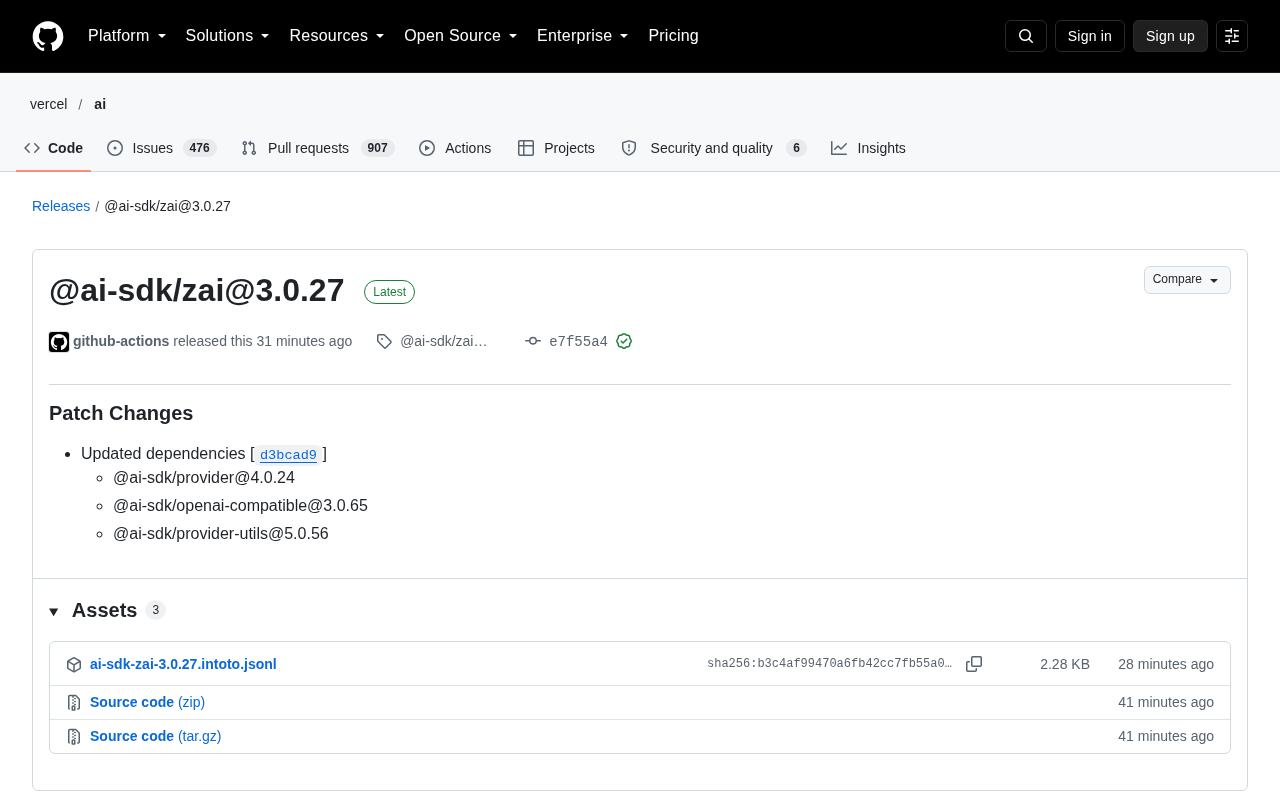
@ai-sdk/zai 3.0.27 is a maintenance patch release that syncs three upstream dependencies: `@ai-sdk/provider@4.0.24`, `@ai-sdk/openai-compatible@3.0.65`, and `@ai-sdk/provider-utils@5.0.56`. Published via GitHub Actions with GPG verification, the patch-level bump is backward compatible and low risk. After upgrading, developers should verify that all related dependency versions are consistent to avoid potential type errors or behavioral differences in the multi-package ecosystem.
Version Overview
@ai-sdk/zai has released version 3.0.27 as a patch update, primarily focused on dependency maintenance. This version was automatically published via GitHub Actions and verified with a GitHub GPG signature (key ID: B5690EEEBB952194), ensuring a trustworthy release process.
For developers working within the Vercel AI SDK ecosystem, patch releases like this typically don't introduce breaking changes. Instead, they synchronize improvements and fixes from underlying dependencies, keeping the entire toolchain consistent.
What's Changed
According to the release notes, 3.0.27 is a Patch Change, with the core update being the synchronization of several upstream dependency versions:
@ai-sdk/provider@4.0.24@ai-sdk/openai-compatible@3.0.65@ai-sdk/provider-utils@5.0.56
These dependency updates were triggered by commit d3bcad9. This makes clear that @ai-sdk/zai, as an AI SDK provider adapter layer, evolves in lockstep with the underlying provider, provider-utils, and OpenAI compatibility layer. When upstream libraries ship fixes, adapter packages need to bump their versions accordingly to pull in those changes.
@ai-sdk/provider is the core abstraction layer of the Vercel AI SDK, defining a unified LLM Provider interface specification — including model call signatures, streaming response types, embedding vector interfaces, and other foundational types. @ai-sdk/provider-utils provides utility functions for parsing responses, handling streams, generating request headers, and more. @ai-sdk/openai-compatible is an adapter layer specifically designed for third-party services that are compatible with the OpenAI API format (such as Groq, Together AI, locally deployed Ollama, etc.), allowing these services to plug directly into the AI SDK's unified calling system. As a provider implementation targeting Vercel's own AI infrastructure, @ai-sdk/zai depends on these three packages to bridge the gap between the unified interface and actual service calls. This layered architecture means that low-level fixes can propagate upward through dependency upgrades, without requiring changes to higher-level application code.
What This Means for Developers
The significance of patch releases is often underestimated. While 3.0.27 introduces no new features, syncing updates from compatibility layers like @ai-sdk/openai-compatible means that underlying API calls, type definitions, or error handling may have received subtle improvements. For teams relying on this SDK in production, staying current with patch releases helps avoid potential compatibility issues down the line.
From a Semantic Versioning (SemVer) perspective, 3.0.27 increments only the patch number relative to 3.0.26, meaning it's theoretically backward compatible and carries a low upgrade risk. Developers can generally update their existing projects with confidence — though it's still recommended to run a validation pass through your CI pipeline.
The SemVer specification defines version numbers as MAJOR.MINOR.PATCH. The PATCH number is incremented only for backward-compatible bug fixes, MINOR for backward-compatible new features, and MAJOR for breaking API changes. Therefore, upgrading to 3.0.27 should theoretically not break any existing call code. However, in a multi-package ecosystem, if peer dependency version ranges across provider packages have constraints, version mismatches can still cause TypeScript type errors or runtime behavioral differences. This is exactly why it's recommended to check related dependency versions after applying such patch releases.
Upgrade Recommendations
If your project uses @ai-sdk/zai, you can upgrade to the latest version using standard package manager commands:
npm install @ai-sdk/zai@3.0.27
# or
pnpm add @ai-sdk/zai@3.0.27
Since this update also upgrades provider-related dependencies, it's recommended to verify that @ai-sdk/provider, @ai-sdk/openai-compatible, and @ai-sdk/provider-utils are all on consistent versions after upgrading, to avoid type errors caused by version mismatches.
Summary
@ai-sdk/zai 3.0.27 is a typical maintenance patch release, focused on syncing upstream dependencies to maintain ecosystem consistency. While the changelog is light, it reflects the engineering practice of continuous iteration and coordinated dependency evolution across the AI SDK ecosystem. For developers tracking this SDK, staying on top of patch releases like this is a good habit for maintaining stability.
Related articles

Random Pruning of the DPO Computation Graph: 1.4x Training Speedup and Lower Peak Memory
DPO training too slow and memory-hungry? This paper proposes a random pruning framework for the DPO computation graph, sampling independently across position, sequence, and branch dimensions; branch pruning achieves a 1.426x step-time speedup and cuts training time by about 30%, with in-depth attribution of memory and time gains.

Why Does JEPA Underperform MLM in Longitudinal EHR Representation Learning?
New study compares JEPA and MLM for longitudinal EHR representation learning on MIMIC-IV: three JEPA variants train stably without collapse but underperform MLM; target size, not heterogeneity, drives prediction error.

Transfer Learning + Visible Light Communication: A New Approach to Energy-Efficient Indoor Positioning
A study proposes a transfer learning-based visible light communication indoor positioning method, achieving 47% accuracy improvement on the BOSCH factory dataset, 67.5% model efficiency under high noise, and introducing the ME composite metric for energy-efficient positioning in energy-constrained industrial IoT scenarios.