AI Subscription Usage Anomaly: One Session Consuming 15% of Weekly Quota Sparks Debate

A single AI session consuming 15% of a weekly quota highlights the broader opacity of subscription metering.
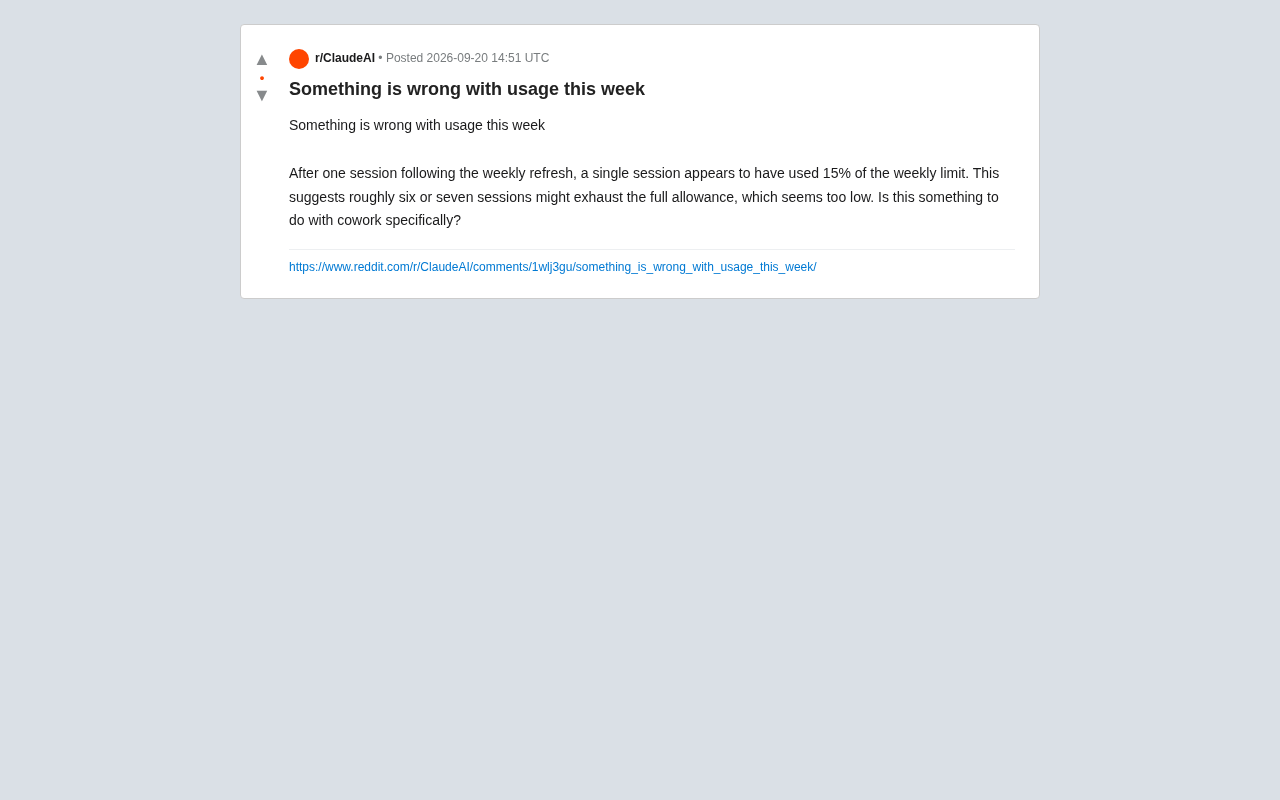
A Reddit user reported that a single AI subscription session consumed roughly 15% of their weekly quota — meaning the entire allowance could be exhausted in just six or seven sessions. The user suspects the collaborative "cowork" feature may be responsible, as such features maintain longer shared contexts and can trigger parallel tool calls, generating far higher compute costs than standard chats. The deeper issue is that most major AI services lack transparent usage breakdowns, leaving users unable to predict the cost of individual operations or determine whether anomalies are caused by their own behavior or server-side metering errors. The article advises users to audit their use of high-consumption features and report significant discrepancies to their provider.
User Report: A Single Session Eating 15% of the Weekly Quota
A Reddit user recently reported an unusual usage spike with their AI subscription service. After their weekly quota refreshed, they completed just one session — and the system showed approximately 15% of their weekly allowance had already been consumed.
At that rate, only six or seven sessions would exhaust the entire week's quota. For users who rely on AI tools for daily work, this kind of consumption is clearly unsustainable and represents a sharp departure from their previous experience.
What Could Be Causing This?
The user had a theory about the culprit. The original post specifically asked, "Is this something to do with cowork specifically?" — suggesting that a collaborative feature (cowork) might be responsible for the abnormal usage drain.
Collaborative and multi-turn interaction features often maintain longer contexts in the background and draw on significantly more compute resources. If a single session involves heavy context processing or multiple tool calls, it could theoretically consume far more quota than a standard conversation. That said, based on a single user's observation alone, it's impossible to say whether this is a product of feature design or a metering system glitch.
The Transparency Problem with Quota Metering
This report also highlights a pain point that's widespread across AI subscription services: opaque usage metering. Most services use "sessions," "messages," or "compute credits" as their quota units, but users often have no way to estimate upfront how much any given operation will actually cost.
When a seemingly ordinary session consumes 15% of a weekly allowance, it's natural to wonder, "Is this a bug?" Without real-time, granular usage breakdowns, users simply can't tell whether an anomaly stems from their own behavior or from a server-side metering issue.
Metering approaches vary significantly across major AI subscription services. Claude Pro, for example, uses a weekly message cap — but the actual deduction multiplies based on the model used (e.g., Opus vs. Sonnet), context length, and whether tools like code execution or web search are invoked. ChatGPT Plus operates on a "messages per 3-hour window" basis, with GPT-4o and GPT-4 consuming quota at different rates. To make things more complex, some services use internal units like "compute credits" or "token equivalents," yet surface them to users as vague percentages or remaining counts — making it impossible to reverse-engineer the true cost of any individual operation.
The root cause of this information asymmetry is that providers typically don't want to publish detailed billing models — partly for business confidentiality reasons, and partly to discourage users from gaming the system with surgical precision. The trade-off, however, is that users lose the ability to plan their usage in any meaningful way.
The reason "cowork"-style features may generate significantly higher consumption comes down to how they're implemented under the hood. Collaborative scenarios typically require the AI to maintain and repeatedly process a full shared context — including the message history of all participants — meaning every new response re-ingests the entire context. As a result, the actual token count processed grows linearly or even quadratically with session depth. On top of that, some collaborative features run multiple subtasks or tool chains in parallel in the background (e.g., auto-search, code execution, document parsing), and each sub-call is billed independently. This is fundamentally different from a standard single-user, single-turn conversation, which has a shorter context and no parallel calls — and naturally costs much less. Users should therefore treat collaborative features, Agent workflows, and long-document analysis as "high-consumption operations" by default, rather than assuming they're equivalent to a regular chat.
Takeaways for Users
If you encounter a situation like this, there are a few angles worth investigating. Check whether you have high-consumption feature modules enabled — such as collaboration tools, extended context modes, or premium model tiers — and observe how different types of operations affect your quota differently. It's also worth checking whether the provider has announced any changes to their metering rules.
If your consumption rate is clearly far beyond what you'd expect, reaching out to the service provider is worthwhile. A single user's observation might be an isolated case — but if a large number of similar reports surface in the community, it often signals a server-side metering anomaly or a rule change.
It's worth noting that the information in this article is drawn from a single community post, and there has been no official response or corroborating reports from other users. It's currently unclear whether this is a widespread phenomenon or specific to one account.
Conclusion
The fairness and transparency of AI subscription quotas are becoming an increasingly important factor in the user experience. When users pay for a service, clear and predictable usage rules aren't just a matter of trust — they directly affect how usable the tool actually is in practice. This report of a single session consuming 15% of a weekly quota may well be an isolated incident. But the question it raises — whether AI service metering is truly transparent and reasonable — is one that every provider should take seriously.
Related articles

OpenAI Codex CLI Practical Guide: The Open-Source AI Coding Agent in Your Terminal
OpenAI Codex CLI is an open-source AI coding agent that runs in your terminal. This guide covers its 2025 launch, 2026 desktop app, ChatGPT merger, and a three-step setup and workflow.

AI for Beginners Course Review: ChatGPT, Gemini, and AI Agents in Practice
A hands-on review of a complete beginner AI course covering ChatGPT, Gemini, Notebook LM, Manus, and DeepSeq, with 18,000-record dataset analysis, AI agent website building, and LLM principles and limits.

How Do AI Agents Autonomously Complete Complex Tasks? The ReAct Framework Explained
What's the core difference between an AI Agent and a chatbot? Using competitive research as an example, this article breaks down the ReAct framework's three-step loop of reasoning, acting, and observing, explaining how Agents autonomously decompose tasks, call tools, spot data gaps, and dynamically adjust plans to ultimately deliver complete results.