How Do AI Agents Autonomously Complete Complex Tasks? The ReAct Framework Explained

The ReAct framework's three-step loop of reasoning, acting, and observing lets Agents autonomously coordinate complete workflows and deliver results.
Using competitive research as an example, the article breaks down the essential difference between AI Agents and chatbots: the latter generates text in one shot and only gives suggestions, while the former coordinates a complete workflow of planning, calling tools, evaluating results, and adjusting strategy to deliver final results. Its core mechanism is the ReAct framework's three-step loop—reasoning and planning to decompose subtasks, calling external tools to act, and observing and evaluating intermediate results. The key detail is dynamic adjustment: when the Agent finds pricing data missing, it revises its plan and launches a second targeted search rather than stopping at an "insufficient information" conclusion—something a static pipeline can't do. The article also notes that an Agent's autonomy depends on the quality of external tool interfaces, that its behavior isn't fully predictable, and recommends starting with structured tasks whose intermediate results can be verified.
How Do AI Agents Autonomously Complete Complex Tasks? The ReAct Framework Explained

When you tell ChatGPT, "research the competition for me and write a brief," it gives you a block of text. But when you give the same instruction to an AI Agent, it might search the web on its own, spot gaps in the data, run follow-up searches for pricing information, and finally save the document. The difference behind this isn't just "being smarter"—it's a fundamentally different way of working.
A recent short video used a competitive research example to break down this process, and the core points to a framework called ReAct. Understanding it helps clarify where the real dividing line lies between "chatbots" and "Agents."
The Essential Difference Between Chatbots and Agents
A standard chatbot operates in "one-shot generation" mode: receive a prompt, output text, task over. It doesn't perform external operations, and it doesn't care whether the intermediate results are sufficient.
Agentic systems are different. They coordinate the entire workflow—planning, calling tools, evaluating results, adjusting strategy—until the goal is achieved. In the video's words, an Agent "actually coordinates the complete workflow," rather than a single-turn conversation.
The practical impact of this difference: a chatbot can tell you "how you should research the competition," while an Agent can just go ahead and finish the research. The former outputs suggestions; the latter delivers results.

The Three-Step Loop of the ReAct Framework: Reasoning, Acting, Observing
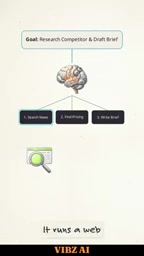
The core of ReAct (Reasoning + Acting) is a repeatable loop, and the video uses a competitive research task to demonstrate the full chain.
The first step is reasoning and planning. The Agent first breaks down the big goal of "research a competitor's new product and draft a brief" into a logically ordered list of subtasks. The video specifically notes that merely generating a task list isn't enough to obtain real-time information—this is the boundary of the planning phase.
The second step is acting. The Agent calls external tools to perform concrete operations, such as running a web search for competitor news. Tool calling is the key capability that distinguishes an Agent from a pure text model.
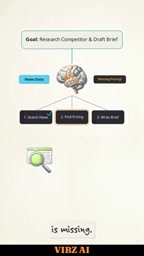
The third step is observing and evaluating. After getting the search results, the Agent checks whether the new data meets the requirements. In this example, it finds that critical pricing data is missing.
Once the three steps complete one round, the loop starts over again.
ReAct is a prompting and reasoning paradigm proposed in 2022 by Shunyu Yao et al. in the paper "ReAct: Synergizing Reasoning and Acting in Language Models." Its key insight is that the internal reasoning of large language models (such as chain-of-thought) is prone to factual hallucinations, while pure action execution lacks contextual guidance—alternating the two can correct each other. In the original paper, the model first generates a "Thought," then outputs an "Action" (such as searching Wikipedia), and after the environment returns an "Observation," the model continues to the next round of Thought. This Thought-Action-Observation trajectory can be injected into prompts as few-shot examples or used for fine-tuning. ReAct later became the default loop template for Agent frameworks like LangChain and LlamaIndex, and it's also an important foundation for understanding subsequent tool calling (function calling) and planning-based Agents.
Dynamic Adjustment: Where the Agent's Real Capability Lies
The most noteworthy detail in the video: when the Agent discovers that pricing information is missing, it doesn't stop at the conclusion of "insufficient information." Instead, it dynamically adjusts its plan and launches a second, highly targeted search specifically for pricing.
This step embodies the fundamental difference between an Agent and "one-shot generation." A static pipeline can only follow preset steps, failing or degrading its output when it hits a gap; an Agent with dynamic replanning capability can modify subsequent actions based on intermediate observations.
After confirming that all required information is in place, the Agent calls one final tool to save the completed document. From the user's perspective, the massive task initially handed over—planning the workflow, filling in missing data, drafting the final brief—is completed entirely autonomously.
What This Mechanism Means for Practical Use
Understanding the ReAct loop helps users set more reasonable expectations for Agents.
On one hand, an Agent's autonomy is built on tool availability. The search and save actions in the video example all depend on external tool interfaces, and tool quality directly determines task completion. On the other hand, the "observe-adjust" step means an Agent's behavior isn't fully predictable—it will change course based on information discovered midway, which raises new requirements for scenarios that need strict auditing.
For teams looking to get started with Agents, a more pragmatic approach is to begin with tasks that are highly structured and have verifiable intermediate results—competitive research happens to be one such task: the output of each step (search results, documents) can be checked, and errors are easy to pinpoint.
From "generating text" to "coordinating workflows," this shift isn't achieved through larger model parameters, but through a mechanism design that alternates reasoning and action. The value of the ReAct framework lies precisely in how concretely it articulates this mechanism.
Related articles

"Black October": Did AI Uncover 3% of All Critical Vulnerabilities Ever?
A Reddit post claims 3% of all critical software vulnerabilities ever were found in the past month, dubbed 'Black October.' We break down the statistical issues, how AI-assisted code auditing accelerates discovery, and how developers should respond.

Microsoft Project Gecko: Using AI to Bridge Language Gaps for African Farmers
Microsoft's Project Gecko launches PharmaChat, letting African farmers ask questions in their native language and get precise video clips and farming book chapters via AI. The project also releases three interactive manuals to advance inclusive AI.

Musk's Space Dominance: How Starlink Throttling Undermines Ukraine's Defense
SpaceX's Starshield throttling disabled Ukraine's high-speed interceptor drones, exposing how Musk's private control over low Earth orbit communications affects battlefield dynamics and national security, and highlighting the risks of commercial space militarization and space governance dilemmas.