AI for Beginners Course Review: ChatGPT, Gemini, and AI Agents in Practice

Jitendra's Complete AI Course covers mainstream tools and hands-on agent practice, taking beginners from zero to real application.
The article reviews a beginner-friendly "Complete AI Course" by Jitendra covering ChatGPT, Gemini, Notebook LM, Manus, and DeepSeq, organized by scenarios like research, long-document processing, data analysis, and programming. Hands-on work includes analyzing an 18,000+ record dataset and watching an AI agent build a travel website from scratch. Theory covers LLM principles and failure boundaries plus single-agent planning. It targets marketing, finance, data, product, and software roles.
AI is changing the way we learn, work, and solve problems. The real question isn't whether it will affect your career — it's whether you know how to use it well. An instructor named Jitendra has launched a "Complete AI Course" that claims to take absolute beginners from today's mainstream AI tools all the way to understanding generative AI and AI agents.

Which Tools and Scenarios the Course Covers
The course's tool lineup covers some of the most frequently mentioned products today: ChatGPT, Gemini, Notebook LM, Manus, and DeepSeq. The corresponding use cases include research, study assistance, long-document processing, data analysis, chart creation, programming, and multi-step task orchestration.
From the course design, it doesn't stop at "introducing what each tool can do" — it binds tools to specific tasks. For beginners, this scenario-based approach is more useful than a product-by-product list. After all, most people's real confusion isn't "what is ChatGPT" but "which tool should I use for this report, and how should I prompt it?"
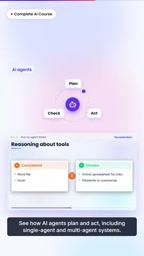
AI Agents are an important concept in today's AI landscape. Unlike traditional chat-based AI, agents can not only answer questions but also autonomously plan task steps, call external tools (such as search engines, code interpreters, and APIs), and adjust strategies based on intermediate results to ultimately accomplish a multi-step goal. For example, an agent can autonomously research a topic — first searching for information, then organizing it, and finally generating a report or building a website. This capability shifts AI from "passive response" to "active execution" and is key to automating complex workflows. Understanding how agents work helps you judge which tasks can be handed off to AI for automatic completion, and how to design instructions to guide agents efficiently.
Hands-On Section: From Datasets to AI Agents
One of the course's selling points is its hands-on component. Learners need to process a dataset with over 18,000 records and turn it into usable insights and visualizations. For an introductory course, this scale is realistic enough without being intimidating.

More interesting is the agent demo: watching an AI agent autonomously research a topic and build a travel website from scratch. The value of this case lies in demonstrating the complete chain of a "multi-step task" — the agent needs to plan steps, call tools, and produce results, which is precisely the essential difference between ordinary chat-based dialogue and how agents work.

Datasets are the foundation of data analysis, typically organized in tabular form with multiple rows (records) and columns (fields). Processing a dataset with over 18,000 records means learners need to master basic skills such as data cleaning, filtering, aggregation, and visualization. With the help of AI tools, this process can be greatly simplified: for example, using natural-language instructions to have AI generate data summaries, identify trends, or draw charts. This kind of hands-on work not only trains data thinking but also lets people experience AI's practical value in boosting efficiency. For beginners, starting with data at a realistic scale helps them adapt more quickly to data tasks in the workplace.
What the Theory Section Covers
The course claims to explain how large language models work and where they fail. This is commendable: understanding a model's limitations helps people avoid pitfalls far better than memorizing a pile of prompting tricks. The course also breaks down how AI agents plan and execute tasks, including how single-agent systems operate.
For learners without a technical background, "knowing when a model is unreliable" is often the prerequisite for judging output quality. The course places this content alongside hands-on practice, which makes logical sense.
Large Language Models (LLMs) are the core technology behind generative AI. By training on massive amounts of text data, they learn the patterns and structures of language, enabling them to generate coherent text, answer questions, translate languages, and more. However, LLMs are not perfect: they can produce "hallucinations" (fabricating plausible-sounding but incorrect information), are not sensitive to time-sensitive information, and lack true logical reasoning ability. Understanding these limitations helps users maintain critical thinking when using them, verify outputs, and avoid blind trust. The course's explanation of model principles and failure boundaries is precisely meant to cultivate this judgment, so learners know when to rely on AI and when human intervention is needed.
Who It's For
The course targets roles in marketing, finance, data, product, and software. There are four core capability goals: choosing the right tool, giving clear instructions, verifying results, and identifying which tasks can be accelerated by AI.
This positioning is quite pragmatic. It doesn't promise to train you into an AI engineer; instead, it targets the need to "talk confidently about AI in meetings and interviews." For most professionals, this is exactly the more urgent gap right now. The course supports learning at your own pace, making it suitable for working people with fragmented time.
It should be noted that the information in this article mainly comes from the course's promotional video. The actual depth of the teaching content, the instructor's level, and the quality of the exercises still need to be judged based on real course experience. Before enrolling, it's advisable to confirm whether there are trial chapters, paying particular attention to whether the hands-on sections on data analysis and agents include reproducible step-by-step instructions.
One-Line Summary
If your goal is to go from "having heard of AI" to "being able to use it at work," this kind of introductory course — which connects tools by scenario and emphasizes hands-on practice and awareness of limitations — is a reasonable starting point; but it cannot replace in-depth training for a specific role.
One-line Summary
Jitendra's Complete AI Course covers mainstream tools and hands-on agent practice, helping absolute beginners go from getting started to real application.
Paragraph Summary
The article introduces a "Complete AI Course" by Jitendra, designed to help absolute beginners start with mainstream AI tools and gradually understand generative AI and AI agents. The course covers five tools — ChatGPT, Gemini, Notebook LM, Manus, and DeepSeq — organized around scenarios such as research, long-document processing, data analysis, programming, and multi-step task orchestration. The hands-on section includes processing a dataset of over 18,000 records and generating visualizations, as well as watching an AI agent autonomously research a topic and build a travel website from scratch. The theory section explains the principles of large language models and their failure boundaries, and breaks down the planning and execution mechanisms of single-agent systems. The course targets roles in marketing, finance, data, product, and software, with core goals of choosing the right tools, writing clear instructions, verifying results, and identifying tasks that can be accelerated. The article also notes that the information mainly comes from a promotional video, and the actual course quality should be judged based on a trial experience.
Related articles

Altman Declares: The Cybersecurity Crisis Is Unsolvable and There Are Too Many Vulnerabilities to Patch
OpenAI CEO Sam Altman publicly admits he can't fix all security vulnerabilities and that the cybersecurity crisis will keep worsening. This article analyzes the industry reality behind this statement: exploding software complexity, the double-edged sword of AI, and the need to shift security paradigms from "zero vulnerabilities" to resilient defense.

Product Hunt Launches Visual Launch Editor, Saying Goodbye to Tedious Form Filling
Product Hunt launches a Visual Launch Editor with in-place editing for name, tagline, gallery, and maker info, auto-saved drafts, and a checklist to guide creators.

Zelensky Speaks: How We Held Kyiv Against 200,000 Russian Troops
Zelensky recalls the early Russia-Ukraine war: 200,000 Russian troops drove on Kyiv while Ukraine's main forces were in the east. He explains how mobilization grew the army from 200,000 to 800,000 and how Kyiv and Chernihiv oblasts were recaptured.