AI Takes Over Code Review: From Reading Diffs Line by Line to Writing More Tests

AI agents now handle code review loops, shifting developers from reading diffs to writing better tests.
A B2B SaaS developer shares how multi-agent AI workflows (Opus, Composer, CodeRabbit) have replaced their habit of reading every line of code before merging. The automated generate-review-patch loop runs until code passes cleanly, but the real risk lies in two AIs confidently agreeing on the same mistake. The developer's role has fundamentally shifted: from line-by-line code reading to writing high-quality tests that serve as the ultimate defense line AI cannot bypass.
A B2B SaaS Developer's Habit Transformation
In software development, code review has always been considered the last line of defense for quality control. Code Review refers to the practice of having team members systematically examine code changes before they're merged into the main branch—it's not just about finding bugs, but a critical step in ensuring code maintainability, architectural consistency, and business logic correctness. For teams building B2B SaaS, this is a non-negotiable practice—because any bad merge could directly impact paying customers. B2B SaaS (Business-to-Business Software as a Service) delivers cloud services directly to enterprise clients, who typically have SLAs (Service Level Agreements) with explicit contractual requirements for system availability and data accuracy. A single serious production incident could trigger compensation clauses or lead to customer churn.
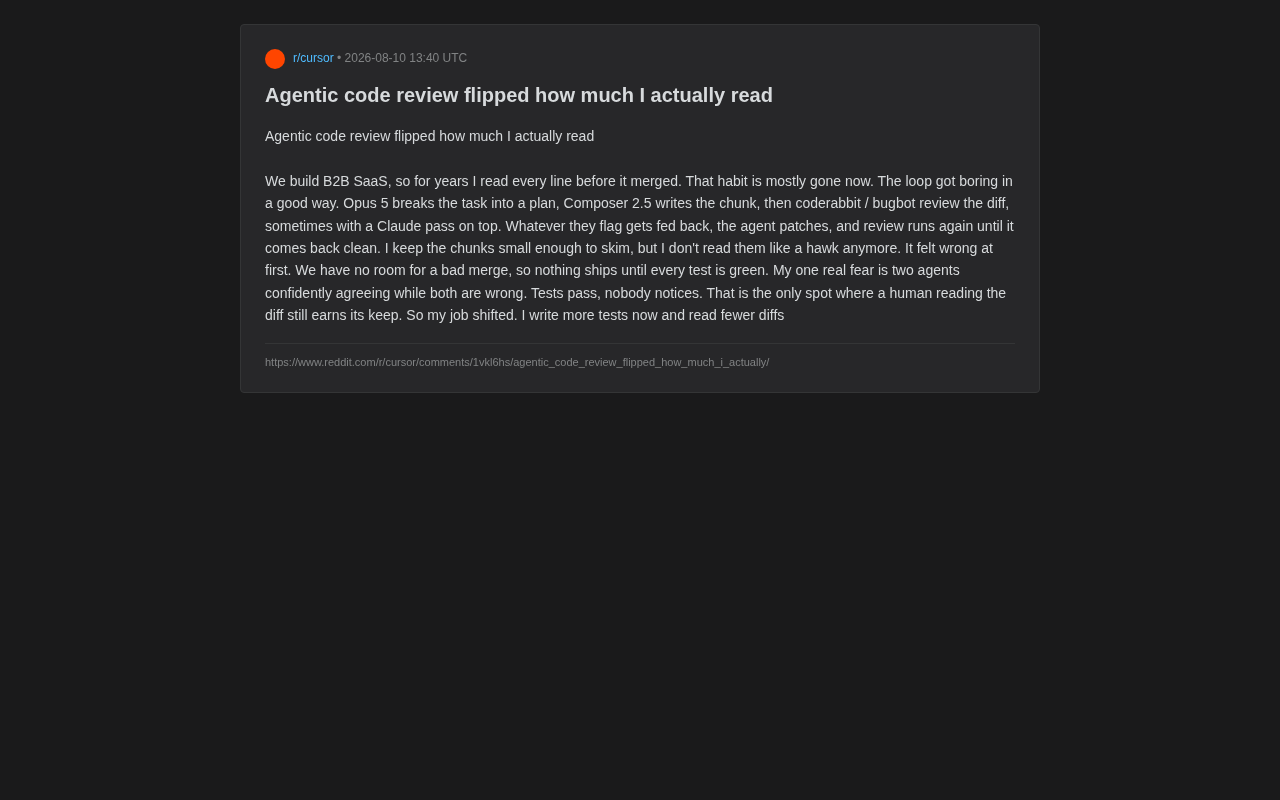
However, a Reddit developer recently shared a fundamental shift in how they work: After years of reading every single line of code before merging, that habit has almost completely disappeared. In its place is an "Agentic Code Review" workflow composed of multiple AI Agents working in collaboration.
This isn't simply "using AI to write code"—it's a real-world case study of how the human developer's role is being redefined.
The Multi-Agent Collaborative Code Review Loop
How the AI Code Review Process Works
The workflow this developer describes is essentially a "pipeline" composed of multiple AI tools, each handling its own specific role. This architecture stems from the "Agentic AI" concept in the AI field—unlike traditional single prompt-response patterns, Agentic AI emphasizes giving AI systems the ability to autonomously plan, execute, provide feedback, and iterate. Different AI tools can play different roles, similar to architects, programmers, and reviewers on a human team:
- Opus 5 breaks tasks down into execution plans;
- Composer 2.5 writes code chunks based on the plan;
- CodeRabbit / Bugbot reviews the diffs, sometimes with an additional Claude review pass;
- Any flagged issues are fed back to the Agent, which automatically creates patches;
- The review runs again, cycling until the code passes cleanly.
A few key concepts need explanation here: Opus and Composer are AI coding features integrated into the Cursor IDE, focusing on complex task reasoning/planning and code generation respectively; CodeRabbit is an AI tool specialized in Pull Request reviews that automatically analyzes code diffs and provides improvement suggestions; Bugbot offers automated defect detection capabilities. Diff (code difference) is a core concept in version control systems, referring to the comparison between two code versions—reviewers read diffs to understand "what changed, why it changed, and whether the change is correct." Patch refers to making localized modifications to existing code—in traditional workflows, reviewers discover issues and developers must manually fix and resubmit, but in the Agentic workflow, this fix-resubmit cycle is completed entirely by AI.
The most interesting aspect of this closed loop is its "self-healing" capability—it's not AI delivering once, but a repeated iteration of "generate → review → patch → review again" until quality thresholds are met. The author used a thought-provoking phrase to describe this state: "boring in a good way."
Why "Boring" Is a Good Thing
In engineering practice, stable, predictable processes that don't require frequent human intervention are often the healthiest processes. When the review cycle becomes mechanical and reliable, developers' attention can be freed from tedious syntax and logic corrections.
The author admits he still keeps code chunks small enough for quick scanning, but no longer "watches like a hawk" over every line of code. This shift from "deep reading" to "skimming" is the direct result of the Agentic workflow.
The Real Anxiety Behind "It Feels Wrong" in AI Code Review
The Psychological Battle in Zero-Tolerance Environments
You might not have noticed, but the author isn't blindly optimistic. He explicitly states that this transition "felt wrong at first."
The reason is pragmatic: B2B SaaS has no room for error—nothing ships until all tests turn green. This workflow only functions because strict automated testing serves as the ultimate safeguard—AI can write code and review code, but only when all tests pass does the code qualify for merging.
Automated testing here typically includes multiple layers: unit tests verify the correctness of the smallest code units, integration tests verify collaboration between modules, and end-to-end tests simulate real user actions to verify complete business flows. "All tests turning green" means every test case in the entire test suite has passed verification. In CI/CD (Continuous Integration/Continuous Deployment) pipelines, all tests passing is typically a hard prerequisite for code merging—the rigor of this automated defense line directly determines the upper bound of trustworthiness for AI-generated code.
The Most Dangerous Blind Spot: Two AIs Confidently Making the Same Mistake
The author raised the most profound insight in the entire post, and his only real concern:
"The only thing I truly fear is two Agents confidently agreeing with each other, and both being wrong. Tests pass, nobody notices."
This is an extremely illuminating risk description. When both code generation and code review are performed by AI, if two models share similar training data or reasoning logic, they might share the same blind spot—the generated code has a problem, the reviewing AI thinks it's fine, and existing tests happen not to cover that scenario.
This risk has theoretical foundations in machine learning. Current mainstream large language models (like Claude, GPT series) share considerable homogeneity in training data and architectural design, meaning they may share similar knowledge blind spots and reasoning biases. This is similar to "correlation risk" in statistics—if two detection systems are built on the same assumptions, the probability of both failing simultaneously on the same edge case is far higher than for truly independent systems. In financial risk management, this is called "model risk correlation," and regulators typically require cross-validation using models with different methodologies to avoid systemic failure. AI code review faces the exact same structural challenge.
This "conspiratorial error" is more frightening than a single AI making a mistake because it bypasses all automated defenses while everything appears normal on the surface. This is precisely where human diff reading remains irreplaceable—the human's value is no longer line-by-line syntax checking, but identifying deep logical flaws that AI collectively overlooks.
The Fundamental Shift in the Developer's Role
From "Reading Diffs" to "Writing Tests"
The most core conclusion of this post is the author's repositioning of their own job responsibilities:
"My job has changed. I now write more tests and read fewer diffs."
This sentence concisely captures the evolution of the engineer's role in the Agentic development era:
- Before: Humans were direct producers and reviewers of code, with value demonstrated through writing well and reading carefully;
- Now: Humans are the "definers" and "validators" of quality standards, with value demonstrated through designing sufficiently rigorous test systems that "trap" potential AI mistakes.
In other words, when AI can efficiently generate and mutually review code, the highest-leverage human investment is building that defense line AI cannot deceive itself past—high-coverage, high-quality automated tests. Test Coverage measures what percentage of code paths are covered by test cases—higher coverage means fewer untested "blind spots" and lower probability of defective AI-generated code slipping through. In the Agentic development model, the ability to write tests upgrades from "best practice" to "core competency," because tests fundamentally define the boundaries and constraints of AI behavior.
What This Means for the Entire Software Development Industry
Although this case comes from an individual developer's practice, the trends it reflects deserve consideration from all technical teams:
- AI tools are moving from "assisting" to "taking over" specific execution steps, with humans gradually retreating to the edges of the process as gatekeepers;
- The importance of test engineering is being amplified to unprecedented levels—it's the key lever for constraining AI behavior;
- Human review won't disappear, but will become more focused—deployed only where AI is most likely to collectively fail.
It's worth noting that this trend is highly consistent with the historical evolution of software engineering. From assembly language to high-level languages, from manual deployment to CI/CD, every advance in automation has pushed humans toward higher levels of abstraction—focusing on "what to do" and "why to do it" rather than "how to do it." AI Agents taking over coding and review is simply the latest step on this evolutionary path.
Conclusion: Trust But Verify
This developer's experience is essentially the latest interpretation of the "trust but verify" principle in the AI era. This principle was first widely cited during the Cold War and has now gained new life in software engineering—he's willing to hand over large amounts of repetitive coding and review work to Agents, but never relinquishes control over final quality—except the means of control has shifted from "reading line by line" to "writing better tests."
For teams exploring AI-assisted development, this may be a more pragmatic reference path: rather than agonizing over "whether to use AI," think about "when AI handles execution, where should humans focus their energy." The answer likely lies in that simple summary—write more tests, read fewer diffs.
Related articles

Gaussian Process Bandit Optimization: Exploration Strategies and Inference Regret Guarantees
Cumulative regret guarantees in Bayesian optimization fail to reflect final recommendation quality. This article examines a new study that provides inference regret guarantees for Gaussian process bandit optimization through exploration query strategies and fill distance analysis, validated on hyperparameter optimization and control tasks.

The Most Detailed Codex Guide on Bilibili: From Installation to Real-World Practice
The most detailed Codex guide on Bilibili: from app store installation to daily work mode configuration, with a real coffee shop project demonstrating file organization, data extraction, dashboard creation, and other practical tasks. Learn to use Plan Mode and desktop pets to leverage Codex efficiently.

Appearance Compensation in Volume Rendering: Why RGB Accuracy Cannot Guarantee Density Correctness
Volume rendering research reveals that volumetric data perfectly reproducing external RGB views may still contain density errors: appearance compensation can double central density and keep external rays unchanged even when L2 error exceeds 14.52%. Density recovery depends on appearance capacity, spatial resolution, and measurement design.