AI Tool Misuse Creates New Enterprise Security Risks, Pluto Security Raises $42M

Security startup Pluto Security raises $42M to target security blind spots from employees' spontaneous AI tool use.
Employees' spontaneous use of AI tools is becoming a new challenge for security teams, bringing data leaks, access control loss, and compliance blind spots. Pluto Security recently closed a $42M round targeting this pain point. AI tools break three assumptions of traditional security: traceable data flows, controllable access, and predictable behavior. The funding signals capital's continued bet on enterprise AI security.
Employees' spontaneous use of AI tools is becoming a new nightmare for security teams. When anyone can casually call on large models to handle work tasks, data leaks, loss of access control, and compliance blind spots follow close behind.
According to TechCrunch, security startup Pluto Security recently closed a $42 million funding round, targeting precisely this wave of enterprise security anxiety triggered by the spread of AI.
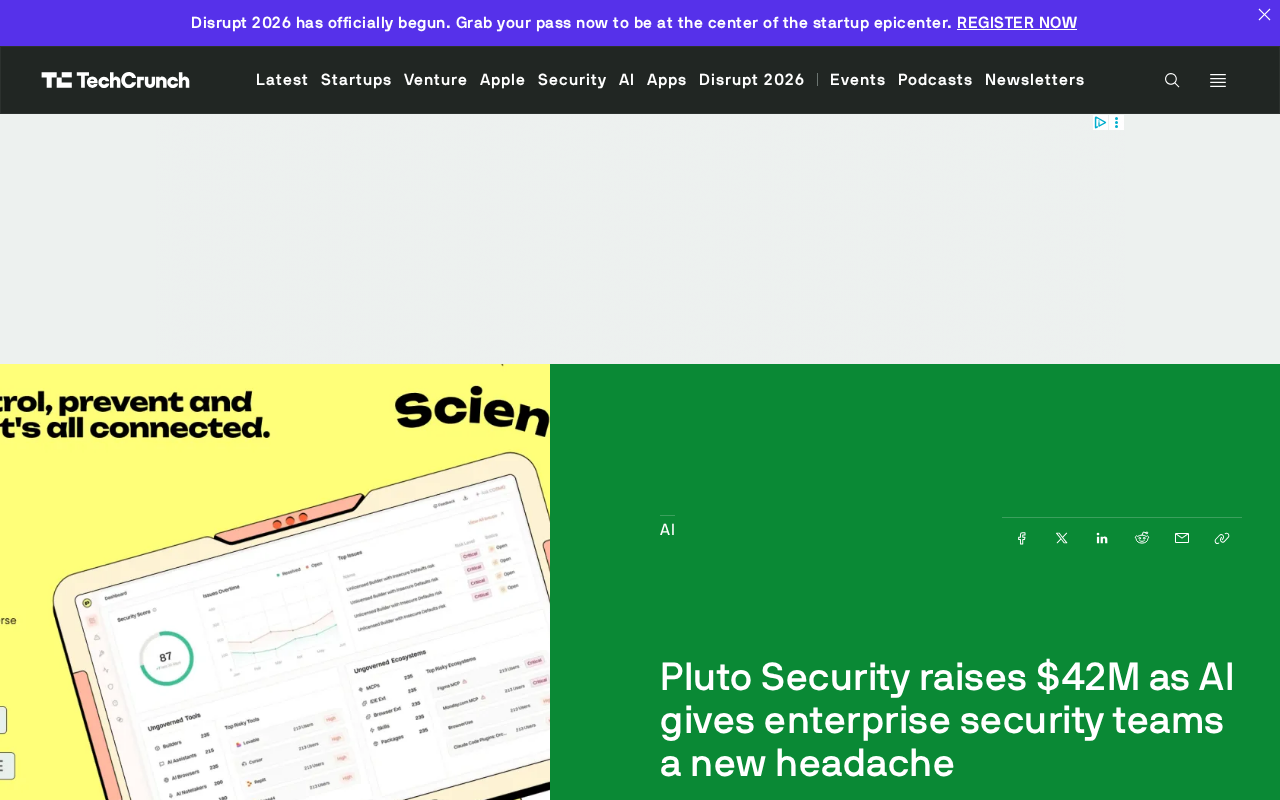
AI Tool Adoption: The Security Cost Behind Efficiency Gains
The root of the problem isn't complicated. Giving everyone in the company access to AI tools means people will use them in unexpected ways.
These "unexpected" scenarios span an extremely wide range: employees might paste sensitive customer data into public large models seeking analytical advice, might use AI to generate code snippets containing internal logic and share them on external platforms, or might connect AI capabilities to internal systems without approval. Every such action pries open a gap in the enterprise security perimeter.
This concern is steadily spreading—enterprises either already have new, massive security vulnerabilities, or will soon face this reality.
Pluto Security's funding timing lands right on this pain point. A $42 million round is no small sum for a security startup, indicating that investors recognize both the urgency of the problem and the market opportunity.
Shadow AI is a key concept for understanding this issue. It refers to the phenomenon where employees use AI tools to handle work matters without approval from IT or security departments, similar to the previously well-known "shadow IT." Typical forms of shadow AI include: logging into public large models with personal accounts to process company data, privately connecting AI capabilities into internal workflows via scripts or plugins, and bypassing enterprise controls through browser extensions.
The danger of shadow AI lies in its stealth—security teams often only discover it after data has already leaked or systems have already been exposed. Compared to traditional shadow IT, shadow AI has a lower barrier to entry and spreads faster: employees don't need to install software or request resources—just pasting a piece of text into a webpage completes a potential data leak. This is why security vendors universally rank shadow AI as one of the risk categories most urgently needing attention.
New Challenges Facing Security Teams
Traditional enterprise security frameworks are built on several core assumptions: data flows are traceable, access permissions are controllable, and employee behavior is predictable. The introduction of AI tools breaks all three assumptions simultaneously.
Data flows become difficult to trace because employee interactions with large models often occur outside the enterprise IT visibility. Access permissions become blurred because AI tools themselves can become a springboard for accessing enterprise resources. Employee behavior becomes unpredictable because AI dramatically expands the boundaries of individual capability.
Security teams need to rebuild a protection system suited to the AI era without hindering productivity. This balance is extremely difficult to strike—too loose, and vulnerabilities abound; too strict, and employees will bypass controls and continue using AI anyway, creating even larger blind spots.
The industry typically uses DLP (Data Loss Prevention) to refer to mechanisms for monitoring and blocking the outflow of sensitive data. Traditional DLP relies on rule matching for known channels such as email, file transfers, and USB copying, using regular expressions, fingerprinting, and other means to detect sensitive content.
But AI interactions pose a direct challenge to this paradigm: content employees paste into chat interfaces is often natural language fragments lacking fixed structural features, and the transmission target is a large model's API or webpage—not on traditional DLP's monitoring list. Therefore, next-generation solutions are beginning to introduce the concept of an "AI firewall" or "large model gateway," establishing a proxy layer between employees and models to inspect prompts and responses in real time, and to perform desensitization, blocking, or audit logging when necessary. This is precisely the track that companies like Pluto Security are trying to enter.
Market Signals Behind the Funding
Pluto Security's $42 million raise reflects capital markets' continued bets on the enterprise AI security track.
From an industry trend perspective, AI security is moving from "whether to do it" into the "how to do it" stage. Early enterprises may have been watching and waiting, but as AI tool penetration in the workplace rises rapidly, the potential probability of security incidents rises in tandem.
The use of this funding has not been disclosed, but it can reasonably be presumed to go toward product R&D, market expansion, and expanding the security research team. For Pluto Security, the key challenge is whether it can find a scalable solution that balances security controls with user experience.
AI Security as a track can currently be roughly divided into three directions: first, protecting AI systems themselves (such as model theft prevention and adversarial example defense); second, using AI to enhance traditional security capabilities (such as AI-driven threat detection); third, addressing enterprise risks brought by AI usage—the core of this article's discussion. Pluto Security operates in the third category, which is also the fastest-growing segment in terms of recent capital attention.
The business logic of this direction lies in the fact that it is not a customized service for a few leading enterprises, but rather has broad demand fundamentals as AI tools are universally deployed across enterprises. At the same time, it is highly correlated with compliance pressure—as countries impose stricter requirements on cross-border data flows and personal information processing, enterprises' motivation to purchase such products will shift from "risk management" to "compliance necessity," and the market space is therefore widely viewed as promising.
How Enterprises Should Respond
Facing the new security risks brought by AI tools, measures enterprises can take include: establishing AI tool usage policies with accompanying technical controls, conducting real-time monitoring and desensitization of AI interactions involving sensitive data, and incorporating AI security into the overall security architecture rather than treating it as a standalone issue.
The deeper problem is that AI security is not purely a technical issue. It involves coordinated adjustments across employee training, process design, compliance auditing, and organizational culture. Deploying a security product alone cannot fundamentally address the risks brought by the "human" factor.
Pluto Security's funding is a microcosm, reflecting the paradigm shift the entire enterprise security industry is undergoing. When AI becomes infrastructure, security must be restructured accordingly.
One-line Summary
Security startup Pluto Security raises $42M to target security blind spots created by employees' spontaneous use of AI tools.
Paragraph Summary
Employees' spontaneous use of AI tools is becoming a new challenge for security teams, bringing data leaks, loss of access control, and compliance blind spots. Security startup Pluto Security recently closed a $42 million round, targeting this pain point. The article notes that AI tools simultaneously break three assumptions of traditional security frameworks: traceable data flows, controllable access permissions, and predictable employee behavior. Security teams are caught in a dilemma—too loose and vulnerabilities abound; too strict and employees bypass controls, creating even larger blind spots. The funding reflects continued capital bets on the enterprise AI security track and signals the industry is moving from "whether to do it" into "how to do it." The article also emphasizes that AI security is not just a technical issue—it requires coordinated adjustments in employee training, process design, and organizational culture.
Related articles

Random Pruning of the DPO Computation Graph: 1.4x Training Speedup and Lower Peak Memory
DPO training too slow and memory-hungry? This paper proposes a random pruning framework for the DPO computation graph, sampling independently across position, sequence, and branch dimensions; branch pruning achieves a 1.426x step-time speedup and cuts training time by about 30%, with in-depth attribution of memory and time gains.

Why Does JEPA Underperform MLM in Longitudinal EHR Representation Learning?
New study compares JEPA and MLM for longitudinal EHR representation learning on MIMIC-IV: three JEPA variants train stably without collapse but underperform MLM; target size, not heterogeneity, drives prediction error.

Transfer Learning + Visible Light Communication: A New Approach to Energy-Efficient Indoor Positioning
A study proposes a transfer learning-based visible light communication indoor positioning method, achieving 47% accuracy improvement on the BOSCH factory dataset, 67.5% model efficiency under high noise, and introducing the ME composite metric for energy-efficient positioning in energy-constrained industrial IoT scenarios.