AI Toolbox 3.0: A Cross-Platform Efficiency Tool for Managing ChatGPT, Claude, and Four Major AI Conversations
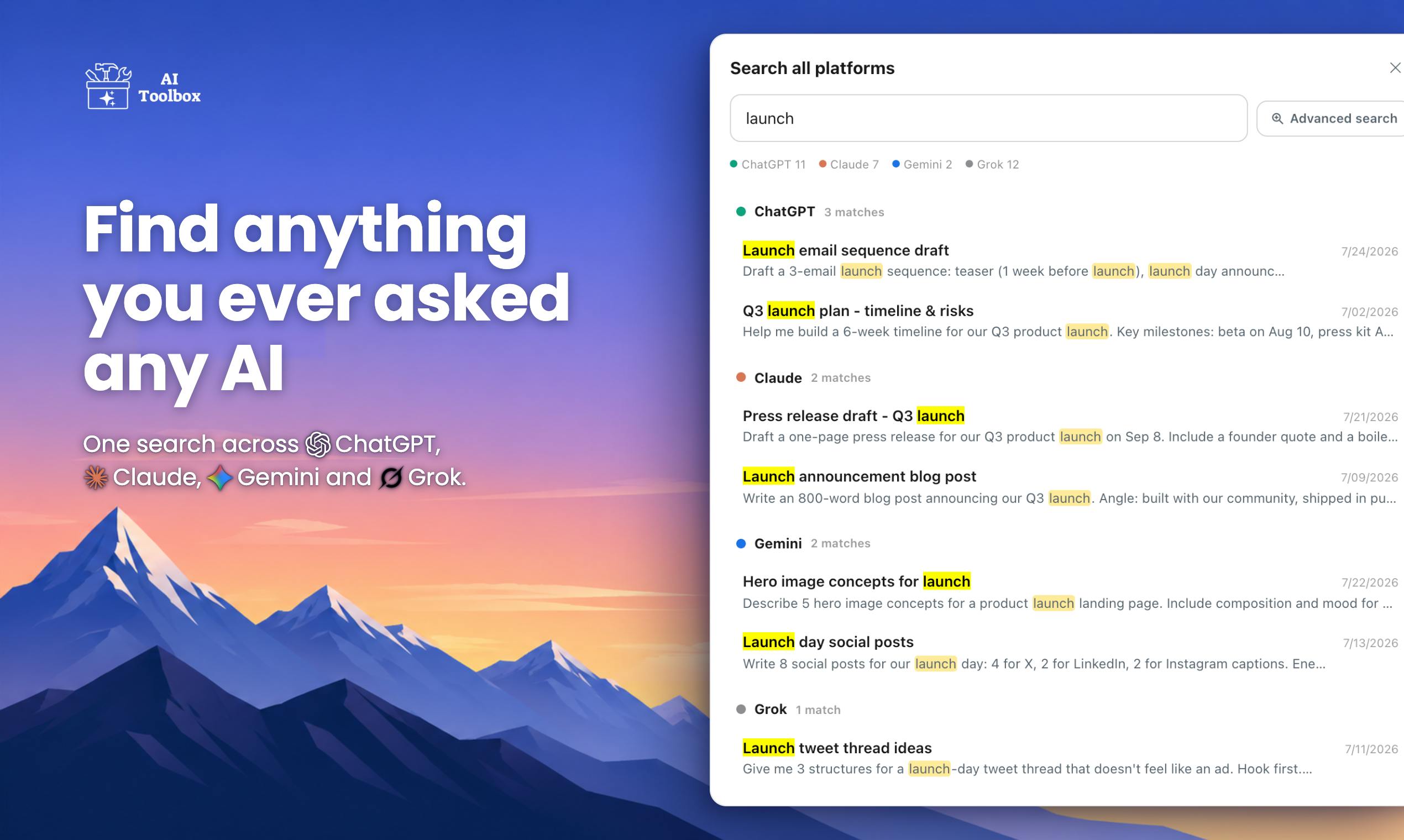
Cross-platform tool managing ChatGPT, Claude, Gemini & Grok conversations with unified search and local privacy
AI Toolbox 3.0 is a Chrome extension that solves the problem of scattered AI conversations across ChatGPT, Claude, Gemini, and Grok. It provides unified full-text search, hierarchical folder organization, a prompt library, and batch export to Markdown/PDF/JSON. Using a local-first architecture, all data stays in your browser for privacy. With 40K+ users and Product Hunt's #1 daily ranking, it's becoming essential infrastructure for professionals managing multiple AI platforms.
AI Conversations Scattered Across Platforms: A Hidden Pain Point in Search and Management
When you switch between ChatGPT, Claude, Gemini, and Grok daily, a hidden problem quietly accumulates: conversation records are scattered across four isolated platforms, unable to be searched uniformly, difficult to archive, and nearly impossible to organize. Finding that critical prompt from last week often relies solely on memory and endless scrolling.
Technical Background of ChatGPT, Claude, Gemini, and Grok: ChatGPT is developed by OpenAI and based on the GPT series of large language models, making it the earliest conversational AI product available to the public. Claude is launched by Anthropic, emphasizing safety and interpretability through its Constitutional AI technical framework. Gemini is Google's multimodal large model, with the Gemini 2.5 Pro version released in March 2025, integrating the massive data advantages of its search engine. Grok is the product of Elon Musk's xAI company, with Grok 3 released in February 2025, positioned as more open and real-time. These four products represent the mainstream camps of current AI large models, each with independent user interfaces, data storage, and API systems that do not share data with each other.
AI Toolbox 3.0 precisely targets this pain point. As a Chrome browser extension, it secured first place on Product Hunt's daily rankings, garnering 412 votes and 62 comments, while boasting over 40,000 users and a 4.5-star rating on the Chrome Web Store, covering more than 150 countries. These numbers indicate that managing AI conversations is becoming a real and high-frequency need.
Chrome Browser Extension Development Ecosystem: Chrome extensions are browser plugins developed using web technologies (HTML, CSS, JavaScript) that can modify or enhance browser functionality. The Chrome Web Store is Google's official extension distribution platform with strict review mechanisms and privacy policy requirements. Extensions can access webpage content users browse, modify DOM structures, and intercept network requests, enabling third-party tools to capture and manage AI conversation data directly from web interfaces without relying on official APIs. As of 2025, Chrome browser holds over 60% market share, making Chrome extensions the most influential browser plugin ecosystem.
AI Toolbox Core Features: Building a Unified Management Layer Across Four Major AIs
Developer Adi Leviim positions AI Toolbox as "the missing layer" above ChatGPT, Claude, Gemini, and Grok. This positioning is remarkably precise—it doesn't attempt to replace any large model but serves as an organizational and search layer spanning multiple platforms.
Product Hunt Platform and Product Validation: Product Hunt is the world's most influential new product discovery community, showcasing dozens of new products daily with rankings determined by user votes. Reaching first place on the daily rankings means gaining the most community recognition within 24 hours, typically requiring hundreds of votes and active discussion. For early-stage products, Product Hunt serves both as a litmus test for market demand validation and an important channel for acquiring seed users. AI tool products are especially active on the platform, with AI-related products occupying a significant portion of rankings during 2024-2025, reflecting the developer community's sustained enthusiasm for exploring AI tool layers.
Full-Text Search and Cross-Platform Conversation Retrieval
The most practical feature is undoubtedly full-text search. You can search for keywords across all conversation history and even search across all four platforms simultaneously. Whether you originally discussed a topic in Claude or Gemini, one search can pinpoint it precisely. For heavy users, this represents an experience leap from "finding a needle in a haystack" to "one-click direct access."
Folder and Subfolder Archiving Management
AI Toolbox provides a folder and subfolder hierarchy, allowing users to organize conversations like documents. Combined with the bookmarking feature, you can mark important conversation nodes for easy backtracking. This approach of "documentizing" AI conversations essentially brings unstructured chat records back into a manageable knowledge system.
Prompt Library and Multi-Step Workflow Chains
For users who frequently reuse prompts, AI Toolbox includes a built-in Prompt Library that supports inserting prompts directly via // shortcut commands and can build multi-step chains. This feature solidifies common workflows, reduces repetitive input, and is a key design for improving AI usage efficiency.
Data Export and Privacy Protection: Local-First Architecture Explained
Batch Export to Markdown, PDF, JSON
AI Toolbox supports batch exporting conversations to Markdown, PDF, and JSON formats. This is extremely friendly for users who need to archive, edit further, or integrate AI outputs into other workflows. Markdown suits writing and knowledge base building, PDF is ideal for sharing and archiving, and JSON leaves an interface for developers' data processing.
Markdown and Knowledge Management Ecosystem: Markdown is a lightweight markup language written in plain text format that can be easily converted to HTML, PDF, and other formats. Due to its simplicity and readability, Markdown has become the de facto standard for technical documentation, note-taking tools, and knowledge management systems. Mainstream knowledge management tools like Notion, Obsidian, and Logseq all natively support Markdown. Exporting AI conversations to Markdown format means users can seamlessly integrate this content into existing personal knowledge bases (PKM, Personal Knowledge Management) for further annotation, linking, and retrieval. This interoperability is key for knowledge workers to efficiently manage fragmented information.
Live Context Meter
An easily overlooked but cleverly designed feature is the live context meter. It helps users intuitively perceive how much of the context window the current conversation has occupied, avoiding information loss or decreased answer quality due to exceeding the model's context limits. This demonstrates the developer's deep understanding of large model usage details.
Context Window Mechanism: The context window is the maximum text length a large language model can process at once, typically measured in tokens. One token corresponds to approximately 0.75 English words or 0.5 Chinese characters. Early GPT-3 had a context window of only 4K tokens, while 2025 mainstream models commonly reach 128K or even 200K tokens. When the context window is exceeded, the model "forgets" the earliest input content, leading to decreased conversation coherence. The live context meter estimates used tokens by parsing conversation content, helping users summarize or start new conversations before approaching the limit, which is particularly important for long-text creation and complex reasoning tasks.
Local-First Privacy Protection Strategy
Notably, AI Toolbox adopts a local-first architecture—all conversation data remains in the browser locally rather than being uploaded to third-party servers. In an era of increasing AI privacy concerns, this design both reduces data breach risks and alleviates users' worries about sensitive conversations being collected. For enterprise users and professionals handling confidential information, this may be a deciding factor in adoption.
Local-First Architecture and Data Privacy: Local-first is a software architecture philosophy emphasizing that data is primarily stored on users' local devices rather than remote servers. This design grants users complete data ownership—even offline or if service providers cease operations, data remains accessible. In AI contexts, user conversations with large models may contain trade secrets, personal privacy, or creative ideas, and uploading to third-party servers carries leakage risks. Local-first stores data in the browser's IndexedDB or LocalStorage, avoiding data passing through developer servers. However, this brings limitations: data cannot automatically sync across devices and requires manual export-import or relies on end-to-end encrypted sync solutions (like Syncthing or end-to-end encrypted cloud storage).
Product Positioning Analysis: The Opportunity Window for Cross-Platform AI Tool Layers
AI Toolbox's success reflects a larger trend: the "efficiency tool layer" around mainstream large models is becoming an independent product category.
As ChatGPT, Claude, Gemini, and Grok each build data silos, the pain point of users being forced to switch between multiple platforms becomes increasingly evident. Due to competitive considerations, these large model vendors are unlikely to voluntarily interconnect their data in the short term. This leaves a clear opportunity window for third-party tools—doing the cross-platform integration that official platforms won't and don't want to do.
From a business perspective, the strategy of "one installation covering four major AIs" is highly attractive. Users don't need to find separate tools for each platform—one extension solves all problems. This "aggregation value" is the core reason for rapidly accumulating 40,000 users.
Of course, its limitations must be viewed rationally: as a browser extension, it heavily depends on each platform's webpage interface structure. If platforms redesign, compatibility maintenance becomes necessary. Additionally, while local-first ensures privacy, it also means data cannot sync across devices (unless another mechanism exists), which may be inconvenient in multi-device work scenarios.
AI Conversations as Knowledge Assets: A New Form of Personal Knowledge Management
The value of AI Toolbox 3.0 essentially lies in redefining "AI conversations" as a type of knowledge asset worth managing. As our interactions with AI become more frequent and deeper, those conversations containing thought processes, solutions, and creative sparks should be organized, searched, and reused like documents and emails.
For professional users, content creators, and developers who interact with multiple large models daily, such tools are gradually transitioning from "nice-to-have" to "essential infrastructure." AI Toolbox topping Product Hunt may be a clear signal of this trend.
Key Takeaways
- AI Toolbox 3.0 addresses the pain point of conversation records scattered across ChatGPT, Claude, Gemini, and Grok, providing unified cross-platform search and management
- Core features include full-text search, folder archiving, prompt library, multi-step workflow chains, and batch export to Markdown/PDF/JSON formats
- Adopts a local-first architecture with all data stored in the browser locally, ensuring privacy protection while sacrificing cross-device sync convenience
- Secured first place on Product Hunt with over 40,000 Chrome Web Store users, validating the market demand for cross-platform AI management tools
- Represents an emerging "efficiency tool layer" trend: third-party tools fill the gap left by official platforms unwilling to do cross-platform integration
- Redefines AI conversations as knowledge assets worth managing, gradually becoming essential infrastructure for professional users
Related articles

TiVo Charging for Ad-Skipping? DVR User Rights and the Digital Ownership Debate Explained
TiVo plans to charge DVR users for ad-skipping, sparking debate over digital ownership and consumer rights. A deep dive into subscription trends and their implications.
Batch Generating Ad Creatives from a Single Product Image: Real Bottlenecks and Solutions for Scaled Workflows
From one product photo to multi-platform ad assets—brand consistency, text rendering, and cross-platform adaptation collapse first. Deep dive into AIGC marketing workflow bottlenecks with template-driven and layered composition solutions.

Scriptly: AI Voice-Following iOS Teleprompter That Eliminates Pace-Chasing
Scriptly is an iOS voice teleprompter using AI real-time voice-following technology to auto-match speaking pace. Supports local storage for privacy, integrates writing, script management & video recording workflow for content creators.