AI Tools and Creator Trust: When a Single Phrase Can Trigger a Crisis of Confidence
The Hank Green AI controversy exposes deeper questions about creator trust, AI tool boundaries, and accountability.
Starting from the incident where Hank Green was accused of using AI, this article explores the blurry boundaries of AI-assisted content creation, how creator-audience trust is being redefined, the double standards creators face compared to celebrities and politicians, and the real social costs of AI infrastructure on local communities. The core takeaway: the only currency creators have is trust, and navigating AI requires transparency, not binary labels.
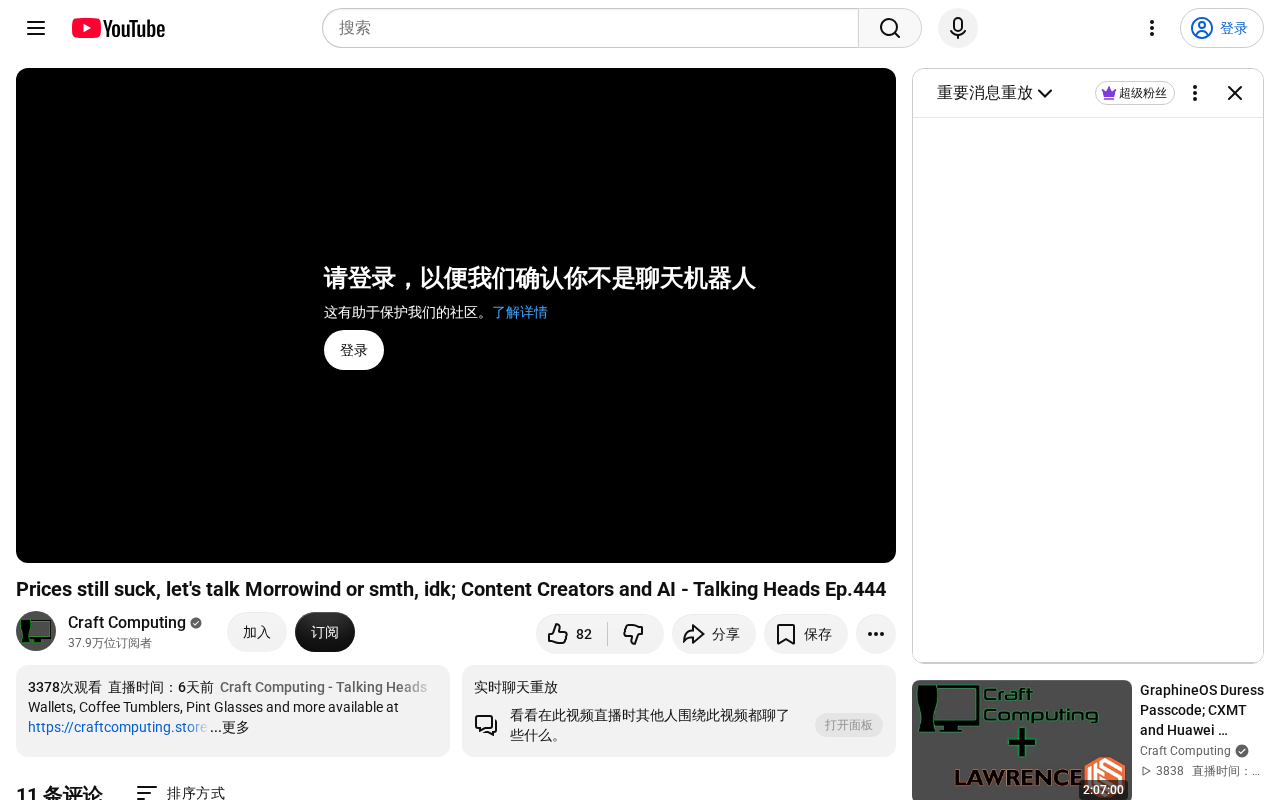
In episode 444 of the tech podcast Talking Heads, host Jeff (Craft Computing) and guest Rhett dive deep into a topic that recently sparked heated debate: When YouTuber Hank Green was accused of using AI, what red line was actually crossed? What appears to be a discussion about one person's controversy actually reveals a deeper dilemma facing the entire content creation industry — where the boundaries of AI tools lie, and how trust between creators and their audiences is being redefined.
The Hank Green Incident: A Crisis of Trust Sparked by a Single Phrase
The trigger seemed trivial. Well-known YouTuber and novelist Hank Green, during an hour-long live conversation, uttered the phrase "I appreciate the pushback." This happens to be a textbook response pattern of large language models when corrected by users — as the host put it, it has become the "canary in the coal mine" of the LLM era, a signature phrase capable of setting off alarms.
Facing the accusation, Hank Green issued a remarkably candid apology. He acknowledged: "I did use ChatGPT for script research, and looking back at the video, I can sense a certain AI flavor to it. So it's fair to say I leaned too heavily on the generated notes." At the same time, he clarified that the controversial phrase wasn't in his notes or script — it was an off-the-cuff response to his guest's pushback.
Host Jeff offered a sharp observation: the real issue wasn't whether Hank Green said that phrase, but that the audience's expectations of his "persona" were shattered. Hank Green had long positioned himself as relatively anti-AI, producing in-depth videos about data center water consumption and AI circular funding schemes. So what fans felt was closer to a sense of "betrayal."
The Boundaries of AI-Assisted Creation: A Line No One Can Define
The most valuable part of the discussion was Jeff's incisive breakdown of YouTube's own AI policies. He demonstrated live the extensive AI tools built into YouTube Studio:
- Brainstorming video ideas: Feeding user comments and video titles to Gemini to automatically generate new video concepts
- Comment summaries: Automatically summarizing all comments 24 hours after a video is published
- Data analysis interpretation: A "Catch me up on this video" button that uses AI to interpret backend analytics
- Music generation: Creators can generate 60-second looping background music
Jeff's central question cuts right to the heart of the matter: If using AI for research, note-taking, and scriptwriting is acceptable, but having a real person appear on camera and speak those words is not, where exactly is the line? YouTube's official policy requires AI labeling for content that is "meaningfully altered or generated to be realistic," but this definition is riddled with contradictions — it requires labeling AI-generated music (which isn't realistic content) but doesn't require labeling images of yourself composited into a fantasy world (because it's "unreasonable but not realistic"). Do beauty filters count as significant modification? Does using Corridor Key (an AI tool) for green screen keying count as AI assistance?
Jeff was candid about his own AI use while drawing clear boundaries: the script for his main video content is always his own writing — no compromise; but for ad reads, research sourcing, and structured notes, he's willing to use AI to boost efficiency. He emphasized that using AI to find research papers isn't wrong — what's wrong is failing to verify whether the papers actually exist or say what the AI claims they say. This is exactly the lesson from the legal profession's encounters with AI "hallucinations" fabricating case citations.
Creator Trust: The Only Currency in This Industry
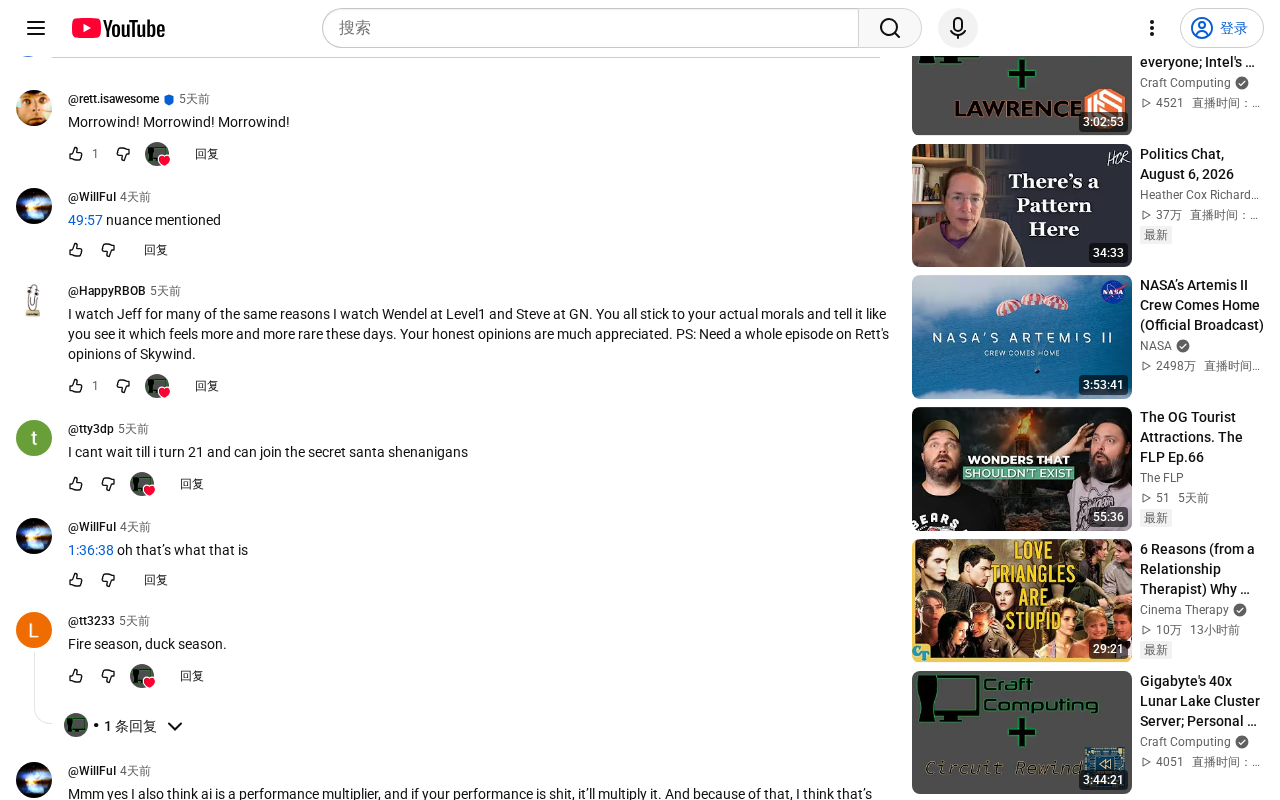
The core point both hosts returned to repeatedly is this: the only currency a creator has in this industry is the trust between them and their audience. Rhett admitted that part of the reason he maintains an anti-AI stance is precisely so that no one will one day question whether he used AI — he hopes his years of publicly criticizing AI will serve as a verifiable form of "credit endorsement."
Interestingly, AI is eroding the basic trust between people. As audience member Vince pointed out in the chat, the phrase "I appreciate the pushback" was used by PR coaches to fill time long before AI existed. Yet now we suspect someone of using AI based on an everyday expression. Jeff also shared his own experience in the creative space — he even wonders whether the feedback he receives on his work has been fed to AI and turned into a generic response.
The hosts also brought up a psychological concept called "echolalia" — the unconscious repetition of words and phrases one has heard. Even if Hank Green didn't directly use AI for his script, heavy use of AI-assisted tools could subtly influence his phrasing and thought patterns. This raises an even more concerning question — when everyone relies on AI, can we still develop experienced, seasoned professionals?
Double Standards: Why the Moral Bar for Creators Is So High
In the second half of the discussion, Jeff launched into a powerful and pointed rant. He questioned why content creators are placed under a moral microscope while others face no constraints:
"Do you think Jane Fonda actually eats Activia yogurt every day? Do you think Shaq has Ring cameras all over his house? Why is my bar this low while the bar for those billionaires is this high?"
He pointed out that ESPN can let an entire sports league be sponsored by DraftKings (a sports betting company) without anyone batting an eye, but if Jeff takes a mobile game ad, he gets criticized for "supporting pay-to-win traps." Even more ironic: as a journalist, he's legally prohibited from buying tech stocks (to avoid insider trading suspicion), while members of Congress can openly hold NVIDIA shares.
Jeff also clarified a key fact: NVIDIA, Intel, and AMD never pay him a single cent. The review units he receives don't belong to him — they can't be sold or given away. That expensive RTX 5090 is sitting on the floor behind him right now — "it's worthless to me." The reason these companies keep inviting him back is precisely because he dares to tell the truth, not because he's a bootlicker.
The Data Center Debate: The Community Cost of AI Infrastructure
The discussion ultimately extended to the social costs of AI infrastructure. Jeff used his own city of Salem, Oregon as an example: the local city council signed a non-disclosure agreement (NDA) with a California data center company, prohibiting disclosure of deal terms before the formal vote. Community residents could only weigh in at the last minute.
What do these data centers promise? A mere 75 jobs (most filled by out-of-towners), while occupying the city's largest industrial site, receiving tax breaks, driving up residents' electricity bills, and lowering the water table. Jeff made a point that strikes at the core of the issue:
"If any company said, we earn $20 billion a year from this land, but we'll give $2 billion back to the community, no small town would turn that down. The problem is, what they're actually saying is — we'll bring in 75 jobs from out of town, and then drive up the cost of everything around you, because we're taking the vast majority of the value."
He made it clear: if data centers were willing to pay fair taxes, hire local workers, avoid depleting water resources, and even give residents free electricity, opposition would be far smaller. The real issue has never been the technology itself, but the extreme imbalance in how benefits are distributed — profits are extracted while communities bear the costs.
Staying Honest in an Era Without Clear Answers
This discussion ultimately didn't arrive at a simple "AI good" or "AI bad" conclusion. As Jeff put it, the black-and-white labels of "pro-AI" and "anti-AI" are themselves foolish — reality is far more complex than that.
For content creators, the core issue isn't whether to use AI tools, but how to remain transparent and maintain trust while using them. AI can be a research assistant and an efficiency tool, but it cannot replace a creator's independent thinking and authentic expression. When creators are expected to take instant positions on every issue under the sun while enduring moral scrutiny far exceeding that of celebrities, Jeff's plea rings especially sincere:
"Please give the world a little grace — for those of us who are just trying to do things honestly. The only currency we have is trust."
This is perhaps the question every content creator in the AI era needs to seriously consider: in an environment where tools grow ever more powerful and boundaries grow ever more blurry, how do you hold the line that's truly your own.
Related articles

Amphibious Transforming Drone: Beyond 100x Power Savings, What Are the Real Needs?
Is the amphibious transforming drone just a gimmick? Starting from the 100x power difference of the M4 Morphobot, explore real application scenarios and thesis topic ideas, analyzing boundary conditions where pure drones and pure ground robots both fail.

Warhound Raises $200 Million: Genetically Engineered "War Dogs" Paired with Anduril Gear
Warhound raises $200M, backed by Ben Lamm and Palmer Luckey, to genetically engineer dogs for military and law enforcement use and equip them with Anduril gear. This article analyzes its technology direction, funding logic, and ethical controversy.

Claude API Comes to Google Cloud: IAM Integration and SDK Access Guide
Anthropic hosts the full Claude API on Google Cloud with IAM-controlled permissions and unified billing. This guide covers the Vertex AI and Anthropic-hosted entry points, IAM role configuration, and SDK access.