AI Translation Struggles with Memes: Human Analysis Remains Irreplaceable
New study using Soviet comedy lines reveals AI can spot culturally loaded difficulties but can't independently generate effective difficulty analyses.
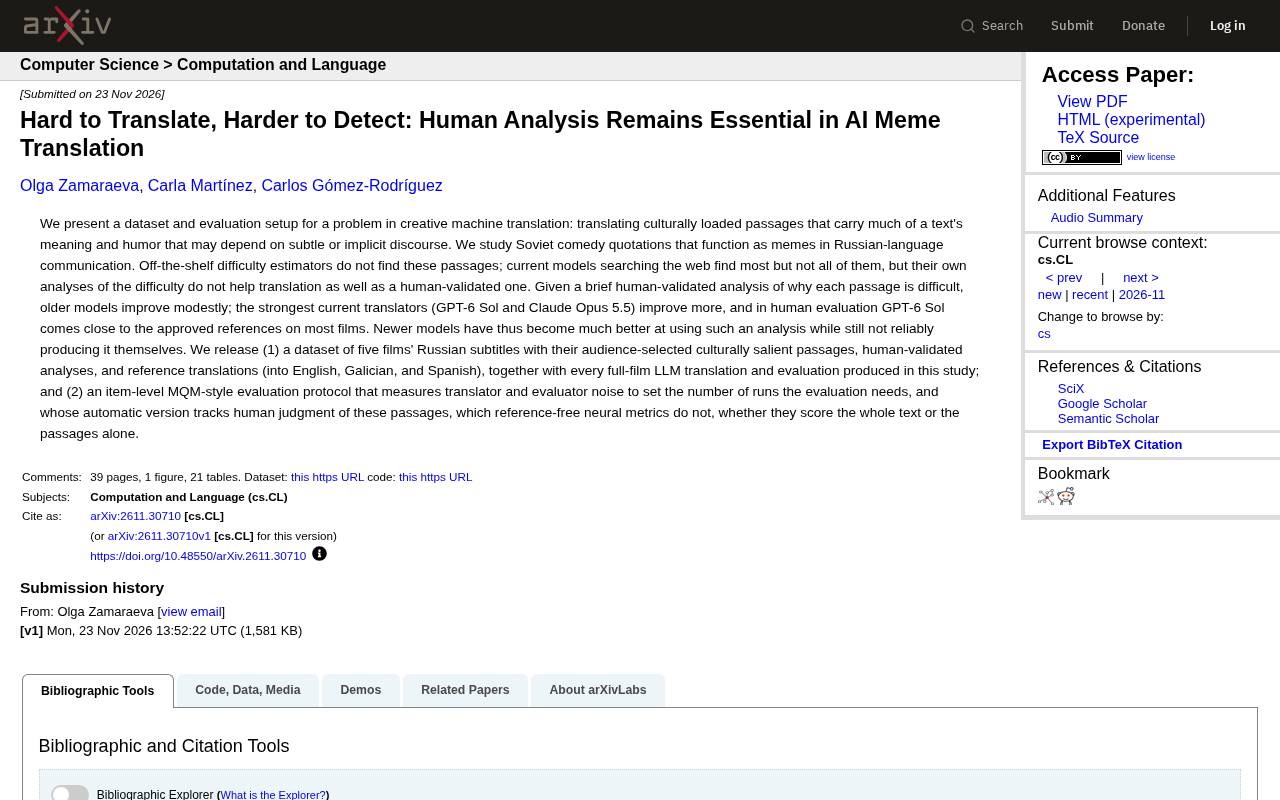
A new study used classic Soviet comedy lines as a test set, building a dataset with subtitles from five films, human-validated difficulty analyses, and multilingual reference translations to systematically examine machine translation on culturally loaded segments. Off-the-shelf difficulty estimators cannot automatically locate these segments; web-search-capable models find most difficulties but their self-generated analyses offer limited help. With brief human-validated analyses, older models improve slightly, while GPT-6 Sol and Claude Opus 5.5 improve more, the latter nearing reference translations on most films. The study also releases a segment-level MQM-style protocol: the automated version tracks human judgments, unlike traditional reference-free neural metrics. Conclusion: new models excel at leveraging human analyses but cannot reliably generate them, so the human diagnostic step cannot be skipped.
Humor and cultural memes have always been treacherous waters for machine translation. A new study using Soviet comedy lines as a test set reveals the true state of current AI when it comes to identifying and translating culturally loaded segments: models can find most of the difficult passages, but they cannot produce effective difficulty analyses the way humans can — and that analysis is precisely what improves translation quality.
Why Are Soviet Comedy Lines Such a Tough Nut to Crack?
In Russian communication, classic lines from Soviet comedies are often used as memes, carrying the humor and deeper meaning of the text. These segments are heavily culturally loaded, and the humor often depends on subtle or implicit discursive context. The research team built a dedicated dataset for this purpose, containing Russian subtitles from five films, culturally salient segments selected by viewers, human-validated difficulty analyses, and reference translations in English, Galician, and Spanish.
The challenge with this kind of translation is that while the literal meaning is easy to transfer, making target-language readers feel the same punchline requires the translator to understand the cultural context, era-specific background, and linguistic puns behind the lines. Machine translation models typically lack this kind of "cultural intuition."
Culturally loaded segments is a term in translation studies referring to text passages whose meaning depends heavily on a specific cultural background, historical context, or shared group memory. The difficulty of such segments lies not in vocabulary or grammar, but in the fact that their meaning cannot be derived from the literal text alone — readers need to share a set of "cultural presuppositions" to decode them. Soviet comedy lines are a textbook example: a single line may simultaneously contain satire of the planned-economy era, parody of a particular bureaucratic archetype, and a Russian phonetic pun — three layers stacked to create the joke. For readers unfamiliar with that cultural context, even if every word is translated correctly, the humor may be completely lost. Therefore, the translation quality of culturally loaded segments often cannot be measured by literal fidelity; instead, one must assess whether target-language readers achieve a reception effect similar to that of source-language readers.
MQM (Multidimensional Quality Metrics) is a widely used framework for translation quality assessment that classifies translation errors by type (e.g., accuracy, fluency, terminology, style) and severity, and supports segment-level annotation. Unlike traditional holistic scoring, MQM-style assessment requires evaluators to judge each segment for whether a problem exists, what category it falls into, and how severe it is, producing finer-grained and more reproducible quality data. The framework was originally used for quality management in the professional translation industry and has been introduced into machine translation evaluation research in recent years. The advantage of segment-level protocols is that they can pinpoint specific difficulties rather than giving only a vague overall score — which aligns closely with the assessment needs of culturally loaded segments, since problems tend to concentrate in a small number of key sentences.
AI Can Identify Difficulties but Can't Explain What Makes Them Hard
The study found that off-the-shelf difficulty estimators cannot automatically locate these segments, and while current web-search-capable models can find most of the difficulties, the difficulty analyses they generate themselves are far less helpful for translation than human-validated analyses.
In other words, the model knows "this passage might be problematic" but cannot accurately explain "where the problem lies and why it's difficult." When models were provided with a brief human-validated analysis (explaining why each segment is hard to translate), older models showed a small improvement in translation quality; the strongest current translators (GPT-6 Sol and Claude Opus 5.5) improved more noticeably. In human evaluation, GPT-6 Sol's performance on most films was already close to officially recognized reference translations.
This reveals a key trend: the new generation of models has made significant progress in leveraging human analyses, but they still cannot reliably generate such analyses.
Difficulty estimators are a class of models or methods specifically designed to predict the translation difficulty of text, typically scoring based on linguistic features of the source text (such as sentence length, proportion of rare words, syntactic complexity) or uncertainty signals from the translation model itself (such as output probabilities or attention distributions). Their goal is to identify in advance which segments may be difficult to translate, so that more resources can be allocated or human intervention triggered. However, most such estimators are designed for general linguistic difficulty and are not sensitive to the dimension of "cultural loading" — a passage may be simple in vocabulary and syntax yet extremely difficult to translate because of cultural memes. The fact that off-the-shelf difficulty estimators in the study could not automatically find culturally loaded segments demonstrates a mismatch between general difficulty signals and cultural difficulty. This also explains why human-validated difficulty analyses are needed: humans can identify dimensions that estimators cannot capture, such as "there's a meme here" or "this pun can't be translated literally."
Reference translations in human evaluation typically refer to translations produced by professional translators and reviewed for approval, serving as a benchmark for assessing the quality of other translations. In this study, reference translations came from official or approved versions and were used to measure the relative level of model translations in human evaluation. It should be noted that reference translations are not an absolute standard — translations of culturally loaded segments often admit multiple reasonable strategies (e.g., domestication, foreignization, annotation), and the reference translation represents only one of these choices. Therefore, when the study reports that a model "approaches the reference translation," it should be understood as a narrowing of the quality gap relative to the reference under that evaluation protocol, not that the model has fully mastered cultural translation competence.
Evaluation Protocol: How to Measure Noise in Translation and Assessment
In addition to the dataset, the study also released a segment-level MQM-style evaluation protocol. The protocol determines the number of runs needed for evaluation by measuring noise between translators and evaluators, and provides an automated version. Experiments show that the automated version can track human judgments on these segments, whereas traditional reference-free neural metrics (whether scoring the full text or only the target segments) cannot.
This means that relying on automatic metrics in the evaluation of culturally loaded segment translations may lead to misleading conclusions. The research team publicly released the complete LLM translations and evaluation results for all five films, providing a reproducible benchmark for future research.
Why Is Human Analysis Still a "Necessity"?
Two implications can be drawn from this study. First, AI translation still has clear shortcomings when it comes to cultural memes: it can retrieve and imitate, but lacks a deep understanding of the mechanisms of humor. Second, human-validated difficulty analysis is a high-value signal — models can learn to use it, but have not yet learned to produce it independently.
For content creators and localization teams, this means that in translation tasks involving cultural memes, puns, or era-specific background, the human translator's analysis step should not be skipped. AI can serve as a powerful assistive tool, but the step of "diagnosing difficulties" still requires human oversight.
The study also reminds us that when evaluating this kind of translation, we cannot rely solely on automatic metrics — they may fail to capture the humor and nuance that human readers actually care about.
One-line Summary
A new study using Soviet comedy lines as a test set reveals that AI can identify culturally loaded difficulties but cannot independently generate effective difficulty analyses.
Paragraph Summary
A new study used classic Soviet comedy lines as a test set, building a dataset containing subtitles from five films, human-validated difficulty analyses, and multilingual reference translations to systematically examine machine translation performance on culturally loaded segments. The study found that off-the-shelf difficulty estimators cannot automatically locate these segments, and while web-search-capable models can find most difficulties, their self-generated difficulty analyses are of limited help for translation. When brief human-validated analyses were provided, older models showed small improvements in translation quality, with GPT-6 Sol and Claude Opus 5.5 improving more noticeably — the latter approaching reference translations on most films. The study also released a segment-level MQM-style evaluation protocol, showing that the automated version can track human judgments while traditional reference-free neural metrics cannot. The conclusion: the new generation of models excels at leveraging human analyses but still cannot reliably generate them, and the human translator's diagnostic step cannot be skipped.
Related articles

GLM-5.4 vs. Opus and Neon: How Far From the Top?
No official benchmarks for GLM-5.4. Based on a YouTube deep test and developer trials, we analyze its gap vs. Claude Opus 5.5 and Gemini Neon, the speed bottleneck from marathon-style thinking, and its real position in enterprise agent scenarios.

From Gobbler to Sloppy Joe: The Hit-Making Playbook of a New Jersey Deli Institution
NYT Cooking visits Milburn Deli in New Jersey to break down the hit logic behind the Gobbler turkey sandwich and the local Sloppy Joe: bread sliced to order, house-made sauces, a group shout culture, and customer co-creation behind six locations.
In the Age of AI Programming, When Do You Still Need to Write Code by Hand?
Is handwritten code still valuable once AI programming agents are widespread? This article outlines three scenarios where handwriting is essential—learning, style development, and prototype validation—and provides a division-of-labor framework between AI and humans to help developers balance efficiency and skill growth.