AI Visibility Tool: Check Whether ChatGPT Will Recommend Your Brand
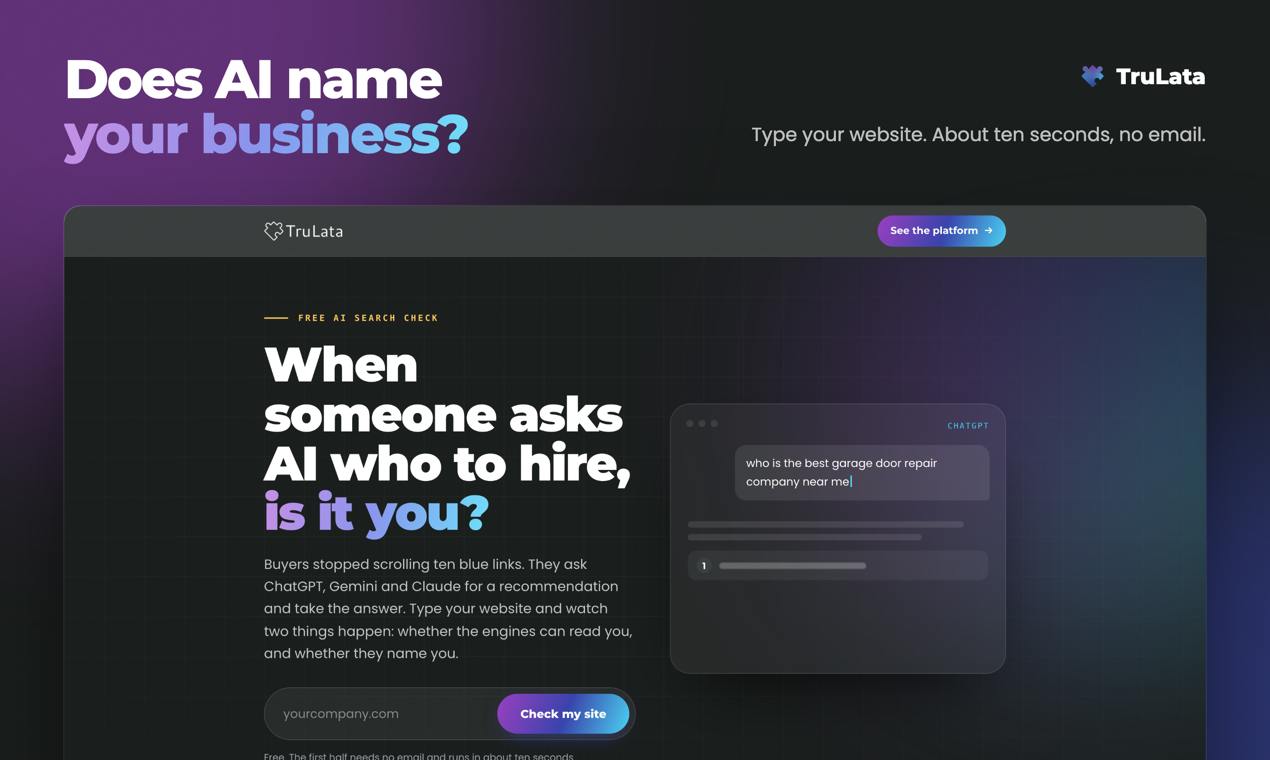
TruLata launches AI Visibility, a tool that diagnoses brand visibility in AI answers in ten seconds.
AI Visibility by TruLata is a new tool that helps brands assess their exposure in AI assistant answers. Users enter a URL and get a diagnosis in about ten seconds, checking whether AI crawlers can read the site and listing fix recommendations, with no registration or email required. It also simulates six real buyer questions to see whether AI engines mention the brand, and notably excludes blank answers from being counted as misses to avoid misjudgment. The platform offers weekly continuous monitoring across nine AI engines to track brand visibility trends. The product received 88 votes on Product Hunt and ranked 16th, reflecting emerging demand for AI visibility, though its sample size, multi-engine data methodology, and non-technical factors behind brand recommendations remain to be verified.
When buyers no longer open a search engine but instead ask ChatGPT directly "which service provider should I choose," can your brand still appear in the answer? AI Visibility by TruLata, a new product on Product Hunt, tries to answer this question: enter your URL and within about ten seconds you can see whether AI engines can understand your website, along with specific fix recommendations.
From Search Rankings to "AI Nominations": The Criteria for Brand Exposure Have Changed
For the past decade, the core KPI for marketing teams has been search ranking. But as AI assistants increasingly take on the role of information intermediaries, buyers' decision paths are being rewritten—they pose real needs to ChatGPT, Gemini, and Claude, then directly adopt the brands mentioned in the answers. This means that even if a website has excellent SEO, if AI models cannot read its content or it is overlooked in answers, it is effectively invisible in the new generation of traffic entry points.
AI Visibility by TruLata targets exactly this anxiety. Its core selling point is straightforward: no registration, no email required—just enter your website address, and in about ten seconds you get a diagnostic telling you whether AI engines can read your site, with every issue that needs fixing listed one by one. This "zero-barrier self-check" design lowers the psychological cost for brand owners encountering the concept of AI visibility for the first time.
Generative Engine Optimization (GEO) is the key concept for understanding this shift. Traditional SEO focuses on a webpage's ranking in search result lists, while GEO focuses on whether a brand or piece of content is cited, recommended, or mentioned by large language models when generating answers. AI assistants typically obtain external information through Retrieval-Augmented Generation (RAG): they first convert the user's question into a query, retrieve relevant webpage snippets, then synthesize an answer based on those snippets. Therefore, whether a website can be smoothly crawled by AI crawlers, whether content is presented in a clear, structured way, and whether it contains authoritative statements that can be cited directly determine whether a brand can enter the model's "candidate answer pool." GEO's optimization target is not keyword density but the factual density, verifiability, and semantic clarity of content.
Ten-Second Diagnosis + Six Real Buyer Questions: How to Use the Tool
The product experience has two layers. The first layer is a technical readability check: the tool evaluates whether AI crawlers and models can properly parse your website content and provides clear fix guidance for the issues it finds. For a site dragged down by JavaScript rendering, misconfigured robots protocols, or missing structured data, this step often exposes overlooked weaknesses.
The second layer is closer to real-world scenarios: the tool has AI engines answer six questions simulating real buyer intent, observing whether your brand is mentioned. One detail: TruLata made a nuanced choice in its scoring logic—blank answers are not counted as "misses." This may seem minor, but it actually affects the accuracy of the diagnosis: a model occasionally refusing to answer or returning an empty result does not mean it considers your brand irrelevant, and conflating the two would mislead optimization direction.
Robots protocols and structured data are two core elements in the technical readability check. robots.txt is a text file in a website's root directory that tells crawlers which paths can be crawled and which should be avoided; if misconfigured, it may inadvertently block AI crawlers (such as GPTBot and ClaudeBot), preventing models from accessing site content. Structured data (such as Schema.org markup in JSON-LD format), meanwhile, annotates page entities in a machine-readable way—company name, service type, price range, frequently asked questions, and so on—helping models accurately understand "what this page is about and who provides it." For sites that rely on JavaScript dynamic rendering, if key content is not server-side rendered or pre-rendered, AI crawlers may see only an empty shell page—which is the typical reason many websites are "visible to humans but unreadable to AI."
Weekly Monitoring Across Nine Engines: From One-Time Checkup to Long-Term Tracking
Beyond the free quick check, the TruLata platform also offers continuous monitoring capability: checks run automatically once a week, covering nine AI engines. For marketing teams, the value of this periodic tracking lies in capturing fluctuations—model updates, changes in competitors' content positioning, and their own website redesigns can all cause brand mentions in AI answers to change. A single snapshot can only answer "how is it now"; weekly monitoring can answer "where is the trend heading."
From a product positioning perspective, it is closer to a brand health dashboard for the AI era than a mere SEO audit tool. The coverage of nine engines also shows that the team does not assume any single model will monopolize user entry points long term.
The randomness of AI answers stems from large models' probabilistic generation mechanisms and sampling parameters (such as temperature). Even with an identical question, the model samples from a probability distribution each time it generates, causing wording, cited sources, and even mentioned brands to vary; there is no memory linkage between different sessions, further amplifying result fluctuations. In addition, model version updates, retrieval index refreshes, and changes in competitors' content all alter answers. Therefore, the result of a single query can only be regarded as one sample, and drawing stable conclusions requires sufficient sample size and time windows. This also explains why weekly, multi-engine continuous monitoring is more informative than a one-time snapshot—it separates signal from noise through repeated observation.
Market Signals and Open Questions
On Product Hunt, the product received 88 upvotes and 16 comments, ranking 16th on the day's leaderboard in the marketing, SEO, and artificial intelligence categories. This result shows that "AI visibility" does indeed hit a pain point for a group of marketing practitioners, but its popularity remains within the scope of a niche tool—still some distance from becoming a marketing staple.
Several questions not yet covered by the product description deserve calm consideration. First, AI answers are inherently random; the same question may yield different results at different times and in different sessions, and whether six questions provide sufficient sampling to support stable brand visibility conclusions is worth users verifying themselves. Second, the tool can diagnose technical issues like "AI can't read the website," but whether a brand is recommended also depends on more complex factors such as content authority and third-party source citations; a fix list can address the former but may not move the latter. Third, the specific implementation and data methodology of multi-engine monitoring have not been disclosed in detail by the official team, and teams with high standards for data rigor need further testing.
Who Should Pay Attention to This Type of Tool
The most direct beneficiaries are marketing and SEO teams that need to track brand online voice, especially B2B service providers that rely on content-driven customer acquisition—their customers are precisely the ones most likely to ask AI assistants "who should I choose." For indie developers and small brands, the free quick check requiring no email lowers the cost of trial and error and can serve as a starting point for understanding their current AI visibility.
More broadly, the emergence of such tools is itself a signal: AI assistants are becoming a new intermediary layer between brands and buyers, and the measurement, optimization, and competition around this intermediary layer have only just begun.
One-line Summary
TruLata launches AI Visibility, a tool that diagnoses brand visibility in AI answers in ten seconds.
Paragraph Summary
AI Visibility by TruLata is a new tool that helps brands assess their exposure in AI assistant answers. After users enter a URL, they receive a diagnosis in about ten seconds that checks whether AI crawlers can read the website and lists fix recommendations, with no registration or email required. The tool also simulates six real buyer questions to see whether the brand is mentioned by AI engines, and notably excludes blank answers from being counted as "misses" to avoid misjudgment. The platform offers continuous monitoring once a week covering nine AI engines, supporting tracking of brand visibility trends. The product received 88 votes on Product Hunt and ranked 16th, reflecting that demand for AI visibility is emerging, but its sample size, multi-engine data methodology, and the non-technical factors behind brand recommendations remain to be verified.
Related articles
Daybreak Red Deployment Guide: A Reference Architecture for Supervised Security Investigation
A breakdown of the Daybreak Red reference architecture: security control design, deployment configuration process, and runtime monitoring for supervised security investigation.
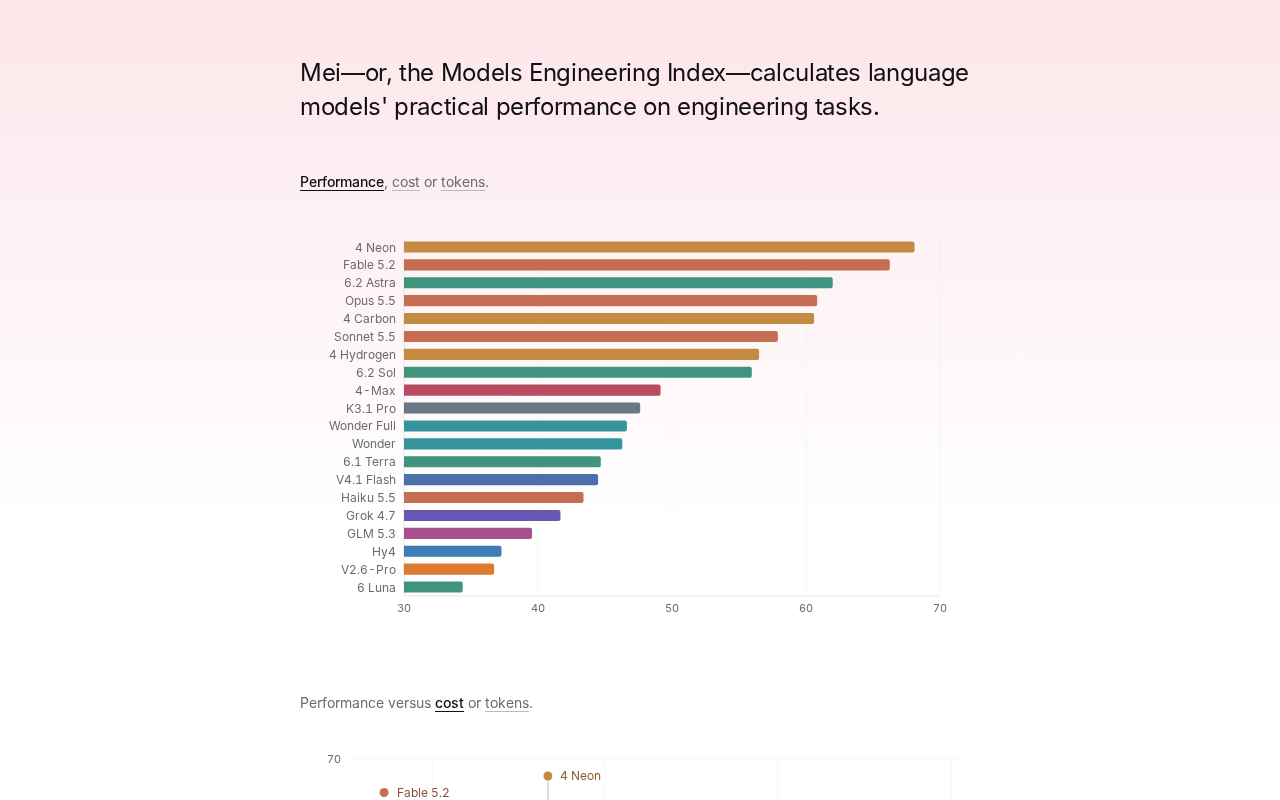
Gemini 4 Neon Tops the Models Engineering Index
Gemini 4 Neon tops the Models Engineering Index, sparking Hacker News debate over ranking credibility and evaluation methods. Here's what it means for developers.

Apple's Self-Developed AI Agent: An Agent That Can Operate Your Mac Is Coming
Apple is reportedly developing an AI agent that can operate a Mac, targeting Meta Muse, Claude, OpenAI Dots, and others. This article analyzes Apple's system-level advantages, the competitive landscape, and likely rollout paths in the agent race.