AI Voice So Realistic It's Unsettling: Is Dessa a Demo or the Real Deal?

Reddit debates a Dessa AI voice demo so realistic it's suspected to be a human recording.
A Reddit AI voice demo sparked heated discussion, with users shocked by its realism and saying 'we're cooked,' while others suspect it's a human recording or an elaborate scam. In the demo, the AI naturally says 'Wolfie's fine' and follows with 'he's smart' in seamless intonation, while 'work is tough' carries a tired sigh, giving some listeners goosebumps. Users speculate Dessa isn't an OpenAI project but belongs to block.xyz, with a possible technical lineage of Moshi to Sesame to Dessa, though unconfirmed. The community remains wary of commercial demos, stressing 'release it first,' while some say they've talked to AI agents and confirm 'it's real.' The debate reflects AI voice approaching or even crossing the uncanny valley.
Recently, an AI voice demo on Reddit sparked intense discussion. Users marveled, "Crazy realistic now. We're cooked," but others questioned whether it's just an elaborate scam until Dessa is officially released.
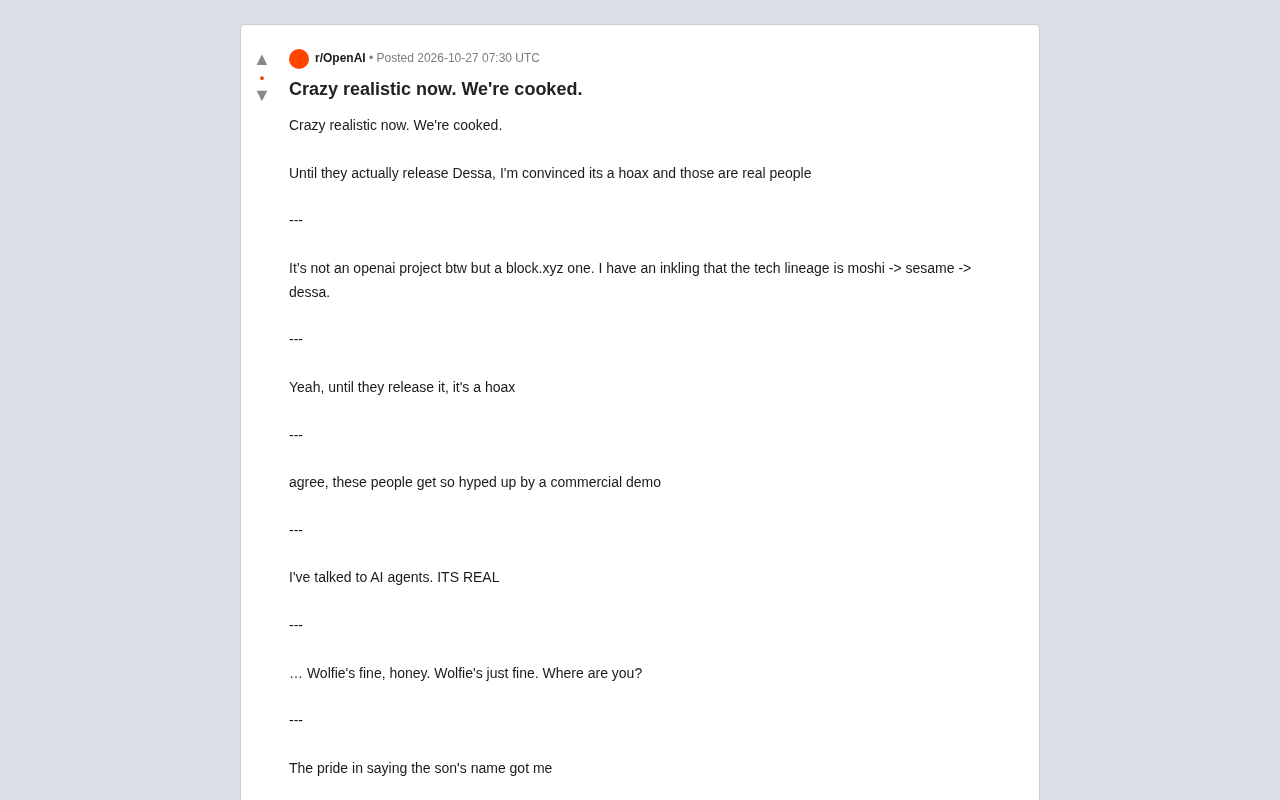
The Demo: From "Wolfie's Fine" to "Work Is Tough"
What broke people was a conversation. The AI, simulating a family scenario, said "Wolfie's fine, honey. Wolfie's just fine. Where are you?" and then seamlessly followed with "he's smart," with the intonation flowing from one line to the next without a hitch. One user commented, "The moment it proudly said its son's name, I got goosebumps."
Another line, "Work is tough," was also repeatedly mentioned—it sounded too much like a real person, even carrying a tired sigh. Such details convinced some that "this is a real human recording," while others retorted, "Those dazzled by commercial demos should wait until the actual release."
Technical Lineage: Moshi → Sesame → Dessa?
A user pointed out that Dessa is not an OpenAI project but belongs to block.xyz. They speculated its technical lineage might be "moshi -> sesame -> dessa." While this claim hasn't been officially confirmed, both Moshi and Sesame are indeed projects that have recently drawn attention in real-time voice interaction. If Dessa stands on their shoulders, its realism is unsurprising.
Moshi is a full-duplex real-time voice dialogue model released by French AI company Kyutai in 2024. Unlike traditional turn-taking voice assistants, Moshi can listen and speak simultaneously, enabling natural interruptions, backchanneling, and emotional responses, with end-to-end latency as low as about 200 milliseconds. It uses a unified speech-text modeling architecture that encodes audio directly into discrete tokens, bypassing the traditional three-stage pipeline of "speech recognition → text generation → speech synthesis," which is a key reason its sound is closer to human.
Sesame is a conversational voice model (such as the CSM series) launched by Sesame AI, a company founded by the former Oculus team. It also emphasizes low-latency, emotionally rich, and prosodically varied speech generation and gained wide attention due to a demo released in early 2025—many listeners said its voice was hard to distinguish from a real person. Sesame's core idea is to treat speech as a generation task that requires understanding context and conversational intent, rather than simple text-to-speech. If Dessa indeed continues the technical路线 of Moshi and Sesame, its realism is traceable.
Skepticism and Anticipation Coexist
"Until they actually release Dessa, I'll consider it a scam—those are real people." This view is not alone in the comments. Many have been burned by various "cry wolf" demos and remain wary of commercial demos. But others said they have already conversed with AI agents, "IT'S REAL."
Whether Dessa ultimately impresses or falls from grace, this discussion reflects the same fact: the "uncanny valley" of AI voice is being filled. When machines can accurately replicate the hesitation, pride, and fatigue in human intonation, we may truly need to rethink the definition of "real."
The Uncanny Valley theory was proposed by Japanese roboticist Masahiro Mori in 1970, originally describing human emotional responses to humanoid robots: as robots become more similar to humans but not quite identical, affinity drops sharply, causing discomfort or even fear; only when similarity crosses a certain threshold and becomes nearly indistinguishable does affinity rise again. This theory has since been widely used to evaluate speech synthesis, virtual humans, and animated characters. The article's statement that "the uncanny valley is being filled" refers to AI voice approaching human levels in details such as prosody, pauses, and emotional fluctuations, significantly reducing the past sense of "human-like yet not human" incongruity. This also explains why listeners waver between awe and doubt—when synthesized speech is realistic enough, people find it harder to believe it comes from a machine.
Related articles

LLM Application Development: A High-Paying Career Guide for Ordinary People
LLM application development offers fresh graduates up to 35K/month, with SP offers reaching 600K. This article explains the core skills, how to break in, and how ordinary people can seize AI opportunities through learning by doing.

Say Goodbye to AI Influencer Faces: A Complete Guide to Creating Visual Assets for AI Comic Dramas from Scratch
Bilibili creator shares a full workflow for zero-basics AI comic drama visual assets: use Doubao Work skills with script-first, visual references, and real-person texture to escape AI influencer faces, then lock character and scene consistency with asset sheet layouts, weapon detail images, scene nine-grids, and cinematic color palettes.

The AI Production Pipeline Behind Great Videos: From Research to Agent Validation
AI video production isn't just a model race. This article breaks down a transferable four-step pipeline: researching professional workflows, organizing a skill checklist, configuring agents, and experimental validation—and explains how general-purpose LLMs like DeepSeek can replace paid tools to run the entire process.