AI Weekly: DeepSeek's New Performance Baseline, Gemini 4 Cuts Costs 40%, Kling 4.0 Single-Shot Video
DeepSeek and Gemini reset cost-performance ratios as agent pipelines accelerate toward end-to-end closed loops.
This week's AI industry shifted from model capability competition to engineering efficiency competition. DeepSeek V4.1 Flash L017 raised DDSWE pass rates to 77% at the same unit price, with per-task costs around 1.3 yuan, pushing the Pareto frontier. Gemini 4 Argon fully opened with 97.5% on ARC AGI 3, per-task costs at only 60% of GPT-6 Asklra. Anthropic commercialized Code Review while restructuring its internal review process. NVIDIA's 128GB unified memory laptops went on sale, Microsoft's Maya 300 chip entered mass production, and Kling 4.0 achieved 30-second single-shot video.
This week in AI, the main themes remain "cost" and "engineering." DeepSeek has redrawn the performance-cost baseline with its V4.1 Flash L017 version, Gemini 4 Argon has pushed complex task costs down by 40%, and Kuaishou's Kling 4.0 has raised the ceiling for video generation shot length to 30 seconds. Meanwhile, Anthropic's commercial Code Review, NVIDIA's 128GB hardware going on sale, and Microsoft's in-house inference chip entering mass production all point to the same trend: agent pipelines are moving from experimentation to end-to-end closed loops.
DeepSeek 1017: Same Low Price, Performance Baseline Pushed Further Down
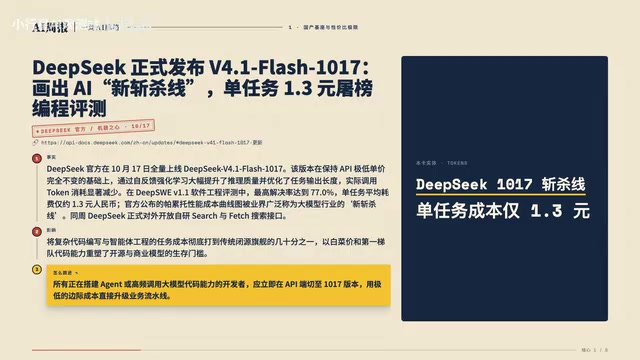
DeepSeekAd released the V4.1 Flash L017 version this week. The most notable aspect isn't any single benchmark score, but that output efficiency and latency were significantly optimized while maintaining the exact same low unit price. According to a breakdown by Bilibili creator Asteroid EI Weekly, this version achieves a 77% pass rate on DDSWE programming tasks, with an average cost of just 1.3 yuan per task.
The significance of this number lies in the shifting of the Pareto frontier. The industry has traditionally traded off between "performance" and "cost," but DeepSeek is trying to prove both can advance simultaneously. In zero-baseline full project and game development scenarios, this version shows overwhelming advantages. For developers, this means the switching cost for engineering pipelines is further reduced, and the 1.3-yuan-per-task calculation will directly change how small and mid-sized teams schedule their projects.
Pareto frontier is a core concept in economics and multi-objective optimization, referring to the set of states where no objective can be improved without harming another under resource constraints. In AI model evaluation contexts, "performance" and "cost" are typically treated as two dimensions, plotted as a scatter diagram, with the envelope curve in the upper-left being the Pareto frontier. The industry has generally assumed that stronger models incur higher inference costs, making the frontier an upward-sloping curve. If DeepSeek can improve pass rates while maintaining unit price, it effectively shifts the entire frontier toward the upper-left, meaning higher performance for the same budget or lower cost for the same performance. This kind of shift is more structurally significant than any single benchmark score because it changes the baseline for developers' cost-benefit calculations.
DDSWE (DeepSeek Software Engineering) is a benchmark used by DeepSeek to evaluate model programming capabilities, typically including tasks such as building complete projects from scratch, fixing code defects, and implementing specified features, requiring models to output runnable code in real engineering environments. Its pass rate measures the proportion of tasks a model completes in one attempt, which is closer to actual development workflows than traditional code completion evaluations. A 77% pass rate means the model can independently complete most standard tasks, with the remainder still requiring human intervention—this directly determines the proportion of human review and rework costs in agent pipelines.
Gemini 4 Argon: Costs Slashed 40%, Engineering Agents Land
Google has officially opened Gemini 4 Argon to all subscribers, positioned squarely at complex engineering and scientific research. On the ARC AGI 3 evaluation, the model scored 97.5%. More critically, third-party testing data shows: per-task completion cost is only 60% of GPT-6 Asklra, equivalent to roughly a 40% cost reduction.
Google simultaneously disclosed a landmark case—using it hands-free to complete optimization of 200,000 lines of Python code, demonstrating the practical viability of engineering agent pipelines. According to analysis from a YouTube channel covering the same launch event, this case is seen as an early signal of "model as engineering team." The realignment of cost structures with task complexity is shifting enterprise migration from observation to calculation.
ARC AGI (Abstraction and Reasoning Corpus for Artificial General Intelligence), proposed by François Chollet, is an evaluation suite designed to measure general reasoning ability. Unlike traditional exam-style benchmarks, its problems provide a small number of examples and require models to induce abstract rules and apply them to new scenarios, emphasizing sample efficiency and generalization rather than memorization or pattern matching. The ARC AGI 3 evaluation typically refers to multiple subsets or versions of this benchmark; high scores indicate the model can perform effective reasoning under unfamiliar rules, seen as an important signal toward general intelligence. A score of 97.5% suggests the model is nearing saturation on abstract induction tasks, but the benchmark itself is limited in scale—high scores don't directly equate to real engineering capability and must be judged alongside cost and real-world cases.
Engineering agent pipelines refer to automated systems that embed large models throughout the entire software engineering workflow, covering requirements decomposition, code generation, testing, review, and integration. Unlike the traditional "model as tool" approach, pipelines emphasize multi-step orchestration: the model not only writes code but also calls external tools like compilers, testing frameworks, and version control, automatically retrying or rolling back on failure. The core challenges are error accumulation over long chains and cost control; a 40% reduction in per-task cost significantly changes the economic feasibility of pipelines, enabling enterprises to move from pilot programs to scaled deployment.
Anthropic Code Review Goes Commercial: Review Mechanisms Restructured
Anthropic has officially launched its Code Review feature for organizational customers, while also disclosing changes to its internal R&D workflow. According to the company, after Claude Code wrote nearly 90% of the code across its entire project, the R&D process has shifted from "humans writing code" to "humans and agents jointly reshaping the review mechanism."
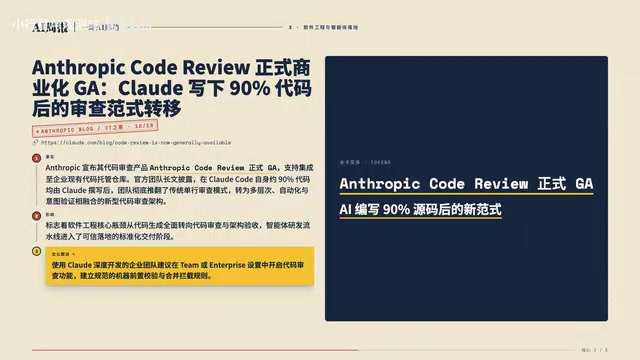
The logic behind this: when agents become the primary producers of code, traditional manual code review quickly becomes a bottleneck. The commercialization of Code Review, combined with OPPO-style assembly points and Festmo-style open strategies, points toward end-to-end agent closed loops. The competitive focus for enterprise engineering pipelines is shifting from "who can write more code" to "who can more efficiently review and integrate agent output."
Code review is a quality gate in software engineering where other developers inspect code changes to find defects, ensure style consistency, and spread knowledge. Traditional review relies on humans reading diffs, which is time-consuming and grows linearly with code volume. When agents become the primary code producers, the review target shifts from "human colleagues' code" to "large batches of model-generated changes," and manual review quickly becomes a throughput bottleneck. Anthropic's commercialization of Code Review essentially delegates review to models as well: models perform static analysis, logic verification, and risk annotation on model-generated code, with humans only handling flagged high-risk portions. This forms a "generate—review—correct" loop, but also introduces the risk of reviewer and reviewed being from the same source—models may systematically miss their own class of errors—requiring independent evaluation and sampled human review as a backstop.
Hardware and Video Generation: 128GB Local Inference and 30-Second Single-Shot Video
NVIDIA, together with major PC manufacturers, has officially launched the RPX Spark laptop and thin-and-light notebooks. 128GB unified memory makes running 10-billion to 100-billion-parameter models locally a reality, with ecosystem partner software following suit. Meanwhile, Microsoft has officially announced its in-house inference chip Maya 300 and begun large-scale production deployment—tech giants are accelerating their pace to break free from single-source compute dependency.
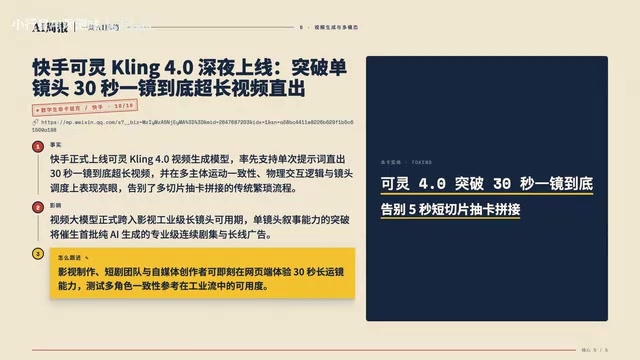
On the video generation side, Kuaishou's Kling 4.0 launched late at night, becoming the first to conquer single-shot 30-second continuous video generation, breaking the industry ceiling of 5-second clips. The all-purpose reference mode supports stable camera movement with multi-character and scene consistency, directly lowering the production barrier for short dramas and commercial advertising.
Unified memory refers to an architecture where the CPU and GPU share the same physical memory pool. In traditional PCs, VRAM and system memory are separate, and large model inference is limited by VRAM capacity—100-billion-parameter models typically require multiple high-end GPUs. Unified memory allows the GPU to directly address 128GB or even larger memory spaces, enabling 10-billion to 100-billion-parameter models to load on a single laptop. The trade-off is that memory bandwidth is typically lower than dedicated VRAM, affecting inference speed, making it more suitable for local development, privacy-sensitive scenarios, and small-to-medium-scale agents rather than high-throughput production services. NVIDIA's RPX Spark matters because it brings this capability down to consumer form factors, lowering the barrier to local inference.
Single-shot continuous video in video generation refers to generating a continuous shot in one pass without editing or splicing, requiring the model to maintain consistency of characters, scenes, and camera movement throughout the entire duration. The industry has generally set a per-clip limit of around 5 seconds because longer durations cause identity drift and visual breakdown. Kling 4.0 extends single shots to 30 seconds, relying on long-sequence attention mechanisms and reference frame constraints to keep the model aligned with initial character and scene features throughout generation. This breakthrough directly affects production workflows for short dramas and advertising: the longer the shot, the less post-production splicing and frame interpolation work is needed, and the closer the generated content is to directly usable footage.
Quick News: Models, Open Source, and Ecosystem
Models and Multimodal: OpenAI released three consecutive internal model calibration reports; ChatGPT gains Chrome tab control; xAI launches third-generation voice model; BPF open-sources lightweight text-to-image model.
Open Source Architecture and Engineering Infrastructure: Meta open-sources 816-billion-parameter model, drawing frequent community response; Reflection open-sources 501-billion model; Anthropic develops in-house version control to replace Git; PyDantic founder questions chart pricing guarantees.
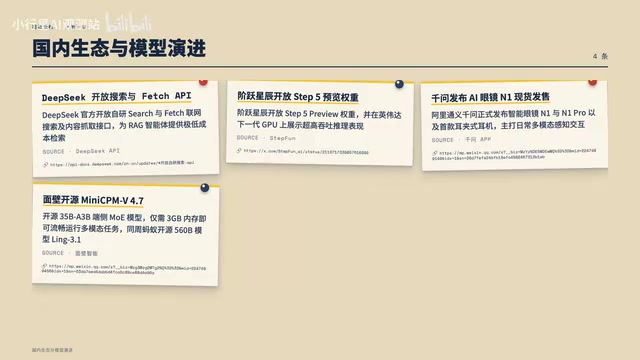
Domestic Ecosystem and Model Research: DeepSeek opens its in-house search API; StepFun opens StepWay; Alibaba's Qianwen first AI glasses go on sale; ModelBest open-sources 35-billion-parameter model.
Agent Applications and Tools: Developer rewrites Aboli suite; Rigor open-sources agent review system; VLLM mechanism optimization; Kimi KZ and Perplexity open-source computer sandboxes.
Business and Capital: CharacterAI sells after bankruptcy; Anthropic Q3 revenue breaks $10 billion; OpenAI faces multiple weeks of pressure; China adds new AI export control list.
Three Things to Watch Next Week
First, how developers switch engineering pipelines under DeepSeek 1017's new baseline will directly reflect in project cost structures. Second, the actual migration rate and real expense changes for enterprises on Gemini 4 Argon will be key to verifying the "40% cost reduction." Third, how Kling 4.0's single-shot continuous video performs in commercial short dramas and film production will determine whether video generation can truly enter production-grade workflows.
From this week's signals, the model capability race is giving way to the engineering efficiency race. Whoever can get agent pipelines running, restructure review mechanisms, and push per-task costs into a reusable range will secure their ticket to the next stage.
One-line Summary
DeepSeek and Gemini reset the cost-performance ratio as agent pipelines accelerate toward end-to-end closed loops.
Paragraph Summary
This week the AI industry's main thread shifted from model capability competition to engineering efficiency competition. DeepSeek V4.1 Flash L017 raised DDSWE pass rates to 77% while maintaining unit price, with per-task costs around 1.3 yuan, pushing the performance-cost Pareto frontier. Gemini 4 Argon fully opened with a 97.5% score on ARC AGI 3, per-task costs at only 60% of GPT-6 Asklra, and a demonstrated case of optimizing 200,000 lines of Python code. Anthropic commercialized Code Review, with nearly 90% of internal code written by Claude Code, restructuring review mechanisms accordingly. On hardware, NVIDIA's 128GB unified memory laptops went on sale and Microsoft's Maya 300 inference chip entered mass production; on video generation, Kling 4.0 achieved 30-second single-shot continuous video. The overall trend points to agent pipelines moving from experimentation to end-to-end closed loops.
Related articles

Linux Kernel's AI Civil War: Anti-AI Activist Elected to TAB, Torvalds Scraps AI Disclosure
Anti-AI activist Laurent Pinchart elected to the Linux kernel TAB as Linus Torvalds scraps AI code disclosure. A rundown of the kernel community's AI civil war, both sides' positions, and the impact on open source.

When Did Paid Childcare Become the Norm? Working Mothers and the Evolution of Childcare
When did paid childcare become the norm? This article traces the evolution from the rise of childcare centers in the 1970s–80s and the 1990s linking of federal subsidies to work requirements, to declining stigma and rising costs, and explores advocates' 25-year effort to catch up with other countries on childcare and paid parental leave.

Red Flags for Product-Market Fit: A Practical Guide from Top VCs and the Superhuman Founder
Investors from Iconiq and Sapphire Ventures and Superhuman founder Rahul Vohra share PMF red flags and practical methods, including the 40% disappointment rule, retention curves, and acquisition costs.