AI Weekly: Stripe Acquires OpenRouter for $8B, Agent Infrastructure Goes Production-Ready

Stripe's $8B OpenRouter deal, Mistral's agentic retrieval, and Anthropic's agent APIs go production-ready.
This week's AI industry focused on three key tracks: Stripe's $8B acquisition of OpenRouter merging token routing with global payment settlement, Mistral launching Agentic Search to replace traditional fixed-chunk RAG with multi-step autonomous retrieval (boosting financial benchmark accuracy from 26.7% to 86%), and Anthropic graduating its agent APIs to GA with accessibility tree-based browser automation. Other highlights include Mojo 1.0 going fully open-source, Alibaba's Qwen UI Agent bridging the sim-to-real gap with 100+ real devices, and Cursor Origin reimagining code hosting for agent collaboration.
This week (August 16–23), the AI industry moved beyond the model parameter arms race, accelerating along three main tracks: commercial integration, retrieval architecture upgrades, and agent infrastructure going production-ready. From Stripe's blockbuster acquisition of OpenRouter, to Anthropic's agent APIs graduating from beta, to Mistral's reinvention of the RAG paradigm—this edition cuts straight to the week's key storylines and unpacks the industry logic behind them.
Stripe Acquires OpenRouter for $8 Billion: The AI Commercial Loop Takes Shape
The biggest capital event of the week was global payments giant Stripe officially announcing its acquisition of AI model routing platform OpenRouter, with the deal valued at an estimated $7.5 to $8 billion. This marks the moment large model distribution leaps from a purely technical layer to a commercial infrastructure layer.
OpenRouter is a unified API gateway platform that lets developers call models from dozens of providers—OpenAI, Anthropic, Google, Meta, and more—through a single interface. Its core value lies in abstracting away the interface differences between model providers and intelligently routing requests to the optimal model based on parameters like price, latency, and context window size. In AI application development, this kind of routing layer solves the engineering pain point of "multi-model management"—developers no longer need to maintain separate SDKs and billing logic for each model. Stripe, as the world's largest online payment infrastructure company processing over a trillion dollars in annual transactions, has a clear strategic intent: to deeply integrate the metering dimension of "who called which model and consumed how many tokens" with global payment settlement capabilities, creating the settlement foundation for the AI economy.
OpenRouter will maintain its independent brand, product roadmap, and neutral operations. The two companies aim to bridge token routing with global payment settlement, jointly building the infrastructure for the AI economy. The significance of this integration is that model distribution is no longer just technical routing based on price comparison and latency optimization—it's being upgraded into economic infrastructure deeply tied to commercial billing, token cost accounting, and profit optimization.
For developers, existing OpenRouter API calls remain unaffected, with keys and APIs staying compatible. What's truly worth watching is the potential emergence of delegated payment splitting and multi-tenant cost aggregation features once Stripe account integration rolls out—this will directly reshape billing and settlement models for enterprise AI applications. When model invocation and payment settlement converge, the AI commercial loop is truly complete.
Mistral Agentic Search: A Retrieval Revolution That Teaches LLMs to "Flip Through Documents"
Frontier retrieval paradigms received a major upgrade this week. Mistral officially launched Agentic Search, with the core breakthrough being that large models can now "flip through" documents like humans, rather than mechanically performing single-pass vector retrieval.
To understand the significance of this breakthrough, you first need to understand the limitations of the current mainstream RAG (Retrieval-Augmented Generation) architecture. Standard RAG works like this: documents are split into fixed-length text chunks (typically 300–1,000 tokens), converted into vectors via an embedding model and stored in a vector database, then at query time the most relevant chunks are recalled via vector similarity and fed to a large model for answer generation. This "fixed chunking + single-pass retrieval" approach has obvious flaws: chunk boundaries can sever critical context, vector similarity fails to capture cross-paragraph logical relationships, and it's particularly helpless with complex structures like cross-page tables in financial reports or cross-reference clauses in contracts.
Mistral's Agentic Search essentially replaces mechanical single-pass retrieval with an agent's multi-step reasoning capabilities, enabling the model to repeatedly search through and cross-verify documents like a human analyst. The solution equips agents with multi-turn positioning and precise browsing capabilities across long, complex documents through five retrieval tools: Search, Open, Navigate, Read, and Grab. The performance data is striking: on the Finance Bench financial report evaluation, accuracy jumped from 26.7% to 86%, P90 latency dropped by 39.6%, and token consumption decreased by roughly one-third.
This paradigm directly breaks through the bottlenecks of traditional "fixed chunking + vector retrieval"—context fragmentation, low recall rates—and establishes a new standard of multi-step autonomous retrieval for processing ultra-long contracts, financial reports, and technical manuals. For teams dealing with hundred-page PDFs or dense data tables, this means it's time to migrate from single-pass RAG to a multi-step retrieval toolchain architecture.
Anthropic Agent APIs Go GA: From Beta to Enterprise-Grade Stability
Anthropic announced this week that Computer Use, Skills API, and Files API have officially graduated to General Availability (GA), dropping their beta headers. Alongside this, the company launched a Browser Use toolset based on web accessibility tree parsing, and provided each organization with dedicated file storage and a 5x rate limit increase.
Dropping the beta label signifies that agent system calls have officially entered an enterprise-grade stability phase. The browser operation approach driven by the accessibility tree deserves particular attention. The accessibility tree is a structured interface description maintained by operating systems and browsers for assistive technologies (like screen readers), containing each interactive element's role (button, input field, link, etc.), name, state, and hierarchical relationships on a page. Compared to traditional screenshot + visual recognition approaches—which require models to identify UI elements from pixel-level images, consuming massive visual tokens and being susceptible to resolution and rendering differences—the accessibility tree-based interaction approach directly reads structured DOM semantic information to precisely locate target elements and execute operations. This method not only dramatically reduces token consumption (text descriptions are far smaller than image encodings) but also offers significantly better reliability for fine-grained operations like form filling and dropdown selection compared to pure visual approaches. It represents the critical technical path for browser automation's transition from experimentation to production.
Online tasks based on Computer Use can now upgrade to the GA toolset. For workflows involving web scraping and form filling, the Browser Use accessibility tree interaction approach is recommended as the first choice.
Mojo 1.0 Open-Sourced: A Milestone for High-Performance AI Infrastructure
Meanwhile, the high-performance AI infrastructure space also reached a landmark moment: following the Mojo 1.0 stable release, Modular announced the full open-sourcing of the Mojo compiler, standard library, and complete build toolchain under the Apache 2.0 license (with LLVM exception).
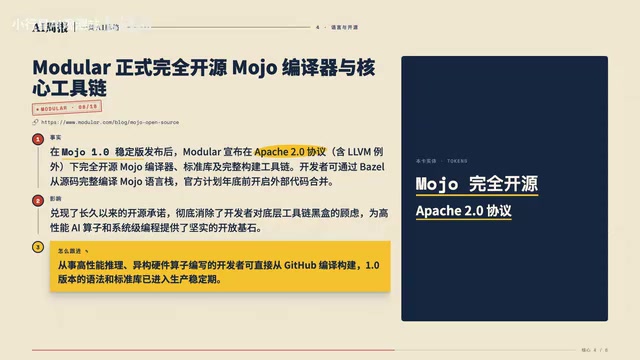
Mojo was developed by Modular, whose founder Chris Lattner is also the creator of the LLVM compiler infrastructure and the Swift programming language. Mojo is positioned as a programming language offering "Python syntax + systems-level performance"—it's fully compatible with the Python ecosystem while achieving near C/C++ performance in AI kernel development and high-performance computing scenarios through mechanisms like an ownership system, built-in SIMD support, and compile-time metaprogramming. Previously, Mojo's compiler core remained closed-source; developers could use the language but couldn't audit or modify the underlying toolchain, raising trust concerns in the systems programming community.
With this open-sourcing, developers can now build Mojo from source directly from GitHub, and the team plans to begin accepting external code contributions before year-end. This fulfills a long-standing open-source promise, completely eliminating developer concerns about the toolchain being a "black box." It means developers can freely compile, modify, and distribute the Mojo toolchain, which is expected to accelerate adoption in areas like CUDA alternatives and custom AI inference kernels, providing a solid open foundation for high-performance AI operators and systems-level programming.
Alibaba Qwen UI Agent: Bridging the Last Mile of GUI Agent Deployment with Hundreds of Real Devices
Domestic GUI agent research achieved a key breakthrough this week. Alibaba's Qwen team released the Qwen UI Agent model series, bridging the last mile of deployment with a cluster of hundreds of real devices.
The training environment consists of a large-scale cluster of over 100 real phones and more than 150 applications. The models support both GUI visual operations and CLI command-line coordinated execution. On evaluation benchmarks, the models achieved 92.2% on AndroidWorld Real and 79.5% on OSWorld Verified. The team also open-sourced the Mobile-Agent codebase.
The core value of this work lies in effectively addressing the sim-to-real deployment gap between simulators and real devices. The sim-to-real gap is one of the central challenges in the AI agent field: in GUI automation, most research relies on Android emulators or web screenshot datasets for training and evaluation, but significant differences exist between simulated environments and real devices—real-device touch response latency, screen resolution variations, app version fragmentation, system-level popup interference, network fluctuations, and other factors can cause models that perform well on emulators to degrade significantly on real devices. Alibaba's Qwen team used a training cluster of over 100 real phones to collect interaction data and feedback signals directly in real environments, essentially using large-scale real-device coverage to bridge this gap. While the engineering investment far exceeds pure emulator approaches, the resulting models demonstrate significantly higher reliability in actual deployment, enabling high-availability automation capabilities even for legacy software and multi-platform applications that lack APIs.
For business process automation and test automation scenarios, hybrid GUI-and-CLI agent orchestration is worth prioritizing.
Cursor Origin: A New Paradigm for Code Hosting Designed for Agent Collaboration
AI-assisted programming is extending into the code hosting layer. Cursor launched Cursor Origin, a code hosting platform purpose-built for agent collaboration, opening beta testing to paid users.
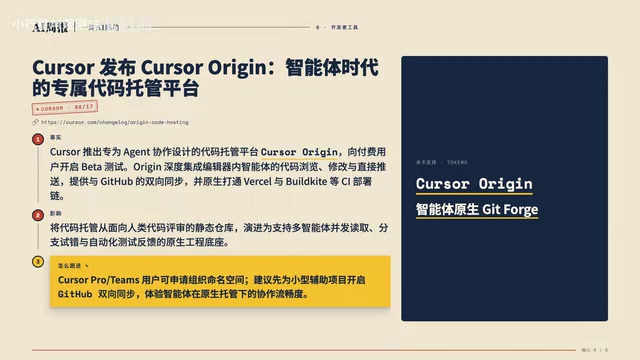
Origin deeply integrates in-editor agent capabilities for code browsing, modification, and direct pushing, provides bidirectional sync with GitHub, and natively connects with CI deployment chains like Forgejo. Its essence is evolving code hosting from a "static repository for human code review" into a native engineering foundation supporting multi-agent concurrent reading, branch experimentation, and automated test feedback.
This reveals a deeper trend: traditional Git workflows were designed around human developers—developers write code on local branches, submit reviews via Pull Requests, and team members conduct code reviews before merging. This workflow assumes code modifications are infrequent, deliberate human actions. But in scenarios where agents participate in development, multiple AI agents may concurrently generate code on different branches, run tests, and fix bugs, producing commit frequencies and branch volumes far exceeding human patterns. Traditional PR review processes become bottlenecks, and branch conflict resolution requires new automation mechanisms. Cursor Origin's design directly addresses this shift—upgrading code repositories from "version management systems for human collaboration" to "continuous integration foundations for human-machine hybrid workflows," natively supporting agents' high-frequency read/write operations and automated test feedback loops.
Cursor and Teams users can apply for organization namespaces. It's recommended to first experience the bidirectional sync collaboration fluency on small side projects.
This Week's Model and Tool Updates at a Glance
Several other noteworthy model and tool developments emerged this week:
- DeepSeek launched a GPT-4V-like visual experimental model, opening a multimodal vision API with enhanced UI operation and agent task capabilities.
- A mysterious model codenamed Oxen/Alpha entered blind testing with million-token context and strong coding abilities; the industry speculates it's Zhipu AI's new foundation model.
- Zhipu AI's open platform rolled out new GLM series versions across the board, achieving excellent scores on authoritative benchmarks while significantly reducing costs.
- xAI's terminal coding assistant Grok Build became fully available, supporting multiple sub-agents.
- ByteDance's Doubao LLM launched on Tesla China's in-car system; Meta released a standalone macOS app supporting system-wide dictation and window context sharing.
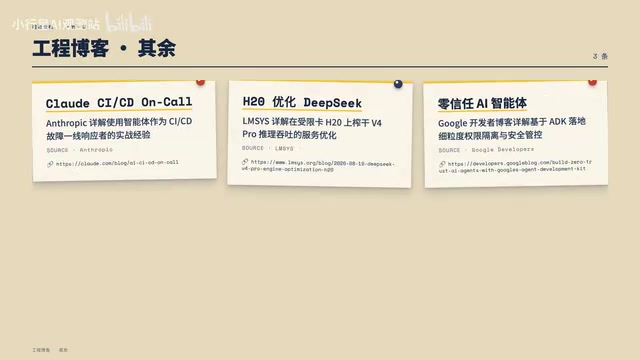
On the engineering practice front, Anthropic disclosed using Claude as a first-line troubleshooting responder for CI/CD automated pipeline failures; Google's developer blog shared a security architecture for building zero-trust AI agents using ADK. These real-world case studies are concrete evidence of agents transitioning from demos to production environments.
What to Watch Next Week
Based on this week's developments, three things are worth tracking:
- The actual integration pace of Stripe and OpenRouter on developer billing and multi-model delegated payments;
- The real-world accuracy gains of Mistral Agentic Search in processing complex, lengthy business documents;
- The real-device performance of Alibaba's Qwen UI Agent in multi-platform, API-less automation scenarios.
This week's common theme is crystal clear: AI is shifting from a "model capability race" to "infrastructure maturity"—whether it's bridging payment settlement, reinventing retrieval paradigms, graduating agent APIs, or reshaping code hosting, everything points in the same direction: making AI capabilities reliably deployable, billable, and scalable for real-world business.
Related articles

A World First in Australia: Delivery Riders to Receive Minimum Wage Guarantee
Australia introduces the world's first minimum wage guarantee for delivery riders, balancing gig flexibility with income protection. Explore the agreement's details, platform impacts, and global regulatory trends.
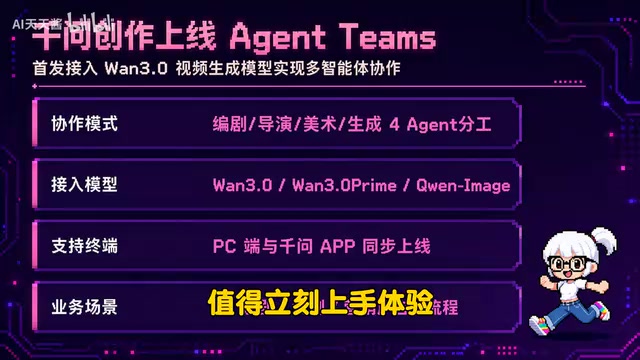
DeepSeek Open-Sources Its First Vision Model, Dramatically Lowering the Bar for Multimodal Agents
DeepSeek open-sources V-Flash-Vision-XP, its first vision model rivaling top closed-source models; Alibaba launches multi-agent video creation; sub-$400 bipedal robot goes open-source.
ReactOS 0.4.16 Released: Graphical Installer, 3D Hardware Acceleration, and Broader Hardware Support
ReactOS 0.4.16 ships with a new graphical installer, real hardware GPU 3D acceleration, and broader hardware compatibility for this Windows NT-compatible open-source OS.