AI Will Eventually Become Invisible: Is Human Craftsmanship the New Luxury?
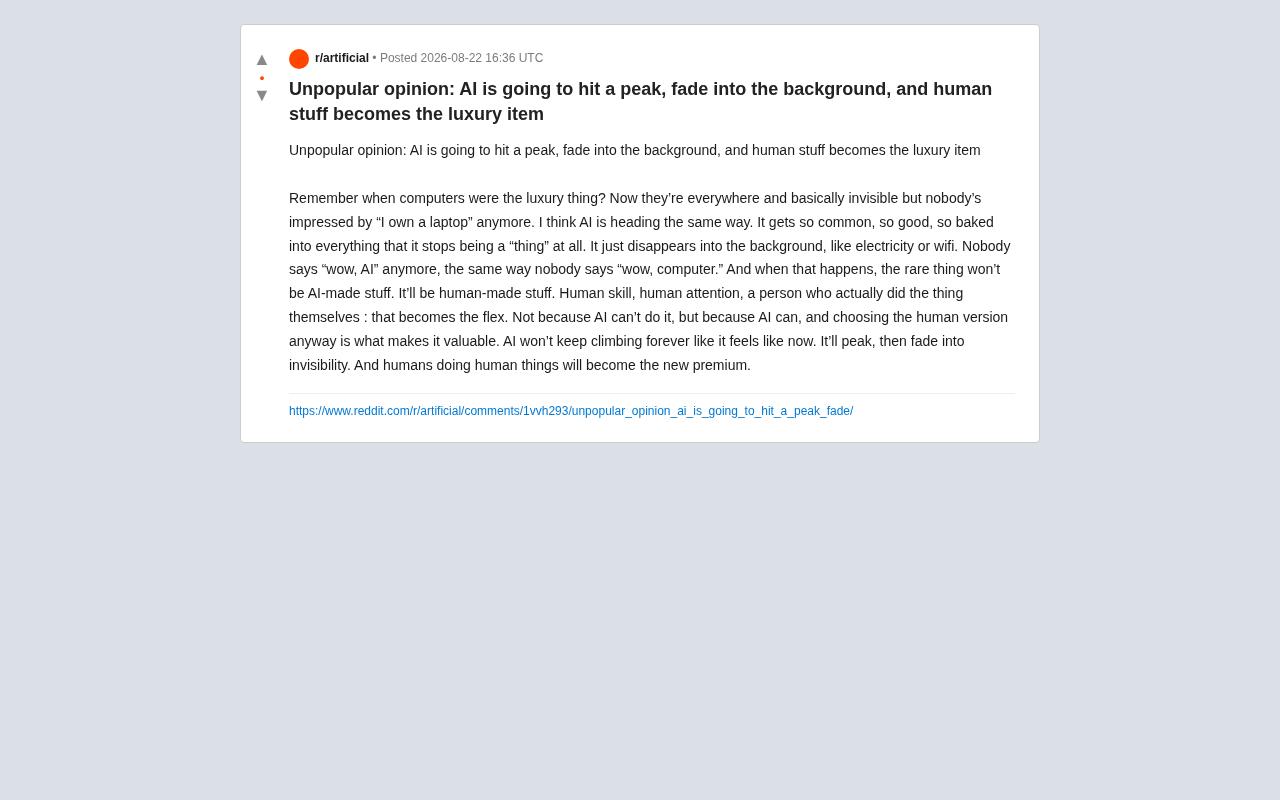
As AI fades into invisible infrastructure, human handcraft may become the ultimate luxury.
A Reddit post predicts AI will eventually become invisible infrastructure like WiFi, making human-made goods the new luxury. Drawing on the historical pattern of technological disenchantment, scarcity economics, and Mark Weiser's vision of ubiquitous computing, the article examines why this counterintuitive prediction has merit—while also exploring its limitations around AI ceilings and human-AI collaboration.
A Counterintuitive Prediction
Recently on Reddit, a post tagged as an "unpopular opinion" sparked considerable discussion. The poster offered a rather philosophical prediction: AI technology will eventually hit some kind of peak, then gradually fade from the spotlight, becoming "invisible" infrastructure much like electricity and WiFi. And when that happens, the truly scarce and truly expensive things won't be AI-generated content—they'll be "things made by human hands."
At first glance, this view seems to run against the current—after all, the entire tech industry is in an AI frenzy right now. But if we zoom out and look at the historical patterns of technological development, this prediction may deserve more serious consideration than it initially appears.
From "Wow, a Computer" to "Wow, AI": The Historical Cycle of Technological Disenchantment
The poster used a brilliant analogy. They wrote: "Remember when computers were a luxury? Now they're everywhere, basically invisible, and nobody is impressed by 'I own a laptop.'"
This observation captures a core pattern of technological evolution—disenchantment. The term originally comes from German sociologist Max Weber, who used the German word "Entzauberung" (meaning "removal of magic") to describe how science and rationality gradually replaced mysticism's hold on explaining the world during the process of modernization. In a technological context, disenchantment refers to how a new technology transitions from awe-inspiring "magic" to an unremarkable everyday tool. Gartner's "Hype Cycle" describes a similar pattern: a technology typically passes through the "Innovation Trigger," "Peak of Inflated Expectations," "Trough of Disillusionment," and "Slope of Enlightenment" before finally reaching the "Plateau of Productivity." AI is widely considered to be in the transitional phase between the peak and the trough.
Every revolutionary technology arrives with a halo of wonder. Personal computers, the internet, smartphones—all of them went through a "wow, that's amazing" phase. But as the technology matures and becomes widespread, it gradually exits the spotlight, merges into the foundational layer of daily life, and becomes taken for granted—even invisible.
The Ultimate Form of Technology Is "Disappearing"
Computer scientist Mark Weiser articulated a similar idea back in 1991: "The most profound technologies are those that disappear. They weave themselves into the fabric of everyday life until they are indistinguishable from it."
Weiser was the Chief Technology Officer at Xerox PARC and is known as the "Father of Ubiquitous Computing." In his seminal paper The Computer for the 21st Century, published in Scientific American, he first systematically laid out this vision: the future of computing isn't bigger screens or more powerful processors, but computing capability permeating the environment like water and electricity, to the point where users don't even realize they're "using" a computer. Today's Internet of Things (IoT), smart homes, and embedded sensors can all be seen as the gradual realization of Weiser's prophecy. The iPhone's core achievement wasn't making people feel like they were using a computer—it was making the concept of "computer" disappear entirely. This is precisely the most profound form of technology that Weiser described.
From this perspective, AI is on the same trajectory. Today, we still marvel when ChatGPT produces a decent article or Midjourney generates a stunning image. But that very sense of wonder is proof that AI is still in its "novelty phase." When AI is truly everywhere—embedded in every search box, every document editor, every customer service system—it will become, like WiFi today, a default presence that no longer draws attention.
The Reversal of Scarcity: Human Labor as the New Luxury
The most thought-provoking argument in the post is this: When AI can do everything, choosing the "human version" itself becomes the value proposition.
The poster emphasized: "The scarce thing won't be what AI makes—it'll be what humans make. Human skill, human focus, a real person who actually did something with their own hands—that's going to be a flex. Not because AI can't do it, but because AI absolutely can, and you still chose the human version."
Scarcity Determines Value
Behind this lies one of economics' most fundamental principles: value comes from scarcity. When something becomes extremely abundant and its marginal cost approaches zero, its market value collapses; meanwhile, the scarce alternative actually appreciates in value through contrast.
Marginal cost refers to the additional cost of producing one more unit of a product. In the digital economy, many products exhibit "high fixed cost, near-zero marginal cost" characteristics—recording a song requires substantial investment, but once digitized, the cost of copying and distributing it is virtually zero. Economist Jeremy Rifkin argued in his book The Zero Marginal Cost Society that as more and more goods and services approach zero marginal cost, the traditional pricing mechanism faces fundamental challenges. AI is extending this trend from digital content to much broader domains: when AI can generate articles, images, code, and music at near-zero cost, the market prices for these outputs will inevitably face enormous downward pressure. Scarcity will shift to dimensions that AI cannot easily replicate—human time, attention, emotional investment, and unique experiences.
We can already see early signs of this trend in the real world:
- The revival of handcrafted goods: In an era of industrial mass production, labels like "handmade" and "artisan" have become justifications for premium pricing. Japan's "Living National Treasure" system and European luxury craft brands (such as Hermès, which insists on hand-stitching) all use "the irreproducibility of human craftsmanship" as their core value proposition.
- The value of live performances: In the streaming era where music can be infinitely copied, people are willing to pay premium prices for a real live show. The global live performance market reached record levels in 2023, and Taylor Swift's Eras Tour generated over $1 billion in revenue from a single tour. The recorded version of music is nearly free, but the value of "being there" has actually been amplified.
- The rise of organic and slow living: When efficiency is the norm, "inefficient but authentic" experiences start being repriced. From organic farms to pour-over coffee, from film photography to the vinyl record revival, consumers are willing to pay a premium for "deliberate inefficiency" because that inefficiency itself carries scarce human attention and emotional investment.
If AI makes content creation, image generation, and coding as cheap as tap water, then the statement "this was made by a real person who spent dozens of hours on it by hand" will itself become the most powerful endorsement of value.
The Merits and Limitations of This Prediction
Where It's Reasonable
From the standpoint of historical patterns and economic logic, the skeleton of this prediction holds up. The disenchantment of technology is virtually inevitable, and the principle that scarcity drives value has never failed. "Human handmade" as an emotional and identity label could indeed regain premium status in an age of AI abundance.
Where It Deserves Scrutiny
But this view also has its limitations. First, "AI will hit a ceiling" is an unproven assumption. The growth curve of AI capabilities is still steep, and we can't be sure when or how it will reach a plateau.
On whether AI will "hit a ceiling," the industry holds starkly different views. On one hand, "Scaling Laws" research led by companies like OpenAI and Anthropic shows that increasing model parameters, training data, and compute leads to continuous, predictable improvements in AI capability, with no clear performance ceiling observed yet. On the other hand, some researchers point to several potential limitations: the finite supply of high-quality training data (the total volume of human-generated text on the internet is limited), rapidly escalating energy and compute costs (training a GPT-4-class model is estimated to cost over $100 million), and structural limitations of the current Transformer architecture in reasoning and planning. However, there's another possibility: AI won't simply "hit a ceiling" but will enter a phase of "continued capability improvement with diminishing marginal surprise"—AI keeps getting stronger, but people's perception of and excitement about its progress gradually fades. This scenario doesn't contradict the "disenchantment" described in the post; in fact, it may be the most likely way disenchantment actually plays out.
Second, the relationship between human labor and AI may not be an "either/or" opposition. A more likely future is human-AI collaboration—humans using AI to amplify their creativity, with the final "human work" itself deeply integrating AI assistance.
Human-AI Collaboration isn't simply "humans using AI tools"—it's a deeply integrated creative paradigm. The "Human-Centered AI" framework proposed by the Stanford Institute for Human-Centered Artificial Intelligence emphasizes that AI's optimal role is not to replace humans but to augment human capabilities. In architecture, designers are already using generative AI to explore hundreds of design options before filtering and refining based on aesthetic judgment and humanistic considerations. In medicine, the "human + AI" combination in diagnostics already surpasses the accuracy of either AI alone or doctors alone. This trend makes the boundary between "purely human-made" and "AI-made" increasingly blurry, giving rise to a new evaluative standard—what matters isn't "whether AI was used," but how much "human intent and aesthetic judgment" the final work contains. The line between "purely human-made" and "AI-assisted" may end up being far more blurred than the post imagines.
Additionally, "the human version becoming a luxury" likely only holds true in specific domains—art, craftsmanship, high-end bespoke goods, and other scenarios that emphasize emotion and uniqueness. In the vast majority of production processes where efficiency is paramount, AI will remain the undisputed leader.
Conclusion: After AI Becomes Invisible
The real value of this Reddit post may not lie in the accuracy of its predictions, but in offering a perspective that steps back from the current frenzy to examine long-term trends.
While everyone is debating what AI can replace and how much productivity it can create, this poster is reminding us: the ultimate destiny of technology is invisibility, and human uniqueness will be rediscovered precisely in the midst of abundance.
Whether or not AI truly "hits a ceiling," one thing is clear—in a world where everything can be generated, the traces of authenticity, focus, and hands-on creation will be more precious than ever before. This may be the piece of human value we still need to protect, even as we embrace AI.
Related articles
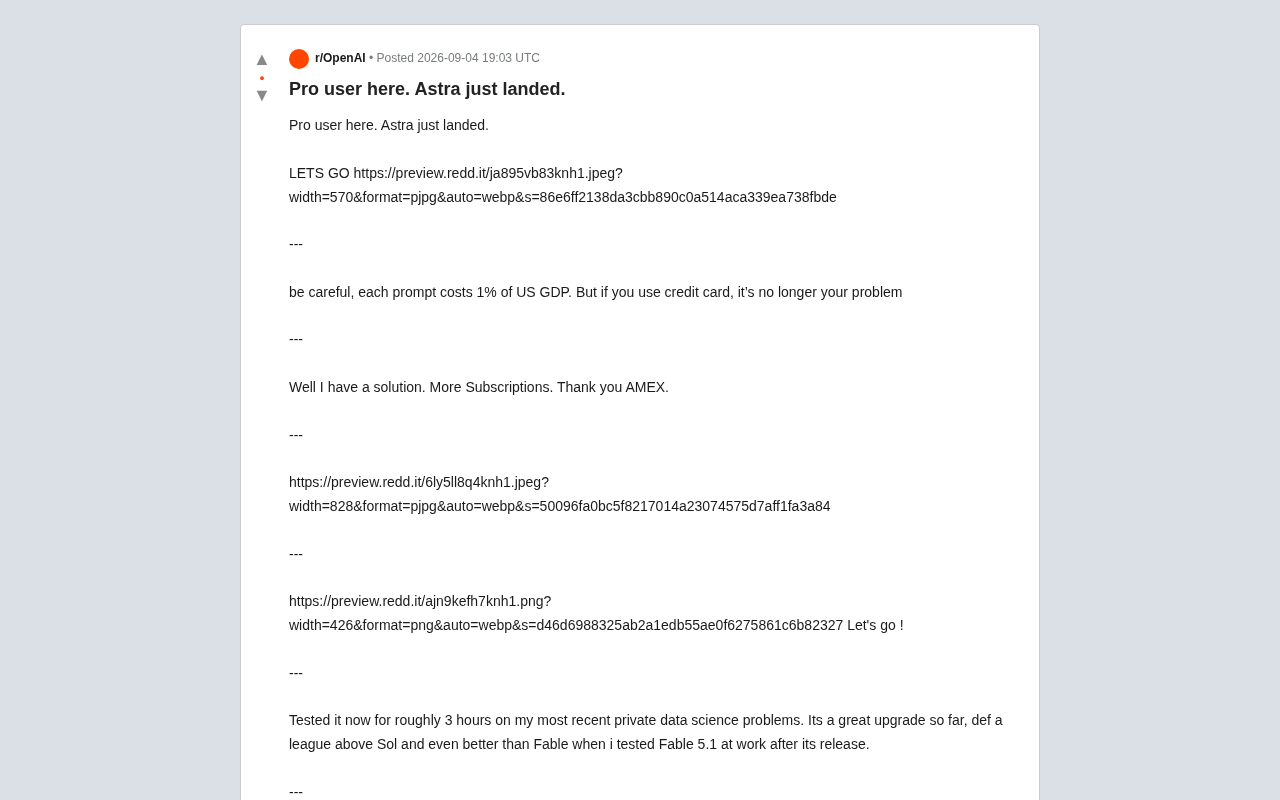
OpenAI Astra Model Launches for Pro Users: Outperforms Fable in Data Science
OpenAI's Astra model is now live for Pro users. Early tests show it outperforms Fable 5.1 in data science and research. Compare performance, use cases, and costs.
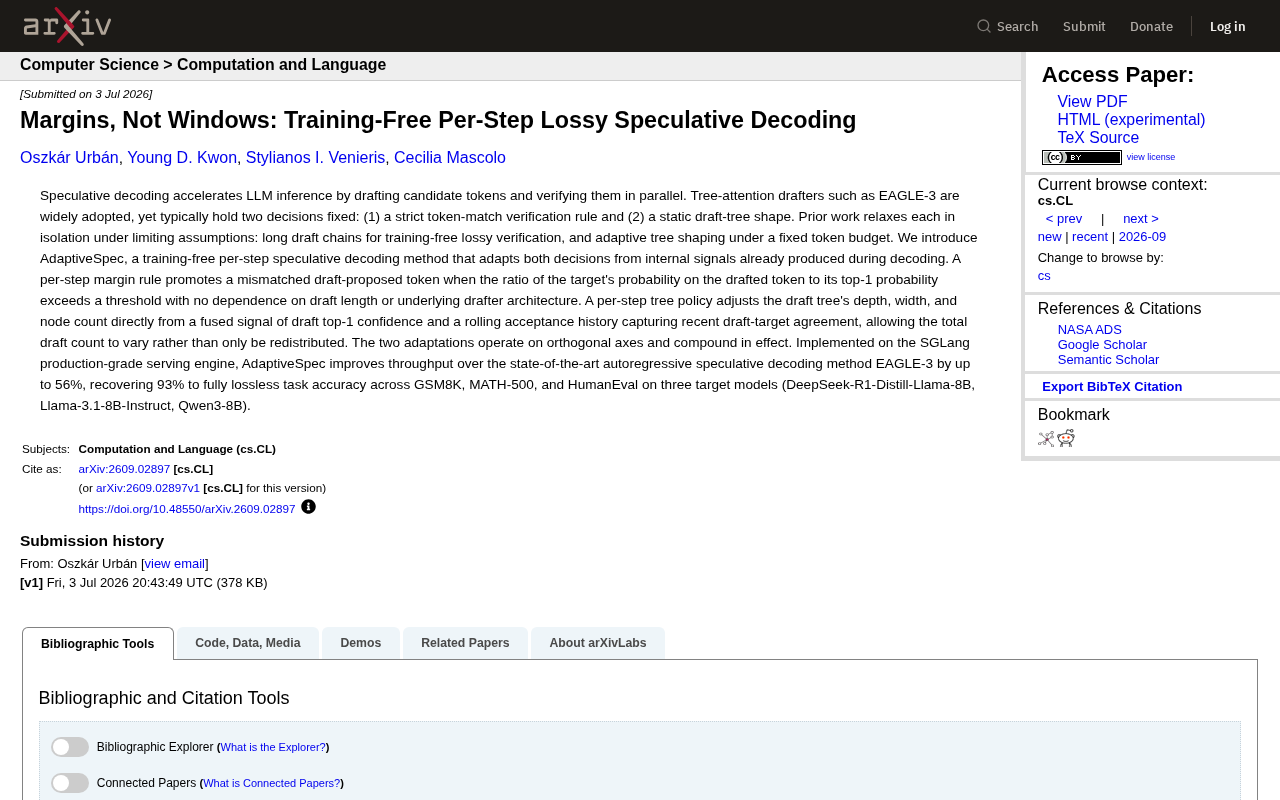
AdaptiveSpec: Technical Breakdown of a Training-Free Speculative Decoding Method That Achieves 56% Speedup
Deep dive into AdaptiveSpec, a training-free speculative decoding method achieving up to 56% throughput gains on SGLang via per-step margin verification and dynamic tree policies while recovering 93% to lossless accuracy.

Behavioral Fingerprinting: How to Identify the True Origins of Anonymous AI Models
An in-depth look at AI behavioral fingerprinting techniques, using Ox Alpha as a case study to explore how output patterns, refusal policies, and formatting preferences can reveal an anonymous model's true origins.