AI Workflow or AI Agent? A Three-Step Decision Framework to Choose Right

Most business tasks don't need AI Agents — start with the simplest workflow and add agent behavior as needed.
The article addresses the common misconception that "AI automation should use Agents" and proposes task-structure-based selection. It divides AI automation into three levels: Prompt Chain, Workflow, and Agent. The core decision criteria are "whether steps are known" and "whether error costs are high." When steps are clear and mistakes costly, workflows win; when each case differs and judgment is needed, Agents prove their value. Two cases—invoice collection and market research—illustrate this, with practical advice: start simple, measure failures, then add Agent behavior only where judgment is needed.
Why Most People Get It Wrong From the Start
When it comes to AI automation, many people's first instinct is "I need an AI Agent." But according to YouTube creator "AI co-founder" in a short video, most business tasks don't need an Agent at all. This judgment deserves serious consideration — choosing the wrong approach not only wastes development costs but also makes the system difficult to audit and maintain.
The core issue isn't which technology is more advanced, but rather the structure of the task itself: are the steps fixed, how costly are mistakes, and does each case require independent judgment. Once you clarify these three points, the choice becomes clear.
Three Levels: From Prompt Chain to AI Agent
AI automation tasks can be divided into three levels based on complexity. Understanding them is the prerequisite for making the right choice.
Level One: Prompt Chain

A prompt chain is the simplest form: connecting fixed steps in sequence, executing one after another. For example, a linear process like "draft → check → format," where each step's output becomes the next step's input. No branches, no loops, completely deterministic logic. Suitable for structured tasks like format conversion and content draft generation.
Why prompt chains are a reliable starting point: Each step in a Prompt Chain is a deterministic function call with clear input-output boundaries, making it possible to do version management and regression testing just like traditional software. Its limitations are also obvious: it cannot handle scenarios requiring conditional branching (if/else) or feedback loops. Once logic like "if A then take path one, otherwise take path two" appears in a task, prompt chains fall short, and you need to upgrade to a Workflow or introduce a simple orchestration layer (such as DAG scheduling). In practice, many teams first use prompt chains to quickly validate the effectiveness of individual components, then gradually assemble them into larger processes. This "building block" approach can significantly reduce debugging difficulty.
Level Two: Workflow
A workflow is more flexible than a prompt chain: the overall path is fixed, but certain steps are handled by AI. For example, an automatic email classification system — the process framework remains unchanged, but the step of "determining which category this email belongs to" is completed by AI. The path is predictable, AI only plays a role at specific points, preserving automation efficiency while maintaining system controllability.
Level Three: Agent
An Agent is the highest level: AI autonomously decides which steps to execute, in what order, and iterates in a loop until the task is complete. It has autonomous decision-making capabilities and can handle open-ended problems, but at the cost of higher expenses, longer execution times, and more difficult audit trails.
The technical essence of Agents: An Agent typically uses a large language model as its core reasoning engine, combined with tool use, memory mechanisms, and planning capabilities. In each loop iteration, it observes the current state, decides the next action, executes and evaluates results until the goal is achieved or a termination condition is triggered. Common implementation frameworks include ReAct (Reasoning + Acting alternating), Plan-and-Execute, etc. It is precisely this "perceive—decide—act" loop that enables Agents to handle tasks with uncertain paths, but it also means that the actual number of steps, token consumption, and time required for each execution cannot be precisely estimated. In contrast, Workflow steps are fixed during the orchestration phase and won't deviate at runtime, making it easier to do unit testing, log tracking, and cost accounting. Understanding this difference is the technical foundation for judging "whether to use an Agent."
Decision Rules: What Approach for What Scenario

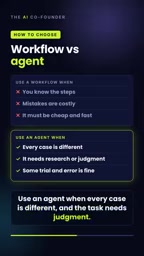
The selection criteria can be summarized along two dimensions: whether the steps are known, and whether the cost of errors is high.
When steps are clear, the path is well-defined, and the cost of mistakes is high, a workflow is the better solution. Its advantages are predictability, low cost, and easy auditing. You know what each step is doing, and you can quickly pinpoint issues when problems arise.
When every case is different and the task requires judgment, that's when an Agent truly proves its value. It can flexibly adjust strategies based on specific situations, handling problems that cannot be pre-defined with fixed paths.
Case One: Chasing Overdue Invoices
Chasing overdue invoices is a typical workflow scenario. The steps never change from start to finish: identify overdue accounts → send reminders → record responses → escalate. The process is fixed, results are predictable, and using an Agent only adds unnecessary complexity and cost.
Case Two: Researching New Markets
Market research is completely different. Each market's situation varies, requiring judgment about which information sources are reliable, which data is worth digging into, and when to adjust the research direction. The path for such tasks cannot be pre-defined, making it the perfect scenario for an Agent — although the cost is higher, its judgment capability delivers corresponding returns.
Quantifying the cost of errors: To judge "whether the cost of errors is high," you can approach it from three angles — financial impact (how much direct loss a single error causes), compliance risk (whether it involves regulatory or legal consequences), and reversibility (whether errors can be rolled back at low cost). For example, mistakenly sending a collection email in invoice chasing could damage customer relationships and is difficult to retract, making it medium-to-high cost; while a data judgment error in market research can usually be corrected in subsequent iterations, with relatively manageable cost. Plotting these two dimensions (step determinism, error cost) into a 2×2 matrix allows you to quickly locate the task quadrant: high determinism + high cost → Workflow; low determinism + low cost → try Prompt Chain or a simple Agent first.
Practical Advice: Start With the Simplest Workflow

The core principle given by the creator is: Start with the simplest workflow, measure where it fails, then add Agent behavior only at those steps.
This progressive approach is very pragmatic. Rather than building a complex Agent system from the start, it's better to first get the workflow running and find bottlenecks through actual operational data. Which steps frequently fail, which stages need human intervention, which situations the workflow cannot cover — this information can only be known once you start running it. Then introduce Agent capabilities at key nodes in a targeted way, controlling costs while letting the system evolve gradually.
This "measure first, optimize second" approach is far more reliable than arbitrarily deciding between Agent and workflow. For small and medium teams with limited resources, this is also the lowest-risk path.
Common Misconceptions
A widespread cognitive bias is treating Agents as the ultimate form of AI automation, believing that more autonomy is always better. But in reality, autonomy comes at a cost — higher token consumption, longer response times, harder debugging and auditing. Using an Agent in scenarios with fixed steps is like using a sports car for food delivery: it can deliver, but the cost is completely unnecessary.
Another misconception is underestimating the applicable scope of workflows. In fact, a large number of business tasks — invoice processing, email classification, data formatting, report generation — fall into the category of pre-definable steps. Automating these with workflows first yields far more practical returns than building a general-purpose Agent.
One-line Summary
Most business tasks don't need an AI Agent — starting with the simplest workflow and adding agent behavior as needed is the pragmatic path.
Paragraph Summary
The article addresses the common misconception that "AI automation should use Agents" and proposes an approach to selection based on task structure. It divides AI automation into three levels: Prompt Chain (fixed steps in sequence), Workflow (fixed path with some steps handled by AI), and Agent (AI autonomously decides steps and executes in loops). The core decision criteria are two dimensions: "whether steps are known" and "whether error costs are high": when steps are clear and mistakes are costly, workflows are more predictable, lower cost, and easier to audit; when each case differs and judgment is needed, Agents prove their value. The article illustrates this with two cases — overdue invoice collection (suited for workflows) and market research (suited for Agents) — and provides a practical principle: run the simplest workflow first, measure failure points, and introduce Agent behavior only at steps requiring judgment.
Related articles

JobRunner MCP Server: AI Agents Can Now Fix Failed Java Jobs
JobRunner launches an open-source MCP server enabling AI agents to view cluster status, diagnose failures, and recover Java jobs—incident response from any cloud coding environment or existing agent.

MLAI Digital Launches 9 Security Agents: MCP Server Safeguards the Full Lifecycle of Agentic AI
MLAI Digital launches Security MCP Server with nine built-in specialized security agents covering vulnerability discovery, attack simulation, prompt injection detection, API and infrastructure assessment, and accelerated remediation—embedding security validation across the full Agentic AI lifecycle from development to production.

Running Isaac Lab on H100 GPUs: Exploring Better Approaches
Exploring optimization methods for running Isaac Lab on NVIDIA H100 GPUs, including MIG configuration, mixed precision, TensorRT acceleration, and community experience to improve robotics simulation and reinforcement learning efficiency.