Ai2's Byte-Level Language Model Published in Nature: A New Path Beyond Tokenizers

Ai2's byte-level LLM Bolmo hits Nature, retrofitting existing models to ditch tokenizers — fully open source.
The core methodology behind Ai2's byte-level language model Bolmo has been published in Nature. Unlike traditional LLMs that rely on tokenizers to split text into tokens, Bolmo operates directly at the byte level, eliminating vocabulary constraints and multilingual imbalances. The research's key contribution is a generalizable method for retrofitting existing token-based models into byte-level ones, validated across multiple model families beyond Olmo via open checkpoints. Fully open source, Bolmo signals that tokenizer-free architectures are moving from theory to engineering reality.
When Language Models No Longer Rely on Tokenizers
The core technology behind Ai2's (Allen Institute for AI) fully open-source byte-level language model, Bolmo, has officially been published in Nature. The key achievement: enabling language models to operate directly at the byte level, without depending on traditional tokenizers.
For a long time, mainstream large language models have required text to be split into tokens before being fed into the model. This pipeline seems natural, but it carries hidden costs — a constrained vocabulary, uneven support for multilingual and rare characters, and inherent weaknesses in spelling and character-level tasks. Byte-level modeling attempts to sidestep these issues at the foundational level: since all text can ultimately be represented in bytes, why not have the model work directly with bytes?
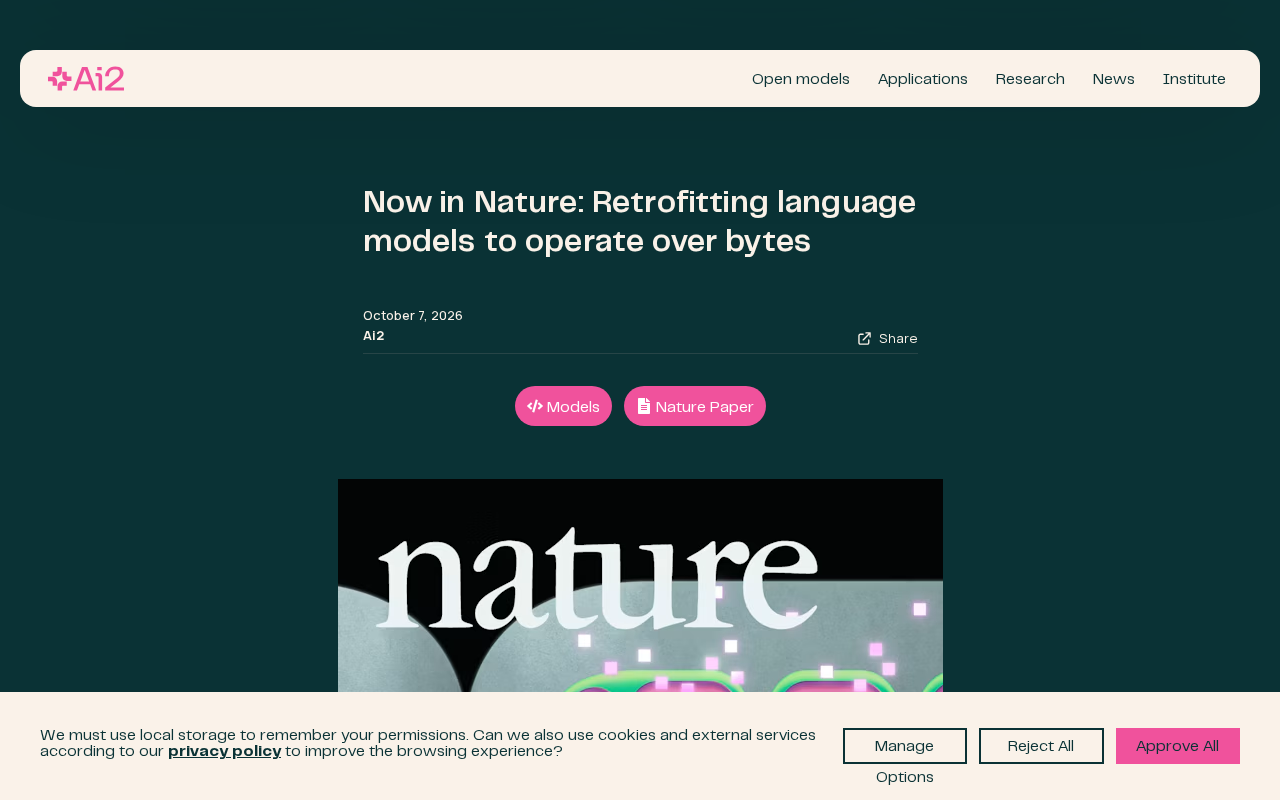
Tokenizers serve as the "entry point" for nearly all mainstream large language models today. Take the widely used BPE (Byte Pair Encoding) algorithm: it merges high-frequency byte pairs from a corpus to form subword units, ultimately producing a fixed-size vocabulary. GPT-series models typically range from 50,000 to 100,000 tokens. This design is highly efficient for high-resource languages like English — one token represents roughly 4 characters on average — but for low-resource languages, special symbols in code, or rare proper nouns, text often gets split into multiple tokens or even processed byte by byte. This results in longer sequences for equivalent information, higher computational cost, and weaker model performance on such content. Furthermore, once a tokenizer's vocabulary is fixed, it's difficult to dynamically expand — cross-lingual transfer often requires retraining or incremental vocabulary extension. Byte-level modeling takes a different approach, pushing granularity down to the basic unit of UTF-8 — the individual byte — reducing the vocabulary to just 256, and fundamentally eliminating the language imbalance introduced by tokenization. The trade-off is a significant increase in sequence length, placing higher demands on the efficiency of the attention mechanism.
Bolmo and the "Retrofitting" Approach Over Retraining
Bolmo is Ai2's fully open-source byte-level language model. The most noteworthy technical contribution isn't training a brand-new byte-level model from scratch, but rather retrofitting existing language models to operate at the byte level.
The significance of this "retrofitting" approach lies in cost efficiency and reusability. Training a large model from scratch is enormously expensive. If an already-trained token-based model can be "refurbished" into a byte-level model, it can largely inherit the capabilities of the original while gaining the advantages of byte-level modeling. This is part of what made the research compelling enough for Nature — it offers not just an isolated model, but a generalizable methodology.
"Retrofitting" in transfer learning is a well-established strategy. The core idea is to preserve most of a pretrained model's parameters, modifying or retraining only the input/output layers or a small number of key modules to adapt to new data formats or task objectives. For byte-level retrofitting, the key challenge is this: the original token embedding layer is tied to a vocabulary, so a byte-level model needs a redesigned way to map byte sequences into the model's internal representation space — without destroying the linguistic knowledge already encoded in the intermediate layers. One typical approach is to add a local aggregation module on top of the byte sequence (such as a small convolution or local Transformer), which first "compresses" adjacent bytes into representations comparable in granularity to the original tokens, then feeds them into the existing Transformer backbone, with a symmetric expansion on the output side. This way, the backbone's weights can be reused with minimal changes, dramatically reducing the retrofitting cost. Bolmo's methodology follows this direction and systematizes it into a reproducible pipeline.
Generalizability: Beyond Olmo
Alongside the paper's publication, Ai2 also released new model checkpoints to demonstrate that this retrofitting method can be extended to model families beyond Olmo.
This is a crucial point. Many research methods are only validated on the authors' own models and break down when applied to different architectures or training setups. By releasing effective checkpoints across different model families, Ai2 aims to show that byte-level retrofitting is a general-purpose technique — not a custom solution tailored specifically for Olmo. For researchers and engineering teams looking to bring byte-level capabilities to their own models, this generalizability directly determines the practical value of the technique.
A model checkpoint is a snapshot of complete model weights saved during training. Researchers can load it directly and evaluate it without repeating the training process, making it straightforward to verify conclusions. The additional checkpoints Ai2 released target multiple different model families, effectively providing a "ready-to-compare reproducibility package." In deep learning research, generalization across architectures is an important benchmark for assessing practical value: if a retrofitting pipeline depends on a specific model's hyperparameters or training data distribution, other teams will struggle to adopt it. Conversely, if it works reliably across models of different scales and pretraining corpora, it suggests the method has captured a more universal transformation pattern between byte-level and token-level representations. Open checkpoints also allow external researchers to independently evaluate on a wider range of downstream tasks, providing third-party validation of the paper's findings.
The Weight of Full Open Source
Ai2 has always been known for its commitment to full openness, and Bolmo continues that tradition. The model itself, the methodology, and the checkpoints used to demonstrate generalizability are all publicly released — meaning the community can directly reproduce, verify, and build upon this work.
At a time when many frontier models are becoming increasingly closed, a byte-level language model that both appears in Nature and remains fully open-source offers the academic community and developers a rare, transparent research artifact. It serves simultaneously as an authoritative endorsement of the byte-level modeling approach and as a practical entry point for exploring "tokenizer-free" architectures.
Why This Matters
Byte-level modeling is not a new concept, but achieving it in a reusable, generalizable way that passes peer review at a top-tier journal remains rare. Bolmo's value can be summarized across three dimensions: technically, it demonstrates the feasibility of retrofitting existing models toward byte-level operation; methodologically, it shows cross-architecture generalizability; and at the ecosystem level, its fully open-source posture lowers the barrier for community participation.
For those tracking the evolution of model architecture fundamentals, this is a signal — tokenizers may not be an immovable prerequisite for language models, and the byte-level path is gradually moving from a research concept toward engineering reality.
Related articles

Gaussian Process Bandit Optimization: Exploration Strategies and Inference Regret Guarantees
Cumulative regret guarantees in Bayesian optimization fail to reflect final recommendation quality. This article examines a new study that provides inference regret guarantees for Gaussian process bandit optimization through exploration query strategies and fill distance analysis, validated on hyperparameter optimization and control tasks.

The Most Detailed Codex Guide on Bilibili: From Installation to Real-World Practice
The most detailed Codex guide on Bilibili: from app store installation to daily work mode configuration, with a real coffee shop project demonstrating file organization, data extraction, dashboard creation, and other practical tasks. Learn to use Plan Mode and desktop pets to leverage Codex efficiently.

Appearance Compensation in Volume Rendering: Why RGB Accuracy Cannot Guarantee Density Correctness
Volume rendering research reveals that volumetric data perfectly reproducing external RGB views may still contain density errors: appearance compensation can double central density and keep external rays unchanged even when L2 error exceeds 14.52%. Density recovery depends on appearance capacity, spatial resolution, and measurement design.