AICON: Natural Language-Powered Infinite Canvas That Turns AI Video Creation into an Editable Workflow
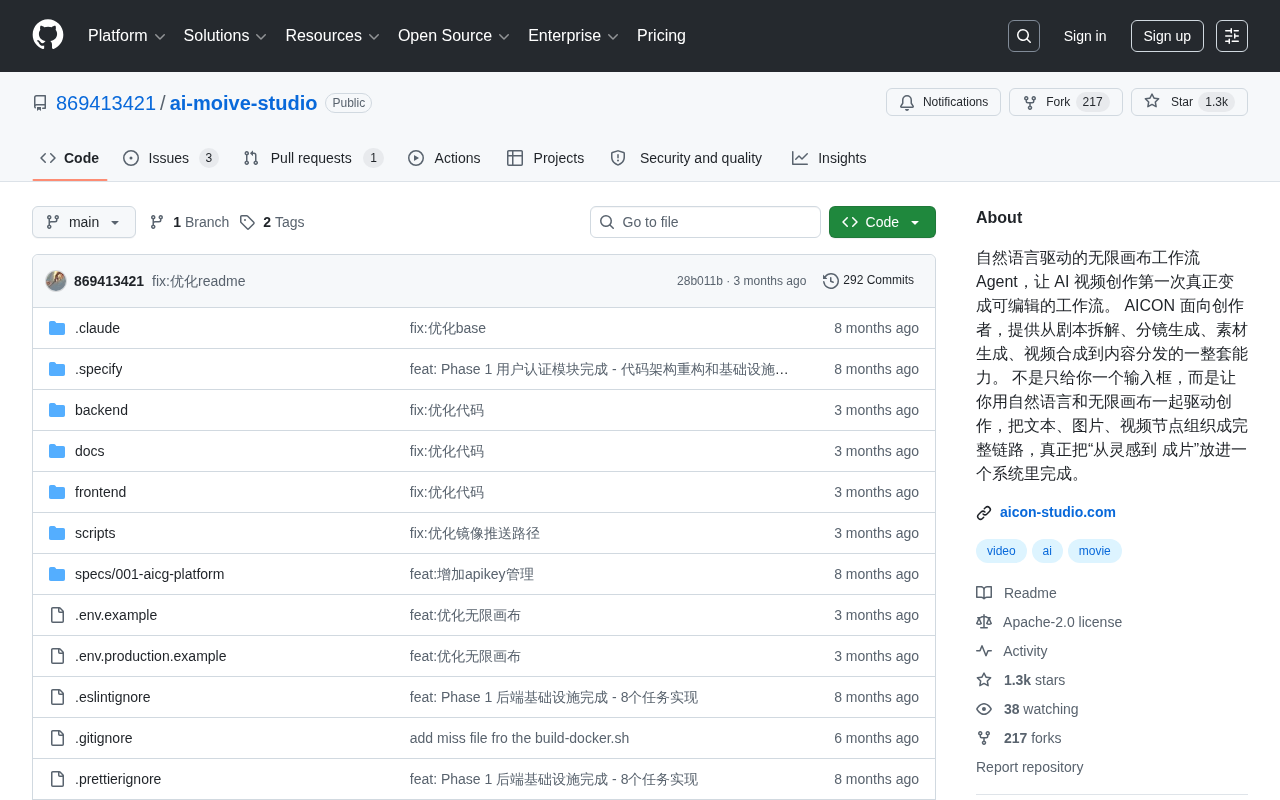
AICON transforms AI video creation from a prompt box into a node-based infinite canvas workflow.
AICON (ai-movie-studio) is an open-source AI video creation tool built around natural language and an infinite canvas, with 1,107 GitHub Stars. It breaks the video production pipeline into visual nodes covering script breakdown, storyboard generation, asset creation, video composition, and content distribution — letting creators adjust any single node without restarting from scratch. Its core value is restoring controllability to AI video tooling, embracing human-AI collaboration over one-click magic, following the node-based workflow paradigm validated by ComfyUI in image generation.
AICON: Upgrading AI Video Creation from an "Input Box" to a "Workflow"
Over the past year, AI video generation tools have proliferated rapidly — yet most of them share the same interaction paradigm: give you a text box, type in a prompt, and wait for a video to come out. The problem is that real content creation has never been a "one sentence generates everything" process. It's an iterative cycle of adjustment, decomposition, and recombination. The open-source project ai-moive-studio (AICON) aims to break this limitation by restructuring AI video creation into an editable workflow.
The project has already earned 1,107 Stars and 162 Forks on GitHub. Built primarily in Python, it positions itself as an all-in-one video production system for creators.
From "a Single Input Box" to "an Infinite Canvas"
The most fundamental design philosophy behind AICON is using natural language + an infinite canvas to jointly drive the creative process. Traditional AI video tools package the entire generation pipeline into a black box, leaving you no way to intervene at any intermediate step. AICON, by contrast, breaks the creation pipeline into discrete, visualized nodes — organizing text, images, and video as nodes on an infinitely expandable canvas.
The value of this approach lies in controllability and editability. When you're unhappy with a particular storyboard segment, you don't have to start from scratch — just modify the corresponding node and re-trigger the downstream process. Natural language plays the role of "director" here, while the canvas carries the entire structure and state of the creative work, making every step from inspiration to final cut transparent and open to intervention.
What is an Infinite Canvas? The Infinite Canvas is an interaction paradigm that originated in creative software, with representative products including Miro, FigJam, and Figma's whiteboard mode. Its defining characteristic is breaking fixed page boundaries, allowing users to freely place, connect, and organize content elements in an infinitely expandable two-dimensional space. In the context of AI tools, the infinite canvas is typically paired with a Node Editor: each node represents a processing unit (such as text input, model inference, or image output), and nodes are connected by edges that express data flow — making the entire canvas a visual computation graph. This interaction model lets users clearly see how data flows between processing steps without needing to understand the underlying code, enabling precise intervention at any specific stage.
Full-Chain Creative Capabilities
AICON is not a single-point tool — it connects the complete chain of video creation end to end. According to the project documentation, it provides creators with capabilities across the following key stages:
Script Breakdown and Storyboard Generation
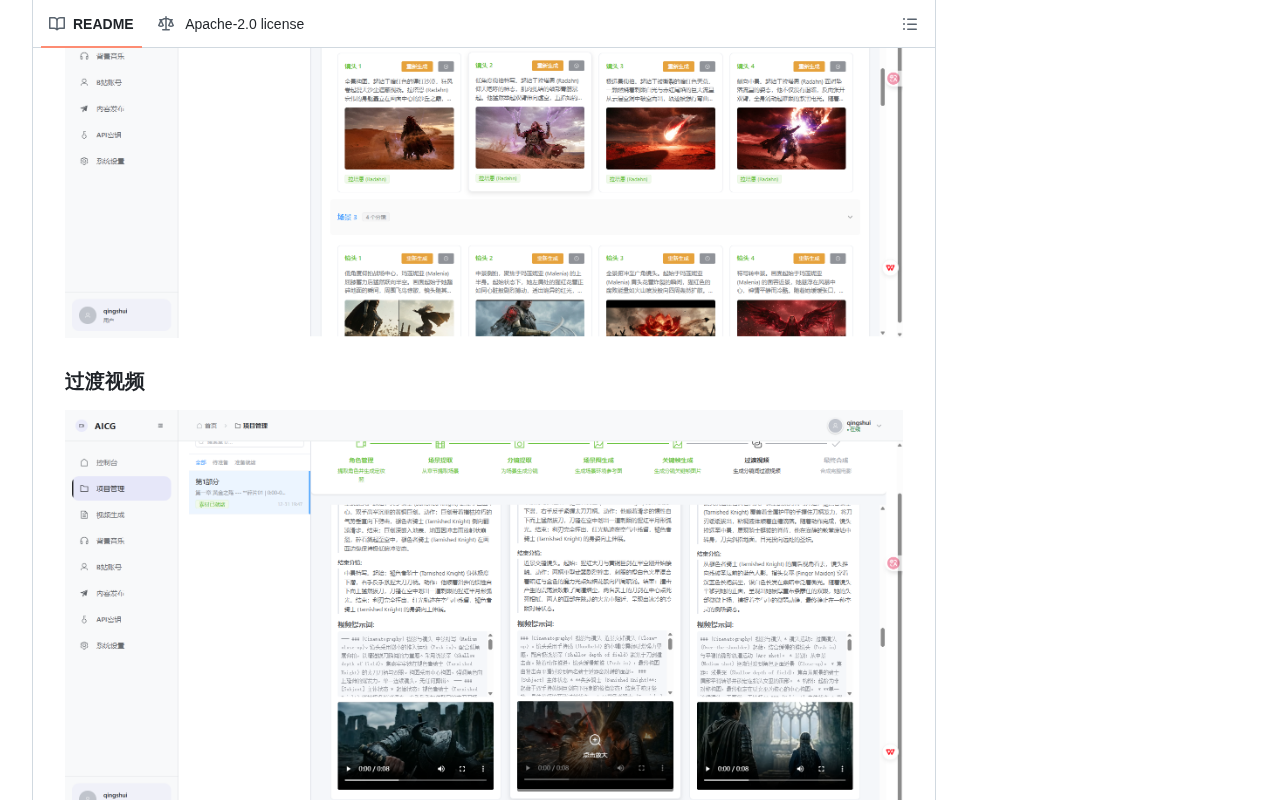
Every creative project starts with an idea or a piece of text. AICON supports automatic script breakdown and subsequent storyboard generation. This step essentially transforms abstract narrative structure into visualized, executable shot units — laying the groundwork for downstream asset generation.
Asset Generation and Video Composition
Once the storyboard is finalized, the system can generate corresponding assets (images, video clips, etc.) for each shot node and compose them into a complete video. Because the entire process is built on a node-based workflow, creators can adjust individual asset nodes independently without affecting the overall pipeline.
Content Distribution
Notably, AICON also incorporates content distribution into its system capabilities. This means it aims to cover not just "production" but also the "publishing" stage after a video is complete — forming a more closed creative loop.
Why "Workflow" Matters More Than "Generation"
A pervasive pain point in today's AI video landscape is this: model capabilities are improving rapidly, but controllability consistently fails to keep pace. A 10-second generated video may look stunning, but assembling it into a complete work with narrative structure, rhythm, and authorial intent involves organizational and editing work that most tools simply ignore.
AICON's approach directly addresses this gap. Rather than chasing the magic of "one-click output," it acknowledges that creation is a process requiring human-AI collaboration and iterative refinement. Organizing text, image, and video nodes into a complete pipeline essentially gives creators a workbench for continuous iteration, reuse, and adjustment — rather than a black box that only delivers final results.
This design philosophy aligns with the broader trend in AI tools shifting from "end-to-end generation" toward "Agent + workflow" architectures. The interaction model of infinite canvas + node-based orchestration has already been validated in the image generation space (e.g., ComfyUI), and AICON extends it to the more complex domain of video creation.
What is ComfyUI? ComfyUI is currently the most representative node-based workflow tool in the image generation space, built on Stable Diffusion. It allows users to freely combine samplers, model loaders, LoRA injection, image post-processing, and other steps as nodes. Its widespread adoption validates a core insight: the ceiling on generation quality often lies not in the model itself, but in the sophistication of the workflow. Complex workflows built by power users in ComfyUI — sometimes containing dozens of nodes — can achieve output quality far beyond default settings, and these workflows can be saved, shared, and reused. AICON draws on this paradigm and migrates it to the video creation domain, where the challenges are even greater: video has a temporal dimension, and dependencies between nodes involve not just data flow but also narrative continuity between shots — placing higher demands on workflow design.
What Open Source Means
As an open-source Python project, AICON's openness gives developers and advanced creators ample room to explore. Users can self-host, customize nodes, integrate different generative models, and even reshape the entire workflow to suit their own creative process. The 162 Forks also indirectly reflect the community's interest in this "editable workflow" paradigm.
That said, as a project still in its early stages, its stability, model integration capabilities, and real-world output quality still need to be validated through actual creative use cases. But the direction it proposes — making AI video creation truly an editable workflow — undeniably addresses one of the most critical evolutionary questions facing today's AI video tooling.
A Note on Model Integration In the AI video generation space, model integration capability is one of the core competitive advantages for workflow tools. Mainstream open-source or locally deployable video generation models currently include ByteDance's CogVideoX, Kuaishou's Wan (Hunyuan Video series), and models released by teams like StepFun; on the commercial API side, there are Runway, Pika, Kling, and others. For open-source workflow frameworks like AICON, the wider the range of supported models, the more flexibility users have to choose based on cost, quality, and generation speed — without being locked into a single provider. This is also one of the core advantages of open-source workflows over vertically integrated commercial products: decoupling the model layer from the orchestration layer gives the system the capacity to keep evolving as the ecosystem matures.
Summary
AICON represents a new direction for AI video tooling: rather than compressing creation into a single prompt, it unfolds it into a freely orchestrated canvas. For content creators seeking greater control and a complete end-to-end creative pipeline, this kind of "workflow Agent" is worth watching closely. Interested developers can search for 869413421/ai-moive-studio on GitHub to learn more.
Related articles

AI Real-Time Generative Simulation: A New Kind of Game Experience
Explore how AI real-time generative simulation—where AI creates audio on the fly and users steer the experience—is redefining interactive entertainment and the future of gaming.

First Look at Solaris: The Interface World Model and a New Direction for Interactive AI
Solaris is positioned as an interface world model (folaris flavor). This article explores the concept's technical significance, use cases, and value for AI agents, with an honest look at what's still unknown.

A $7 Ad in 9 Minutes? The Truth and Concerns Behind Low-Cost AI Content Production
A '$7 ad in 9 minutes' tweet went viral. This article examines how AI is reshaping ad production costs—and the real risks of homogenization and brand trust.