AIGC in Practice: A Complete Guide from Content Generation to RAG and AI Agent Development

A complete practical guide covering AIGC from personal content monetization to enterprise RAG and AI Agent deployment.
Based on an AIGC instructor's course, this article maps out two major tracks for deploying large models: a 2C "visual generation" school covering text, image, GIF, and video creation with concrete monetization strategies, and a 2B enterprise school introducing RAG (retrieval-augmented generation for knowledge bases), AI Agents for multi-step tasks (using Microsoft AutoGen), and LLM integration for legacy systems like customer service platforms.
AIGC (Generative AI) is making the transition from concept to real productivity tool. An AIGC instructor sharing content on Bilibili has systematically laid out two main tracks for deploying large language models in practice: 2C content generation for individual creators, and 2B enterprise applications for complex business scenarios. This article, based on that course, breaks down the full AIGC application landscape — from text, image, and video generation to RAG knowledge bases and AI Agents.
Content Generation: Monetization Paths for 2C Creators
Text output is the most fundamental — and most underestimated — capability of today's large models. The instructor shared a real-world example: while traveling for work, he used speech-to-text to record his boss's remarks during a meeting, fed them into a large model to generate a summary, and posted the polished content to the company group chat within one minute of the speech ending. This kind of efficiency boost has enormous practical value in the workplace.
Beyond productivity gains, content generation can also directly generate income. Some students in the course went on to write short fiction on novel platforms after completing it, earning 20 to 30 RMB per piece. Others used large models to create cartoon avatar images — selling them for 9.9 RMB when competitors charged 18.99 RMB on Taobao — and were fielding around ten orders a day in the early days, building a lightweight micro-business.
Image generation is another popular path, covering advertising illustrations, cartoon graphics, and artistic photos. The instructor highlighted the evolution of Prompt Engineering: while it was enormously popular in the early days of ChatGPT, its hype faded after OpenAI released an official prompting guide covering six key principles. His advice is to distill that lengthy official document into a two-slide core framework, skipping the need to understand complex underlying theory.
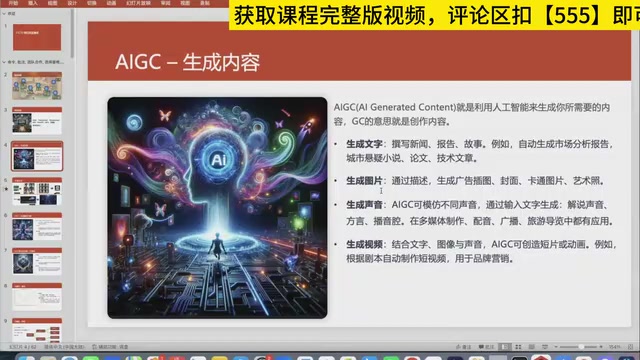
More advanced applications include GIF and video generation. GIFs are more complex than static cartoon images — they require using GPT's Code Interpreter to write code that cuts images into a grid, sequences the frames, plays them one by one, and stitches them into a GIF. For video, the workflow involves writing a script with ChatGPT, then handing it off to tools like CapCut along with generated images to produce a complete video. The instructor pointed to a popular format online — animated versions of "binge-watch an entire career" stories — which are exactly this combination: cartoon images, voiceover, and text overlays. By uploading three or more landscape (16:9) videos over one minute long to Douyin, Xigua Video, or Toutiao's mid-length video program and reaching 17,000 views, creators can start earning revenue, at nearly zero cost.
Prompt Engineering refers to the methodology of designing and optimizing text instructions given to large models in order to guide the model toward more desirable outputs. Its core elements typically include: defining a clear role (e.g., "You are a senior legal advisor"), clearly describing the task objective, providing necessary background or examples (Few-shot), constraining the output format (e.g., JSON, tables), and decomposing complex instructions step by step (Chain-of-Thought).
As major vendors continue improving models' instruction-following capabilities, the early "alchemy-style" prompting tricks are losing their edge. However, structured, scenario-specific prompt design remains the fastest path for everyday users to consistently get high-quality outputs. For content creators, mastering prompt templates suited to their vertical niche often delivers more immediate efficiency gains than deeply understanding model internals.
Two Schools of Thought: 2C "Visual Generation" vs. 2B Enterprise Applications
The instructor draws a clear line between two schools of large model deployment. The first is the "visual generation" (图森) school — everything covered above falls here: individuals using large models for image design and video production, earning side income from the general public. At its core, this is a 2C monetization approach.
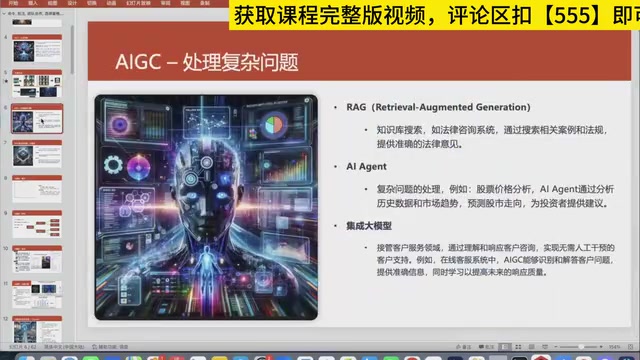
The second school is the 2B direction, targeting enterprises and more complex problems. For example, a department manager in the course needed to draft an annual AIGC roadmap and envision how large models could be applied across their business. These scenarios can't be solved with prompting alone — they require more systematic technologies like RAG and AI Agents.
RAG: Stopping Large Models from "Making Things Up"
RAG stands for Retrieval Augmented Generation, and is essentially a search-enhanced generation technique. Its most representative application is knowledge base search. The instructor used a legal scenario as an example: a company builds a knowledge base from various legal statutes, and when a case summary is entered, the system automatically surfaces relevant articles. Different industries — IT operations, logistics, and more — can each build their own domain-specific knowledge bases.
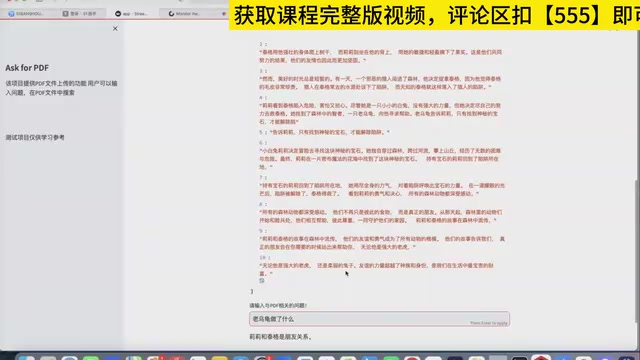
The core value of RAG lies in addressing the hallucination problem in large models. The instructor demonstrated using a fairy tale PDF: after uploading it, the system split the document into approximately 11 chunks. When asked "What is the relationship between Lily and Tiger?", the Baidu Qianfan model had no answer on its own — but after knowledge base processing, the model prioritized retrieval from the PDF and accurately answered that the two are friends. When asked "What did the old turtle do?", the model could also find the passage stating "the old turtle told Lily that only by finding the mysterious gemstone could Tiger be saved."
This mechanism is tremendously valuable in commercial customer service systems. The course demonstrated building a customer service assistant using GPTs: product information for the "Haomeng Lai" brand of bed sheets was uploaded as a TXT file, and when users asked about products, the model prioritized retrieval from the knowledge base to deliver a targeted response about "Haomeng Lai premium bed sheets" rather than pulling generic information from the web. Merchants can thereby guide the large model to only surface information they want customers to see — such as recommending specific products or top-ranked items.
The technical principle behind RAG can be understood as a two-stage "retrieve first, then generate" workflow. When a user poses a question, the system first converts it into a vector (Embedding) and performs a similarity search in a pre-built document vector store to identify the most relevant text passages. These passages are then appended to the prompt as context before being fed to the large model to generate a response. This way, the model's answer is grounded in real documents rather than generated from "memory."
Large model hallucination refers to the phenomenon where a model outputs information with high confidence that is inaccurate or entirely fabricated. The root cause is that models learn probability distributions from training data rather than storing facts. RAG addresses this by injecting external knowledge into the context in real time — effectively giving the model a reference book it can consult on demand. The granularity of document chunking, the recall quality of vector retrieval, and how the final prompt is assembled are the three critical engineering details that determine RAG system performance.
AI Agents: Tackling Multi-Step Complex Problems
When a problem is too complex to be solved with a single prompt, AI Agents step in. The instructor used stock price analysis as an example to illustrate the complexity: you need to find a stock data website, write code to download the data, monitor the code for errors, download and compare against historical data (requiring more code), and finally generate a chart with investment recommendations. The full chain involves data scraping, error correction, data comparison, and chart generation.
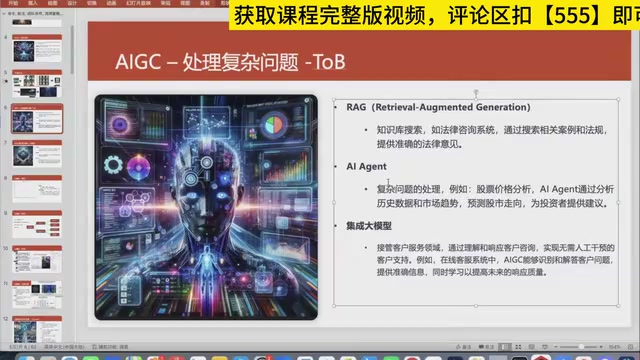
Tasks like "the boss wants you to analyze this stock" look simple on the surface but involve multiple intertwined steps — exactly the kind of work AI Agents excel at. The course introduced Microsoft's AutoGen framework for orchestrating multiple agents to collaboratively complete this type of complex task.
AI Agent (intelligent agent) is built on the core idea of having a large model do more than passively answer questions — it actively plans, calls tools, executes actions, and iterates based on feedback until the goal is achieved. A typical Agent loop consists of four stages: Perceive (receive task and environment information), Plan (break down subtasks), Act (invoke tools such as code execution, search, or APIs), and Reflect (assess whether the result meets expectations and decide whether to retry).
The distinctive feature of Microsoft's AutoGen framework is its support for multi-agent conversational orchestration: you can define roles such as "user proxy," "assistant agent," and "code execution agent," having them pass messages and divide work like members of a team. In the stock analysis example, one Agent writes the scraping code, another reviews and runs it in a sandbox, and if an error occurs, it passes the error back to the coding Agent for correction — the entire error-correction loop requires no human intervention. This multi-Agent collaboration model makes it particularly effective in scenarios requiring long-chain reasoning, such as data analysis, automated testing, and research assistance.
Integrating Large Models: Injecting Intelligence into Legacy Systems
The final piece is large model integration. Many companies' OA platforms, internal management systems, and apps were built years ago; integrating large models can dramatically enhance their capabilities. The instructor shared a customer service system case study: analyzing customer chat records to assess purchase intent. Traditional AI could only handle scripted Q&A (shipping policy, return windows, product features), but after integrating a large model, the system could gauge a customer's purchase intent from the conversation, compile that intent data into a dataset for ongoing model fine-tuning, and flag high-intent customers for special handling — ultimately improving conversion rates.
Summary: Two Tracks for Deploying AIGC
The instructor distills AIGC deployment into two main directions: first, the 2C-oriented content generation track, covering creation and monetization of images, videos, GIFs, and more; second, the 2B-oriented enterprise track, encompassing knowledge bases (RAG), complex problem handling (AI Agents), and large model integration. Regardless of direction, the common thread is leveraging machines' ability to understand and generate human language and images to deliver tangible productivity gains. For those looking to get started with AIGC in practice, this framework — spanning personal monetization all the way to enterprise deployment — provides a clear and actionable roadmap.
Related articles

JobRunner MCP Server: AI Agents Can Now Fix Failed Java Jobs
JobRunner launches an open-source MCP server enabling AI agents to view cluster status, diagnose failures, and recover Java jobs—incident response from any cloud coding environment or existing agent.

MLAI Digital Launches 9 Security Agents: MCP Server Safeguards the Full Lifecycle of Agentic AI
MLAI Digital launches Security MCP Server with nine built-in specialized security agents covering vulnerability discovery, attack simulation, prompt injection detection, API and infrastructure assessment, and accelerated remediation—embedding security validation across the full Agentic AI lifecycle from development to production.

Running Isaac Lab on H100 GPUs: Exploring Better Approaches
Exploring optimization methods for running Isaac Lab on NVIDIA H100 GPUs, including MIG configuration, mixed precision, TensorRT acceleration, and community experience to improve robotics simulation and reinforcement learning efficiency.