Airtable Announces Major Layoffs: Low-Code Platforms Face Transition Pressure
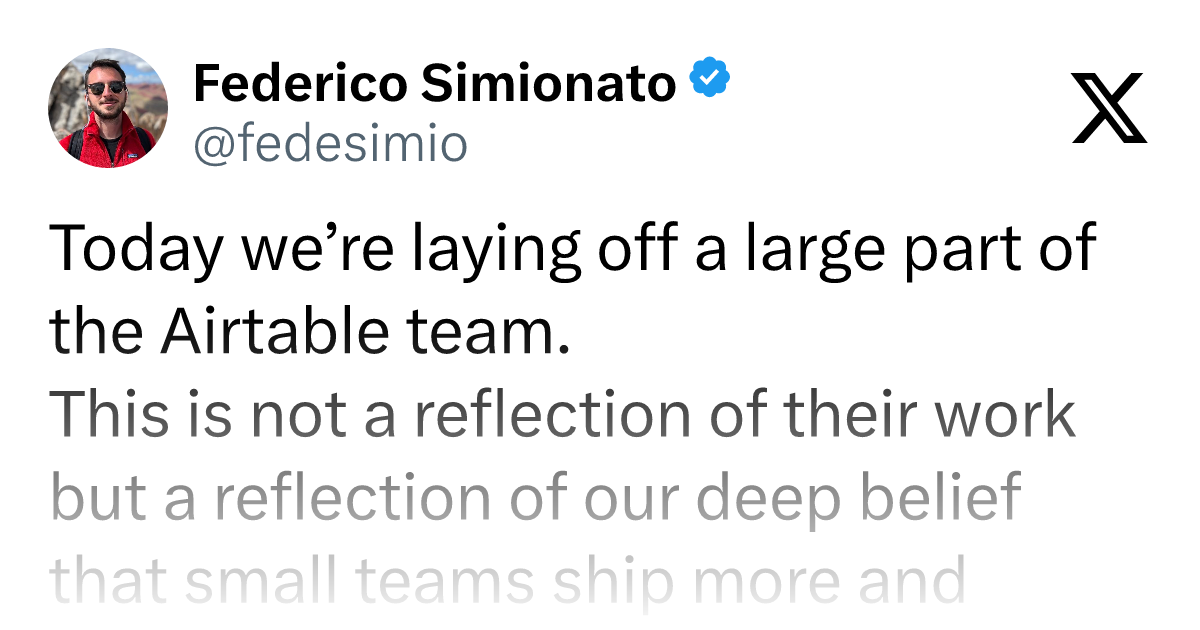
Airtable's major layoffs reflect the competitive and positioning dilemma facing low-code platforms in the AI era
Airtable announced layoffs affecting most of its team, drawing widespread attention to the future of low-code platforms. The article notes intensifying competition in the low-code/no-code space, with rivals like Notion, Smartsheet, and Microsoft Power Platform overlapping heavily, while AI coding tools are eroding the differentiation advantage of drag-and-drop building. The layoffs also reflect the SaaS industry's broader shift from scale expansion to focus and cash flow priority. Community reactions are divided, and the article reminds developers to reassess the risks of relying on a single platform long-term.
Airtable Layoffs: An Overview
According to the Hacker News community, low-code collaboration platform Airtable has announced that it will lay off the majority of its team members. The news drew attention in the tech community, but as of now, the company has not disclosed the specific number of layoffs or the departments affected.
As a representative product in the low-code/no-code space, Airtable was once seen as a bridge between traditional spreadsheets and databases, widely used for project management, content operations, and lightweight application building. This round of large-scale layoffs is interpreted by outsiders as a strategic contraction by the company amid growth pressure and intensifying market competition.
What is Low-Code/No-Code? Low-code refers to a development paradigm in which developers build applications with minimal or even zero code through visual drag-and-drop, configurable components, and similar approaches. It typically provides out-of-the-box modules such as forms, data tables, workflows, and permission controls, which users can combine through a graphical interface to produce usable business systems. Airtable is a quintessential example of this space: it packages the capabilities of a relational database into a spreadsheet-style interactive interface, enabling non-technical users to build lightweight applications with relations, views, and automation just as they would use Excel. This model gained rapid popularity in the mid-to-late 2010s, because the demand for "shadow IT" within enterprises had long been suppressed by traditional software development cycles, and low-code filled the gap of being "stronger than spreadsheets, lighter than custom development."
Intensifying Competition in the Low-Code Space
The low-code/no-code space in which Airtable operates has become increasingly competitive in recent years. Products such as Notion, Smartsheet, and Monday.com overlap heavily with Airtable in collaboration and project management scenarios, while giant-level products like Microsoft Power Platform and Google AppSheet continue to erode market space through their ecosystem integration capabilities.
On the other hand, the rapid rise of AI coding tools is changing the barrier to entry for application building. Workflow automation that once required low-code platforms can now be generated directly through natural-language-driven AI coding tools. This poses a structural challenge to traditional low-code platforms like Airtable — when "describe your needs and get a tool" becomes the norm, the differentiation advantage of drag-and-drop building is being weakened.
The mechanism by which AI coding tools disrupt low-code deserves further explanation. AI coding tools such as GitHub Copilot, Cursor, and Claude Code have a core capability of automatically generating code based on natural language descriptions or context. Unlike low-code platforms, they are not limited to a platform's preset components and templates, but directly produce deployable general-purpose code, theoretically with no functional ceiling. This means the core reason users once chose low-code platforms — "you can build systems without knowing how to code" — is gradually being dissolved: as long as you can clearly describe your needs, AI can generate a corresponding application prototype. This change poses a fundamental challenge to the value proposition of low-code platforms, because their moat was originally built on "lowering the programming barrier," while AI is lowering that barrier even further, with deliverables that are more flexible and more portable.
The Dilemma of Platform Products in the AI Wave
Airtable's layoffs are not an isolated event. In recent years, many SaaS and platform companies have been adjusting their organizational structures, shifting resources toward AI capabilities. For Airtable, the core question is: in an era when AI-native applications are rapidly emerging, the positioning of traditional low-code platforms needs to be re-examined.
Some industry observers believe that if low-code platforms can deeply integrate AI capabilities into data management and automation workflows, they still have irreplaceable value — especially in scenarios involving business system building for non-technical teams. But this transition requires substantial R&D investment, and layoffs often mean that short-term cash flow pressure takes priority over long-term investment.
The organizational characteristics of the SaaS (Software as a Service) model help explain the logic behind such layoffs. SaaS companies typically adopt a subscription-based revenue model, relying on financing to support rapid expansion in the early stages, with team size and R&D investment often ahead of current revenue. When the capital market environment tightens and growth slows, companies face pressure to prioritize "cash flow over long-term investment," and layoffs become a means of rapidly cutting costs. At the same time, building AI capabilities requires highly paid talent and computing power investment, further squeezing the manpower budget of traditional business lines. Therefore, Airtable-style layoffs are not simply a signal of operational failure, but more a reflection of the SaaS industry's cyclical adjustment from "scale first" to "profitability and AI focus."
Reactions from Users and Developers
In the Hacker News discussion, community members expressed differing views on Airtable's future direction. Some comments argued that Airtable still has advantages in product experience and API openness, and that layoffs may be a necessary move to focus on core business; others worried that team contraction could affect product iteration speed and customer support quality, thereby accelerating user churn.
For teams that rely on Airtable to build critical business systems, platform stability and long-term sustainability have become risk points that need reassessment. This also reminds developers: when choosing a low-code platform as infrastructure, they should pay attention to its business model health and team stability.
Takeaways from the Event
Airtable's layoffs reflect the collective anxiety of the low-code industry in the AI era. The boundaries of tools are being redefined by AI, and platform products need to make clearer choices between "general-purpose capability" and "vertical depth." For content creators and developers, staying sensitive to changes in the tool ecosystem and avoiding excessive dependence on a single platform may be a more prudent strategy.
Vendor lock-in risk is a concept that cannot be ignored when evaluating low-code platforms. When a team deeply binds critical business data and workflows to a single platform, migration costs rise sharply with the depth of usage: data structures, automation logic, and permission configurations are often difficult to export and reuse with one click. Once the platform adjusts pricing, reduces features, or runs into operational difficulties, users are left in a passive position. Therefore, when selecting a platform, in addition to focusing on functional experience, one should also evaluate the platform's data export capabilities, degree of API openness, support for standard protocols, and financial health. For critical business systems, adopting a strategy of "platform + self-built backup" or "migratable architecture" is usually more prudent than going all-in on a single platform.
One-line Summary
Airtable's major layoffs reflect the competitive and positioning dilemma facing low-code platforms in the AI era
Paragraph Summary
Airtable announced layoffs affecting most of its team members, sparking widespread attention in the tech community about the future of low-code platforms. The article notes that the low-code/no-code space in which Airtable operates is becoming increasingly competitive, with rivals such as Notion, Smartsheet, and Microsoft Power Platform overlapping heavily in collaboration and project management scenarios, while the rise of AI coding tools is weakening the differentiation advantage of drag-and-drop building — when natural language can generate applications, the core value proposition of low-code platforms faces a structural challenge. The layoffs also reflect the SaaS industry's broader adjustment under the AI wave, shifting from scale expansion to focus and cash flow priority. Community reactions are divided: some see it as a necessary move to focus on core business, while others worry that declining iteration and support quality will accelerate user churn. The article reminds developers to reassess the risk of long-term dependence on a single platform.
Related articles

Anthropic IPO Countdown: The Compute Cost Ledger Behind a $2 Trillion Valuation
Anthropic's IPO targets up to $2 trillion — double its Series H valuation. We break down the timeline, compute cost logic, and the key question investor day must answer.

Anthropic IPO Prospectus Revealed: Behind 12x Revenue Growth, the Twin Tests of Compute Costs and Customer Concentration
Anthropic filed its IPO prospectus: 2025 revenue up 12x to $4.6B, net loss $42B including $34B non-cash. Breaking down compute costs, $2T valuation logic, customer concentration risks, and founder control.

Xteink X4 Pro Review: A Mini E-Reader That Fits in Your Pocket, Now More Affordable
Xteink X4 Pro is a 4.26-inch mini e-reader, smaller and thinner than a 6-inch Kindle, magnetically attachable to phones, and cheaper than ever. We analyze its screen, design, use cases, and value.