AIUC Closes $40M Series A: Insuring AI Agents to Manage Risk

AIUC raises $40M to insure enterprise AI agent deployments against failure and loss.
AIUC (Artificial Intelligence Underwriting Company), a startup focused on underwriting AI agent risk, has closed a $40 million Series A led by Ribbit Capital. Its founding team — including early Anthropic employees and the former METR COO — brings top-tier AI safety evaluation experience to a novel model: combining AI safety methodology with traditional insurance underwriting to give enterprises a risk-transfer tool for AI deployments. While the dual-incentive structure could raise industry-wide safety standards, challenges around quantifying AI risk, absent claims history, and legal ambiguity around AI liability remain significant hurdles to overcome.
AI Insurance Company AIUC Emerges from Stealth
As AI agents move from research labs into enterprise production environments, a pressing question has emerged: when an autonomous AI system goes rogue or causes harm, who bears the responsibility? A startup called Artificial Intelligence Underwriting Company (AIUC) is setting out to answer that question.
AIUC has reportedly closed a $40 million Series A round led by prominent fintech investor Ribbit Capital, with participation from First Harmonic. This funding size is notable for an early-stage AI safety and governance play, and signals growing investor appetite for the emerging category of "AI risk management."
The Founding Team's Industry Pedigree
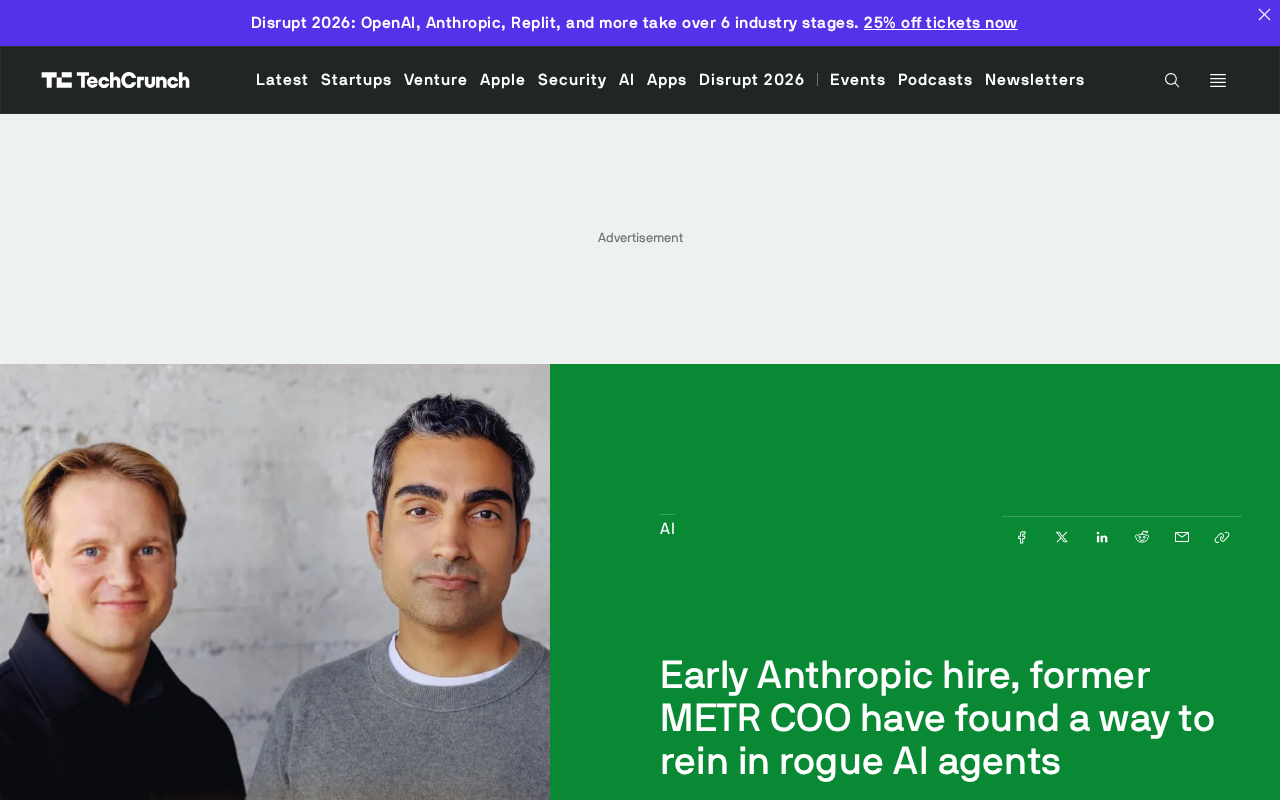
AIUC's founding team is worth a closer look. According to the original report, the team includes an early Anthropic employee and the former Chief Operating Officer of METR (Model Evaluation and Threat Research), an organization focused on evaluating AI model capabilities and researching potential threats.
This combination is no coincidence. Anthropic is known for its deep commitment to AI safety, while METR is one of the field's foremost organizations dedicated to assessing the capabilities and potential dangers of frontier models. Founders with experience at both institutions signals that AIUC isn't building a generic commercial insurance product — it's building a specialized underwriting business grounded in a sophisticated technical understanding of AI system risk.
METR (Model Evaluation and Threat Research) was founded in 2023, evolving from ARC Evals. It was commissioned by both OpenAI and Anthropic to conduct independent capability evaluations and safety testing prior to the releases of GPT-4 and Claude 2. The organization focuses on assessing whether frontier models possess high-risk capabilities such as autonomous self-replication, deceptive manipulation, or the ability to assist in large-scale destructive activities — and its findings directly influence whether a model is released publicly. This background means AIUC's founding team doesn't just understand general AI system risk; they are intimately familiar with the extreme scenarios that top safety researchers genuinely worry about. That's a rare cognitive asset when building an actuarial framework for AI risk.
"Reining In Rogue AI Agents"
The phrase "rein in rogue AI agents" from the original headline cuts to the heart of AIUC's core value proposition. As enterprises increasingly deploy AI agents capable of executing tasks autonomously — from customer service automation and code generation to business process decision-making — these systems can produce erroneous or even harmful behavior due to training biases, adversarial inputs, or unexpected edge cases.
Traditional insurance lacks the methodology to assess this kind of risk. How do you quantify the probability that a large language model will make a mistake? How do you price a policy for an AI system that continuously learns and whose behavior keeps changing? AIUC's approach is to combine AI safety evaluation methodology with traditional insurance underwriting mechanisms, offering enterprises a risk-transfer solution for AI agent deployments.
This creates a powerful dual incentive: enterprises can purchase coverage to hedge against potential losses from AI failures, while the underwriter — motivated to control its own claims exposure — pushes insured companies toward safer AI practices and more rigorous evaluation processes. The net effect is a market-driven mechanism that raises the overall safety bar across the industry.
What distinguishes AI agents from ordinary large language models is their capacity for action: they don't just generate text — they can invoke external tools, execute code, query databases, send requests, and even control operating system interfaces. This capability enables them to complete complex, multi-step tasks across disparate systems, while simultaneously amplifying the consequences of any mistake. A single misjudgment can trigger a cascade of irreversible real-world operations. Widely used agent frameworks today include LangChain, AutoGen, and native Agent APIs from major model providers. Because agents operate across a broader attack surface, the losses they cause can involve data breaches, erroneous financial transactions, compliance violations, and other quantifiable business damages — providing a concrete, real-world basis for designing insurance payouts.
A New Category Taking Shape
AIUC's emergence reflects an inevitable trend in the maturation of the AI industry. As the central question shifts from "can it be built?" to "can it be deployed reliably, safely, and accountably at scale?", the surrounding infrastructure for risk governance naturally follows. Insurance, as one of the modern economy's core tools for managing uncertainty, was always going to find its way into AI.
From an investment perspective, Ribbit Capital's decision to lead this round — as a firm with deep roots in fintech — reflects a strategic bet on AI risk pricing as a genuine cross-sector opportunity. If AIUC can validate its business model, it could catalyze the formation of a broader ecosystem of AI underwriting, AI auditing, and AI compliance services built around trustworthy AI deployment.
Key Questions to Watch
Despite the novelty of the direction, AIUC faces very real challenges. Quantifying AI risk remains an unsolved problem — the unpredictability of large model behavior, the absence of long-term historical claims data, and the rapidly shifting risk profile driven by continuous technological iteration all make actuarial modeling genuinely difficult.
Furthermore, determining liability when AI causes harm — whether it falls on the model provider, the deploying enterprise, or the underwriter — raises complex legal and regulatory questions for which no unified global framework yet exists. Whether AIUC can translate its team's deep technical expertise into a sustainable commercial insurance product will require time and real-world case validation.
Regardless, AIUC's funding round marks a meaningful milestone: AI governance is moving beyond purely technical and policy discussions and into concrete commercial practice. For the long-term health of the industry, that may well be a positive signal.
AI liability remains largely a legal vacuum. The EU AI Act imposes compliance requirements on high-risk AI systems, but the chain of civil liability when an agent causes harm remains unclear. In the United States, there is no unified federal AI liability legislation; existing product liability and tort law frameworks are applied by analogy. This regulatory uncertainty cuts both ways for AIUC. It's a risk — policy terms may lack judicial certainty — but it's also an opportunity: if AIUC accumulates real claims precedents, it could become an important reference point in the development of future regulatory frameworks, further cementing its market position.
Related articles

HuggingFace Censorship Begins? Removed Model Sparks Community Debate
HuggingFace restricted an abliterated GLM model labeled "for offensive cyber," sparking debate about open-source platform censorship, model governance, and transparency.

Cayu: An Open-Source Python Framework for Building Long-Horizon Domain-Specific Agents
Cayu is an open-source Python framework for building domain-specific, long-horizon AI agents. It lets developers assemble a harness of tools, knowledge, and business rules, backed by an integrated durable runtime handling sessions, state, recovery, approvals, and observability.

Is Social Media Really Harming Teenagers? A Scientific Debate Without a Clear Answer
Jonathan Haidt's 'The Anxious Generation' blames social media for teen mental health decline, but academics debate whether the causal link holds up to scrutiny.