Is Social Media Really Harming Teenagers? A Scientific Debate Without a Clear Answer

Haidt's 'The Anxious Generation' blames social media for teen mental health crises, but the causal claim faces serious methodological challenges.
Social psychologist Jonathan Haidt argues in 'The Anxious Generation' that the sharp decline in adolescent mental health since 2010 is mainly driven by social media and smartphones — a claim that has already spurred real-world policies like school phone bans. However, academics raise significant concerns: the temporal overlap between the teen mental health crisis and social media's rise does not establish causation, and concurrent factors like economic stress, academic pressure, and global uncertainty are plausible confounders. The broad and behaviorally diverse nature of 'social media' makes precise measurement difficult. The article calls for taking the adolescent mental health crisis seriously while maintaining scientific caution toward oversimplified causal narratives.
How a Bestseller Ignited the Social Media Debate
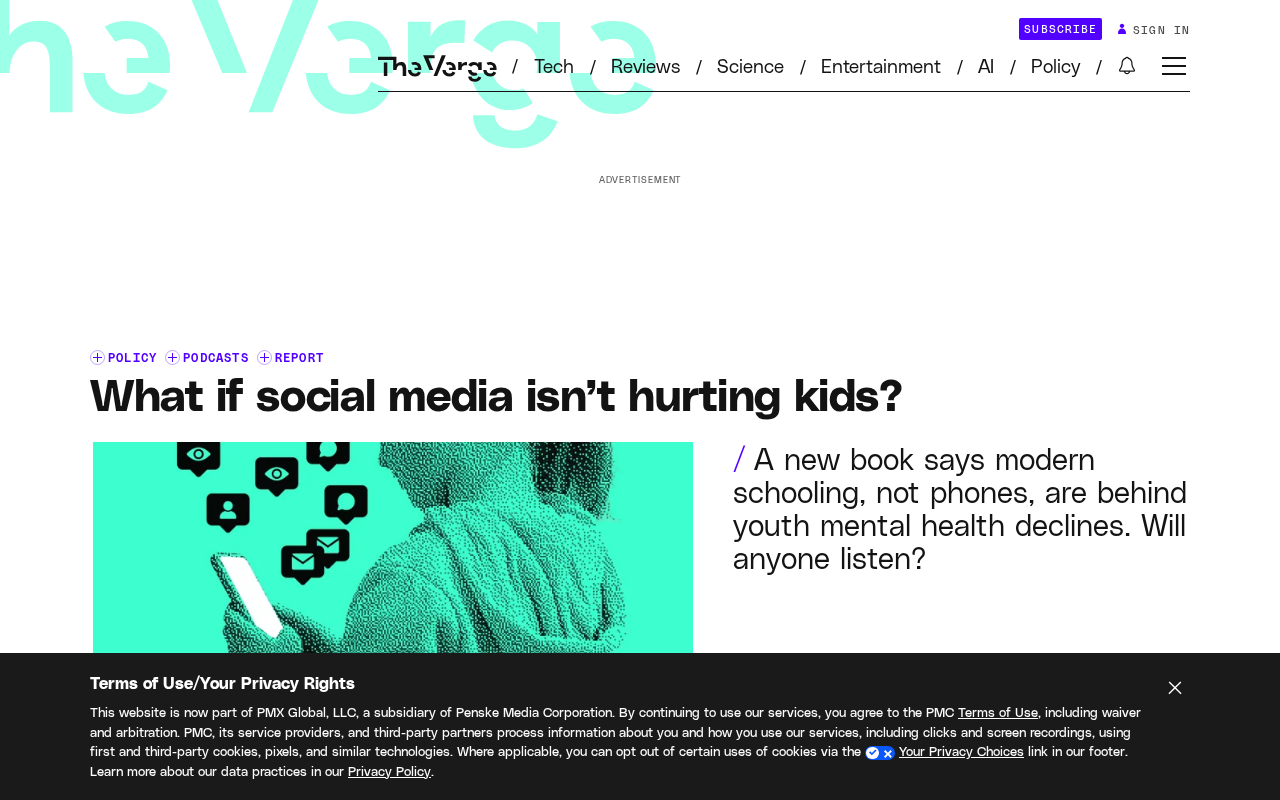
Two years ago, social psychologist Jonathan Haidt published The Anxious Generation, which quickly climbed to the top of the New York Times bestseller list. The book's central argument is straightforward: the significant decline in adolescent mental health since 2010 is primarily due to the widespread adoption of social media and smartphones.
This view rapidly transcended academic discussion, becoming a rallying cry for a broader societal pushback against social media. Parents, educators, and policymakers alike found resonance in it — that intuitive sense that screens are eroding the next generation finally had systematic backing from a prominent scholar.
Correlation Is Not Causation
Yet Haidt's claims have also sparked considerable disagreement within academic circles. At the heart of the controversy lies a classic methodological challenge: the deterioration of adolescent mental health and the rise of social media do closely coincide in time, but temporal overlap alone cannot prove that one caused the other.
Critics point out that many other social changes occurred around 2010 simultaneously — economic pressures, intensified academic competition, shifts in the media environment, and a growing sense of global uncertainty. Reducing the complex adolescent mental health crisis to "it's the phone's fault" may overlook broader structural factors. Establishing a reliable causal chain requires more than correlation data; it demands rigorous experimental designs capable of ruling out other variables.
In epidemiology and social science, distinguishing correlation from causation is the most fundamental — and most easily overlooked — methodological principle. The "confounding variable" lies at the core of this problem: when A and B both rise together, a third factor C may be driving both, rather than A causing B. In research on adolescent mental health, potential confounders that emerged around 2010 include financial pressures on families following the global financial crisis, eco-anxiety driven by climate change, and intensive media coverage of disasters. To establish causation methodologically, researchers typically rely on tools such as randomized controlled trials (RCTs), regression discontinuity designs, and difference-in-differences methods — all of which are extremely difficult to implement in social media research for ethical and practical reasons. This is precisely why debate in this field persists.
Why This Question Is So Hard to Answer
Research on the effects of social media has struggled to reach firm conclusions largely because of the inherent complexity of the subject. Adolescent mental health is shaped by countless interacting factors — family environment, socioeconomic status, peer relationships, and more. Isolating the precise effect of a single variable, such as time spent on social media, is methodologically daunting.
Furthermore, "social media" is not a monolith. Scrolling through short videos, messaging friends privately, browsing news, participating in interest-based communities — these behaviors can have vastly different effects on different individuals, and may even push in opposite directions. Measuring the overall impact under a single umbrella label risks obscuring the very real differences beneath it.
The Real-World Stakes of This Debate
This is not a purely academic exercise. Haidt's arguments have already influenced actual policy: multiple jurisdictions have begun discussing or implementing smartphone bans in schools and age restrictions on social media platforms. If causal relationships have not been sufficiently established, public policies built on these premises risk being misdirected — potentially missing the real intervention points while producing unintended side effects.
At the same time, the very framing of "is social media really harming kids?" is worth reflecting on. It reminds us that when facing complex social phenomena, intuitive attribution is always tempting — but a scientific mindset demands caution, acknowledgment of the limits of existing evidence, and openness to alternative possibilities.
In the history of science, it is far from rare for public policy to move faster than evidence — sometimes called "policy ahead of evidence." The potential unintended consequences of blanket smartphone bans in schools deserve attention: phones are also tools through which some adolescents access mental health resources, stay in contact with family members, or report campus safety incidents. A one-size-fits-all ban may sever these use cases entirely. Moreover, the symbolic effects of a policy can sometimes feed back into the research agenda — once a measure is widely implemented, political pressure to justify it may impede objective evaluation of contradictory evidence, creating a cognitive feedback loop. This is not an argument against policy action, but an emphasis that any intervention should include built-in evaluation mechanisms so that it can be adjusted in response to new evidence.
Conclusion: Between Certainty and Doubt
Haidt's book has succeeded in pushing adolescent mental health to the center of the public agenda, and that itself has value. But a responsible conversation requires neither casually accepting the optimistic claim that social media is harmless, nor blindly declaring it the culprit. The truth likely lies somewhere in the gray zone between these poles, and will require more rigorously designed long-term studies to gradually bring into focus.
Until the evidence is more conclusive, perhaps the most rational position is this: take the real crisis of adolescent mental health seriously, while maintaining healthy skepticism toward oversimplified causal narratives.
Related articles

LynnReal-Omni: 32B Unified Video Diffusion Model Goes Open Source with Multi-Task Coverage in Four Steps
LynnReal-Omni is a 32B unified video diffusion model on MiniMax H3, covering text-to-video, pose guidance, style transfer, restoration in 4 steps. Flash version generates 540p video in 377ms on one H100.

Anthropic Co-Founder: AI 'Kill Switch' May Need to Be Mandatory by Law
Anthropic's co-founder tells the BBC that AI 'kill switches' may need to be legally mandated. We analyze the industry logic, technical challenges, and the tension between regulation and innovation.

The AI Data Center Boom Is Colliding With Cities Scarred by Heavy Industry
The AI data center boom is clashing with post-industrial communities. Philadelphia's case reveals structural conflicts between AI growth, energy use, water, and environmental justice.