HuggingFace Censorship Begins? Removed Model Sparks Community Debate

HuggingFace restricted a model explicitly labeled for cyberattacks, with community debate focusing on transparency over the takedown itself.
HuggingFace recently restricted an abliterated GLM derivative whose name contained "for offensive cyber," triggering a Reddit debate about whether open-source platforms are beginning to censor content. Abliterated models — which have their safety refusal mechanisms removed — are common in open-source research, but explicitly labeling one for malicious cyberattacks is a different matter. Interestingly, the original poster largely accepted the platform's rationale; the real frustration was the vague "disabled" notice with no explanation of which rule was violated. The incident highlights the enduring tension between open ecosystems and legal compliance, and how rule transparency ultimately shapes community trust.
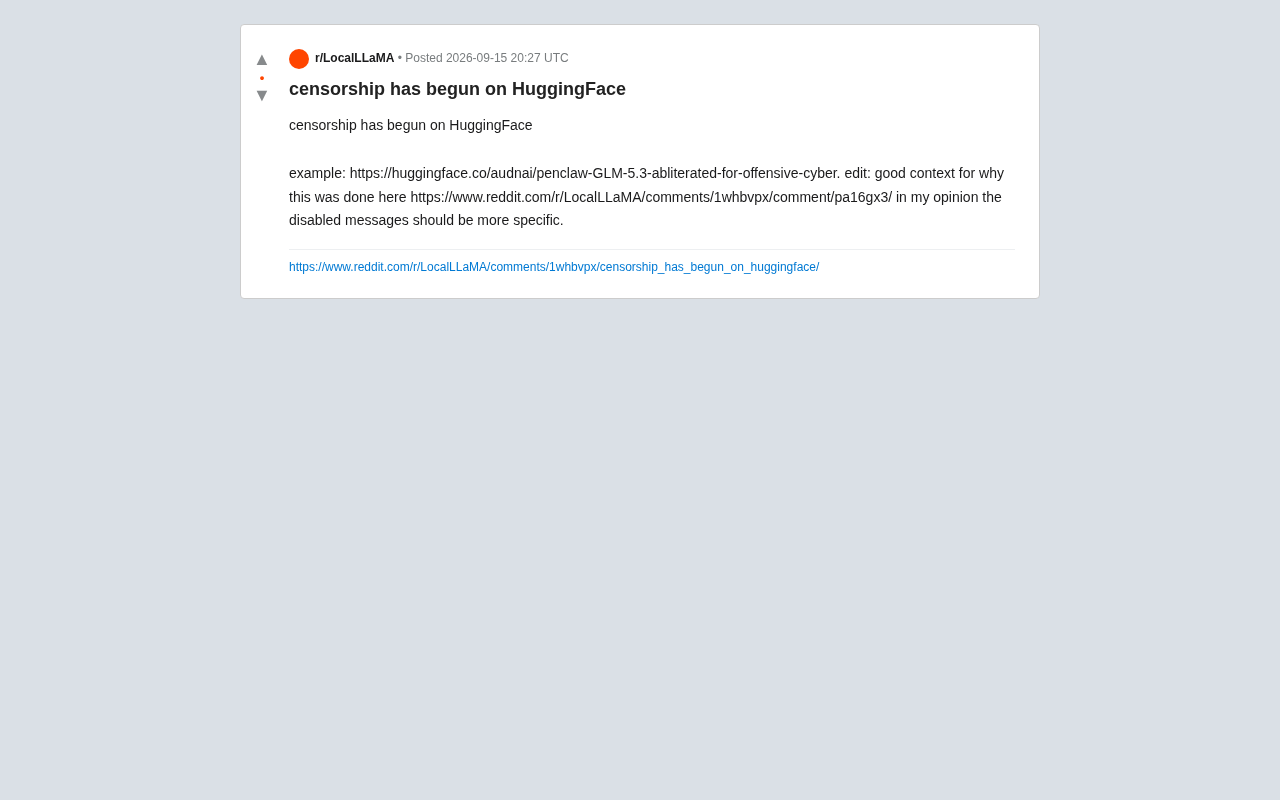
Recently, a post titled "censorship has begun on HuggingFace" sparked heated discussion in Reddit's LocalLLaMA community. Users discovered that a model repository named penclaw-GLM-5.3-abliterated-for-offensive-cyber had been restricted on the platform, with related messaging disabled. Some community members interpreted this move as a signal that the open-source model hosting platform is shifting toward content moderation.
What Happened
According to the Reddit post, the model in question is a GLM derivative that has been "abliterated" — meaning its safety alignment and refusal mechanisms have been stripped out — with the explicit label "for offensive cyber" in its name. These types of models typically use technical methods to remove the original model's safety guardrails, allowing them to respond to requests that would otherwise be rejected.
The original poster acknowledged that, given the context provided in the community discussion, the platform's action "had its reasons." What actually sparked controversy wasn't the takedown itself, but how it was carried out — the poster argued that the "disabled" notice displayed by the platform was too vague and should have more specifically explained the reason for the restriction, so developers and users could clearly understand which rule had been triggered.
Why "Abliterated" Models Are Sensitive
To understand this controversy, it helps to first clarify the nature of "abliterated" models. Most mainstream large language models undergo safety alignment training before release, causing them to refuse requests to generate malware code, assist with cyberattacks, or produce illegal content. "Abliteration" is a technique that weakens or removes these refusal behaviors by modifying the model's internal activation directions, making the model effectively "compliant with any request."
Plain uncensored models are actually quite common in the open-source community — many researchers use them to test capability boundaries or conduct safety research. But when a model is explicitly named with "offensive cyber" as its stated purpose, the situation is fundamentally different: it amounts to publicly labeling the model with a clear malicious use intent on an open platform. This is the core reason many in the community considered platform intervention reasonable.
From a technical standpoint, "abliteration" is typically implemented using methods such as activation steering or representation engineering. Researchers first identify the activation direction vectors most strongly associated with "refusal behavior" inside the model, then apply a counter-intervention in that direction during inference or fine-tuning, systematically suppressing the tendency to refuse. This approach was systematized by Andy Zou et al. in the 2023 paper Representation Engineering and has since been widely adopted by the community for model unlocking experiments. Compared to traditional fine-tuning, abliteration requires minimal computational resources and can be applied directly to existing model weights — which explains why derivative models of this kind can proliferate so rapidly. Because the technical barrier is low and the results are clear, a hosting platform's stance on models that "explicitly declare malicious intent" also sends a signal to the community: the line the platform draws is not the technical method itself, but the publicly stated use intent.
Content Censorship or Compliance Necessity?
This incident touches on a long-standing tension in the open-source AI community: the balance between platform freedom and legal compliance and platform liability.
Those who support the platform's action argue that hosting a model that openly bills itself as a tool for cyberattacks creates real legal and reputational risk for the platform. As the world's largest open-source model hosting platform, HuggingFace has legitimate reasons to draw a line at content with obvious malicious intent — and this is fundamentally different from suppressing normal research-oriented or uncensored models.
Those with reservations worry about the slippery slope implied by the headline "censorship has begun" — if today's removal targets a model explicitly labeled for malicious use, will tomorrow's standards expand to cover ordinary uncensored models or even research models? The vitality of the open-source ecosystem comes precisely from its low barriers to entry, and any censorship mechanism risks creating a chilling effect.
HuggingFace's legal position as a model hosting platform resembles that of code hosting platforms like GitHub in some ways, but it also faces additional challenges. Regulations such as the U.S. Computer Fraud and Abuse Act (CFAA) and the EU Cyber Resilience Act both create potential liability for platforms that "knowingly provide tools that can be used in cyberattacks." At the same time, HuggingFace launched its own Acceptable Use Policy in 2023, which explicitly prohibits hosting models "designed to cause harm." As a result, this restriction is more likely a routine enforcement of existing policy than a sudden escalation of censorship. Understanding this legal and policy context helps distinguish between two very different situations: "the platform proactively tightening its rules" versus "the platform fulfilling its existing compliance obligations."
Transparency Is the Real Pain Point
Notably, the original poster's actual grievance was quite measured. Rather than opposing the takedown outright, the criticism was directed at the transparency of enforcement: the disabled notice the platform displayed was too vague.
This points to a common problem in platform governance. When a platform begins moderating content, vague, one-size-fits-all notices tend to inflame tensions and leave developers feeling arbitrarily banned. By contrast, clearly stating something like "restricted because the name/description explicitly indicates malicious cyber use" would both leave genuine violators with nothing to complain about and reassure ordinary researchers that the platform is targeting malicious intent, not the technology itself.
For any content platform, the clarity of its rules and the consistency of their enforcement typically determines community trust more than whether those rules are strict or lenient. This discussion around a single model is, in effect, an early stress test of open-source AI platform governance.
Summary
This incident remains an isolated case and is not yet sufficient to conclude that HuggingFace is systematically tightening its content policies. The model that was actioned carried an explicit label indicating offensive cyber use, making it a fairly exceptional edge case. But the community reaction reminds us that as open-source model capabilities continue to grow, how platforms draw the line between openness and responsibility — and how transparently they communicate those boundaries — will become an unavoidable issue for the entire ecosystem.
Related articles

LynnReal-Omni: 32B Unified Video Diffusion Model Goes Open Source with Multi-Task Coverage in Four Steps
LynnReal-Omni is a 32B unified video diffusion model on MiniMax H3, covering text-to-video, pose guidance, style transfer, restoration in 4 steps. Flash version generates 540p video in 377ms on one H100.

Anthropic Co-Founder: AI 'Kill Switch' May Need to Be Mandatory by Law
Anthropic's co-founder tells the BBC that AI 'kill switches' may need to be legally mandated. We analyze the industry logic, technical challenges, and the tension between regulation and innovation.

The AI Data Center Boom Is Colliding With Cities Scarred by Heavy Industry
The AI data center boom is clashing with post-industrial communities. Philadelphia's case reveals structural conflicts between AI growth, energy use, water, and environmental justice.