Algorithm Role or Application Role? Breaking Down Large Model Job Directions

Algorithm roles build models, application roles use models; choose your path based on your own cards and prove your ability with projects.
The article revolves around the choice between algorithm roles and application deployment roles for job seekers as the large model hiring window approaches. It clarifies that algorithm roles focus on pre-training, fine-tuning, alignment, and evaluation, while application roles focus on RAG, agents, workflow orchestration, and business integration, and notes that demand is shifting from pure research to engineering deployment. It then gives advice for new graduates and career changers: new graduates should use projects and quantifiable metrics on resumes, focusing on RAG retrieval and reranking, agent tool calling, and inference optimization; career changers should take the "original position + large models" transfer path and use real work outputs rather than homogeneous training class projects as endorsements. Finally, it discusses the preparation rhythm for the hiring window at the end of 2026, emphasizing that application role interviews also test understanding of principles.
Title
Algorithm Role or Application Role? Breaking Down Large Model Job Directions
Meta Description
Should you choose an algorithm role or an application deployment role for large model jobs? This article breaks down the capability differences between the two paths, the preparation focus for new graduates and career changers, and how to write resumes and prepare for interviews with RAG and agent projects.
Article Content
As the large model hiring window approaches, many people are torn between "algorithm roles" and "application deployment roles." This choice not only affects how you write your resume and prepare projects, but also determines your career path for the next two to three years. Combining the two teachers' discussion of the 2026 hiring window in the livestream, as well as the common confusions of new graduates and career changers, let's clarify the differences between the two paths.

The Essential Difference Between the Two Paths
The core of algorithm roles is "building models": pre-training, fine-tuning, alignment, evaluation, focusing on loss curves and benchmarks. The core of application deployment roles is "using models": RAG, agents, workflow orchestration, business integration, focusing on effectiveness, cost, and delivery.
The livestream mentioned a key judgment: the demand for large model positions is shifting from "pure research" to "engineering deployment." Companies don't lack people who can tune parameters; they lack people who can turn model capabilities into products. This is not to say algorithm roles are unimportant, but that the gap in application roles is more directly reflected in the number of hires.
For job seekers, choosing which path first depends on your own foundation. If you have strong math and paper-reading skills, and have top-tier conference or lab experience, algorithm roles are a natural extension; if you have strong engineering skills and are familiar with backend and business logic, application deployment roles have a higher conversion rate.

RAG (Retrieval-Augmented Generation) refers to retrieving relevant document fragments from an external knowledge base before the large model generates an answer, then splicing them as context into the prompt so the model answers based on the retrieved evidence. It solves problems such as outdated knowledge, inability to access private data, and easy hallucination of large models. In engineering, it is usually split into four stages: indexing, retrieval, reranking, and generation. Among them, retrieval quality determines the upper limit, and reranking determines precision. Common interview questions include: why do reranking, how to fuse vector retrieval and keyword retrieval, and how chunk splitting granularity affects recall.
Agent refers to a system that lets a large model autonomously make decisions in a loop, call tools, observe results, and correct the next action. Core components include planning, tool calling, memory, and reflection. Engineering difficulties lie in handling tool call failures, termination conditions for infinite loops, and reliability evaluation of multi-step tasks. This is fundamentally different from a simple question-answering bot, and is also a high-frequency assessment point in application role interviews.
New Graduates: What to Focus on Learning and How to Write Your Resume
The biggest mistake new graduates make is "learning a little bit of everything." The livestream repeatedly emphasized that writing "familiar with Transformer" on a resume is meaningless; instead, write "used a certain model to complete a certain task, with metrics improved from A to B."
The focus of the application direction is threefold: RAG retrieval and reranking, agent tool calling and planning, and inference optimization on the deployment side. It is recommended to pair each with a demonstrable project, not a course assignment.
The algorithm direction should highlight data construction and experimental design capabilities. Even without large model pre-training resources, a complete loop of fine-tuning plus evaluation can demonstrate methodology. Writing clearly on your resume "what you did, how you measured it, and what the result was" is far more effective than piling up model names.

Inference optimization is a key capability on the deployment side of application roles, referring to reducing model inference latency and cost while maintaining acceptable effectiveness. Common methods include quantization (such as INT8, INT4), KV Cache management, batching and continuous batching, speculative decoding, and model distillation. Common interview questions include: how much accuracy loss quantization brings, how to balance throughput and latency, and what scenarios are suitable for replacing large models with small models. Mastering these concepts and being able to explain their applicable boundaries demonstrates engineering depth better than merely calling APIs.
Career Changers: Find Transferable Points from Existing Experience
The livestream mentioned students with backgrounds in Java, frontend, testing, and operations who want to transition to large models. The advantage of such job seekers is engineering experience and business understanding; the disadvantage is the lack of AI project endorsements.
A pragmatic path is "original position + large models": backend developers transition to RAG serviceization, frontend developers to the agent interaction layer, and testers to model evaluation and red teaming. In this way, the projects on your resume are real work outputs, not hastily assembled demos.
What to be wary of is the homogenization of "training class projects." Interviewers have seen too many identical question-answering bots; differentiation comes from whether the problem you solved is real and whether the metrics are reproducible.

Red Teaming originated in the security field. In the context of large models, it refers to actively constructing adversarial inputs to systematically probe model harmful outputs, jailbreak vulnerabilities, biases, and factual errors. For career changers with a testing background, this is a low-barrier, high-value transition path: it requires designing test case sets, defining pass criteria, quantifying risk levels, and driving the fix loop. Related capabilities also include evaluation set construction and automated evaluation pipelines, which are explicitly stated requirements in application role hiring.
Hiring Window and Preparation Rhythm
The livestream mentioned that the end of 2026 is a hiring window worth seizing, and the time nodes before the new year have a practical impact on the job search rhythm. For preparation, it is recommended to work backwards: leave buffer time for project wrap-up, resume polishing, fundamentals review, and mock interviews.
One easily overlooked point: application role interviews also ask about principles. Why does RAG need reranking, why do agents get stuck in tool-calling infinite loops—these questions test depth of understanding, not memorization.
Common Questions
Are algorithm roles more demanding? Academic and paper requirements are indeed stricter, but application roles also have high requirements for engineering ability; they just examine different dimensions.
Can I apply without large model experience? Yes, but you need to prove your learning ability with projects. Traditional machine learning or backend experience is transferable.
Can I switch between the two paths later? Switching from application to algorithm is harder, while switching from algorithm to application is relatively smoother, because the cost of catching up on the engineering side is lower.
Summary
Algorithm roles and application deployment roles are not about superiority or inferiority, but about differences in capability structure. Before choosing a path, take stock of your own cards, then use projects to turn your capabilities into verifiable evidence. The hiring window is external, while the preparation rhythm is internal. Grasp the latter firmly, and the former will be meaningful.
One-line Summary
Algorithm roles build models, application roles use models; choose your path based on your own cards and prove your ability with projects.
Paragraph Summary
The article revolves around the choice between algorithm roles and application deployment roles for job seekers as the large model hiring window approaches. First, it clarifies the essence of the two paths: algorithm roles focus on pre-training, fine-tuning, alignment, and evaluation, while application roles focus on RAG, agents, workflow orchestration, and business integration, and points out that demand is shifting from pure research to engineering deployment. Then it gives advice for new graduates and career changers respectively: new graduates should write resumes with projects and quantifiable metrics, and the application direction should focus on RAG retrieval and reranking, agent tool calling, and inference optimization; career changers should take the transfer path of "original position + large models" and use real work outputs rather than homogeneous training class projects as endorsements. Finally, it discusses the preparation rhythm for the hiring window at the end of 2026, emphasizing that application role interviews also test understanding of principles.
Related articles

64 Releases in 40 Days: How Strata Uses Release Velocity to Define Its AI Local Inference Roadmap
Strata shipped 64 releases in 40 days with 460k+ characters of notes. From 0.1.0 to 0.2.10, a three-step path: make it run, make it fast, make it trustworthy.
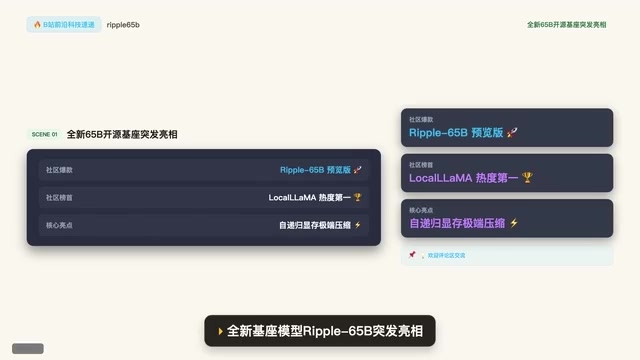
Ripple-65B Open-Source Model Tops Community Charts
Ripple-65B open-source LLM debuts atop community charts, using a self-recursive architecture to slash long-context KV cache for low-latency hundred-billion-scale inference on ordinary GPUs, with preview weights, quantized files, and one-click Olema & VLM deployment.

Deploy Open-Source Video Model MiniMax H3 Locally in 5 Minutes and Skip Cloud Generation Fees
Bilibili creator tests local deployment of open-source video model MiniMax H3: three-step ComfyUI install, 5-minute setup, no coding. Same prompt generates in 2 minutes locally vs 4 minutes online with queuing, saving about 30 RMB per 15-second 720P video. Includes VRAM requirements and RTX 5080 test results.