ALHR: How O(NlogN) Attention Maintains 97% Accuracy on Long Contexts

Developer proposes ALHR, using learnable binary tree routing to cut attention complexity from O(N²) to O(NlogN) — but awaits independent validation.
Standard Transformer self-attention scales at O(N²), causing memory to explode in long-context scenarios. A Reddit developer's ALHR (Adaptive Learnable Hierarchical Routing) organizes Keys in a static binary tree with learnable routing functions, letting each Query traverse only a subset of Keys and reducing complexity to O(NlogN). Unlike fixed sparse attention, the learnable routing lets the model adaptively decide what to attend to during training. The author claims 97% accuracy on the MQAR associative recall benchmark, suggesting sparsification doesn't heavily degrade retrieval. However, all claims come from a single developer post with no paper, open-source code, or reproducible comparisons — treat it as a promising concept, not a proven solution.
The Attention Bottleneck in Long Contexts
The self-attention mechanism at the heart of the standard Transformer architecture is also one of its biggest performance bottlenecks. Its computational complexity is O(N²) — when sequence length N doubles, both compute and memory usage grow fourfold. This means that processing long documents, extended conversation histories, or large codebases causes VRAM consumption to spiral out of control fast.
A Reddit developer recently shared a new approach he built: ALHR (Adaptive Learnable Hierarchical Routing). According to the author, this system reduces attention complexity to O(N log N) while maintaining approximately 97% accuracy on long-context tasks. While this comes from a single developer's own account, the design is worth breaking down from a technical perspective.
To put the O(N²) pressure in concrete terms: storing an attention matrix in common FP16 precision requires roughly 32MB at sequence length 4,096, but balloons to around 8GB at sequence length 32,768 (32K tokens) — and that's just the attention matrix alone, already pushing the limits of a consumer GPU's total VRAM. This is why commercial models like GPT-4 and Claude, despite claiming support for 100K+ token contexts, must rely on memory optimization techniques like FlashAttention (which avoids instantiating the full N² matrix by computing in chunks) or dedicated hardware clusters. For individual developers, running a full-attention model beyond 8K tokens on a single consumer GPU is practically infeasible — and that's precisely why efficient attention research remains so active.
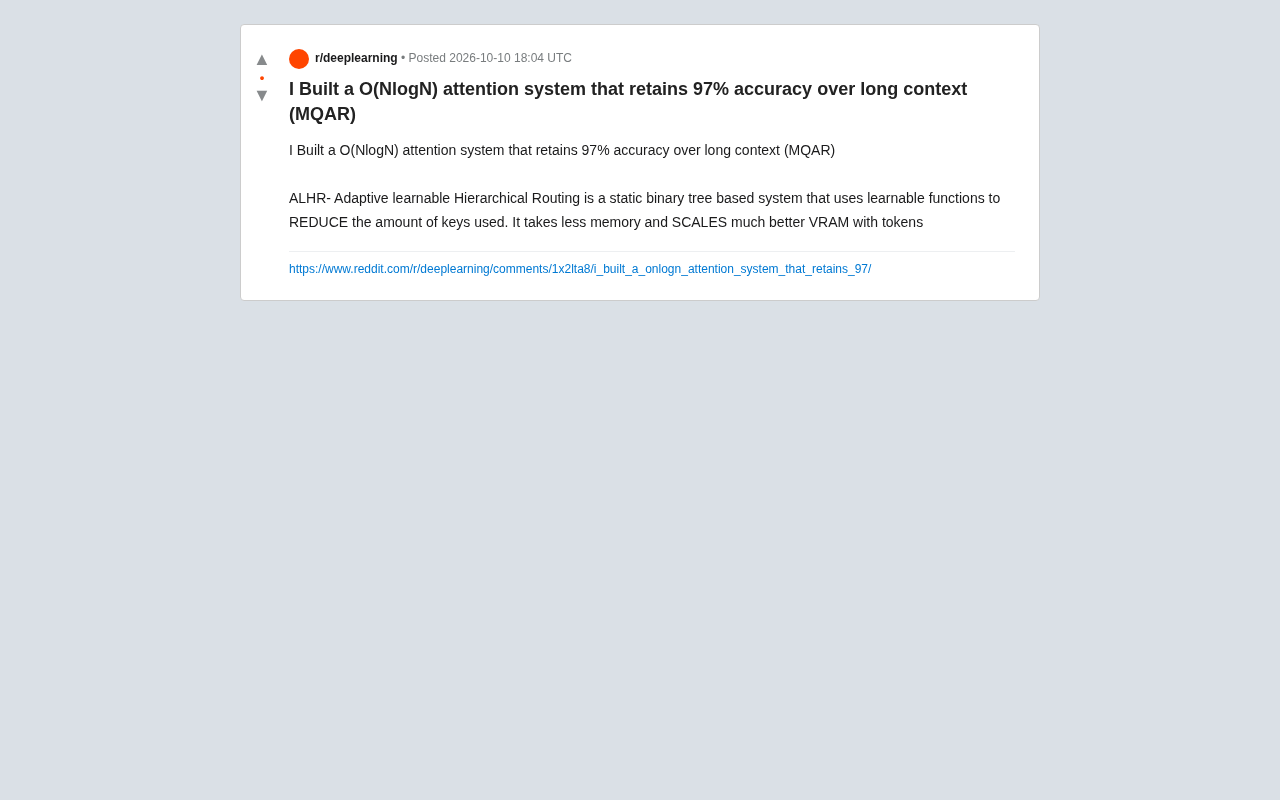
ALHR's Core Idea: Reducing Key Count Through Hierarchical Routing
According to the author, ALHR is a static binary tree-based system whose core mechanism uses learnable functions to reduce the number of Keys that actually participate in attention computation.
The intuition is straightforward: in standard attention, every Query computes dot products with every Key in the sequence — the root cause of O(N²) complexity. ALHR organizes these Keys in a binary tree, then routes each Query through the tree structure to access only a relevant subset of Keys rather than all of them.
Why O(N log N)
A binary tree has depth on the order of log N. If each Query retrieves Keys by traversing log N levels of the tree rather than scanning all N Keys, then the total complexity for N Queries drops from N×N to N×log N. This is the complexity advantage that hierarchical structures provide — analogous to the improvement binary search offers over linear search.
The Critical Role of "Learnable"
The "Learnable" in ALHR's name is what distinguishes it from fixed sparse patterns. The problem with fixed sparse attention (e.g., local windows, fixed-stride jumps) is that it presupposes which positions are important, limiting flexibility. ALHR instead uses learnable routing functions to decide which tree paths to follow and which Keys to retain, letting the model learn during training where it should attend. In theory, this preserves the efficiency gains of sparsity while approaching the expressive capacity of full attention.
Memory and Scalability Advantages
The author specifically highlights two benefits: lower memory footprint and better VRAM scaling with token count.
These address the most practical pain points in long-context modeling. Under O(N²) attention, the attention matrix itself requires N²-scale memory — often more than the model parameters. Reducing complexity to O(N log N) significantly flattens the memory growth curve, theoretically allowing the same hardware to handle much longer context sequences. For developers looking to run long-context models on consumer GPUs, this kind of improvement has direct appeal.
The MQAR Benchmark: What Does 97% Accuracy Mean?
The MQAR benchmark the author references stands for Multi-Query Associative Recall — a commonly used synthetic benchmark for evaluating whether efficient attention or state-space models can truly "remember" information across long contexts.
MQAR matters because many linear or sparse attention methods, while faster, lose the ability to precisely retrieve historical information — they run quickly but "forget" critical details. MQAR specifically tests whether a model can accurately recall specific key-value associations within long sequences.
Achieving 97% accuracy on this task, if accurate, would suggest that ALHR's Key pruning doesn't discard important information along with the irrelevant — that sparsification preserves recall quality. This is precisely the key metric for determining whether an efficient attention scheme is genuinely useful, since efficiency and accuracy are often in tension.
A Measured Take: More Validation Is Needed
It's important to note objectively that all of this information comes from a single developer's Reddit post, with no accompanying paper, code repository, or fully reproducible experimental results. Several key questions remain unanswered:
- At what sequence length and MQAR configuration was the 97% accuracy measured?
- How does actual throughput and VRAM usage compare against mainstream efficient alternatives like FlashAttention, linear attention, and Mamba?
- Does the static binary tree's routing generalize stably across different data distributions?
Efficient attention is a hot area of AI research, with extensive prior work spanning Longformer, BigBird, various linear attention approaches, and state-space models. ALHR's approach of using learnable hierarchical routing to balance efficiency and recall is conceptually sound, but its real value depends on whether the code eventually gets open-sourced along with rigorous, reproducible comparison experiments.
Existing mainstream efficient attention approaches provide useful reference points: Longformer and BigBird use fixed local windows plus global token sparse patterns, reducing complexity to O(N) but sacrificing direct connections between arbitrary positions; linear attention methods (e.g., Performer, RWKV) approximate attention via kernel functions to achieve O(N) complexity, but typically show noticeably weaker precise recall compared to full attention; state-space models like Mamba abandon the attention matrix entirely in favor of recurrent hidden states for O(N) complexity, performing well on language modeling but still lagging on tasks requiring precise key-value retrieval; FlashAttention achieves large reductions in peak VRAM through IO-aware tiled computation without changing the mathematical equivalence — an engineering optimization rather than an algorithmic complexity improvement. ALHR's claimed O(N log N) sits in this landscape at a position of "more flexible than fixed sparse, more precise than linear approximation" — a reasonable positioning in principle, but whether it can deliver both simultaneously in practice is exactly what rigorous comparison experiments need to verify.
Summary
ALHR represents a concrete engineering attempt in the efficient attention space: organizing Keys in a static binary tree, using learnable routing functions to select which Keys participate in computation, thereby reducing attention complexity from O(N²) to O(N log N) and claiming 97% recall accuracy on MQAR. For long-context and memory-constrained scenarios, this direction has genuine practical relevance. But until more thorough validation emerges, it's best treated as a promising technical concept rather than a proven solution.
Related articles

Gaussian Process Bandit Optimization: Exploration Strategies and Inference Regret Guarantees
Cumulative regret guarantees in Bayesian optimization fail to reflect final recommendation quality. This article examines a new study that provides inference regret guarantees for Gaussian process bandit optimization through exploration query strategies and fill distance analysis, validated on hyperparameter optimization and control tasks.

The Most Detailed Codex Guide on Bilibili: From Installation to Real-World Practice
The most detailed Codex guide on Bilibili: from app store installation to daily work mode configuration, with a real coffee shop project demonstrating file organization, data extraction, dashboard creation, and other practical tasks. Learn to use Plan Mode and desktop pets to leverage Codex efficiently.

Appearance Compensation in Volume Rendering: Why RGB Accuracy Cannot Guarantee Density Correctness
Volume rendering research reveals that volumetric data perfectly reproducing external RGB views may still contain density errors: appearance compensation can double central density and keep external rays unchanged even when L2 error exceeds 14.52%. Density recovery depends on appearance capacity, spatial resolution, and measurement design.