Alibaba Raises DeepSeek V4 Flash Output Price by 230%: Is an AI Inference Cost Inflection Point Approaching?

Alibaba raised DeepSeek V4 Flash 0731's output price by 230%, sparking concern over inference costs.
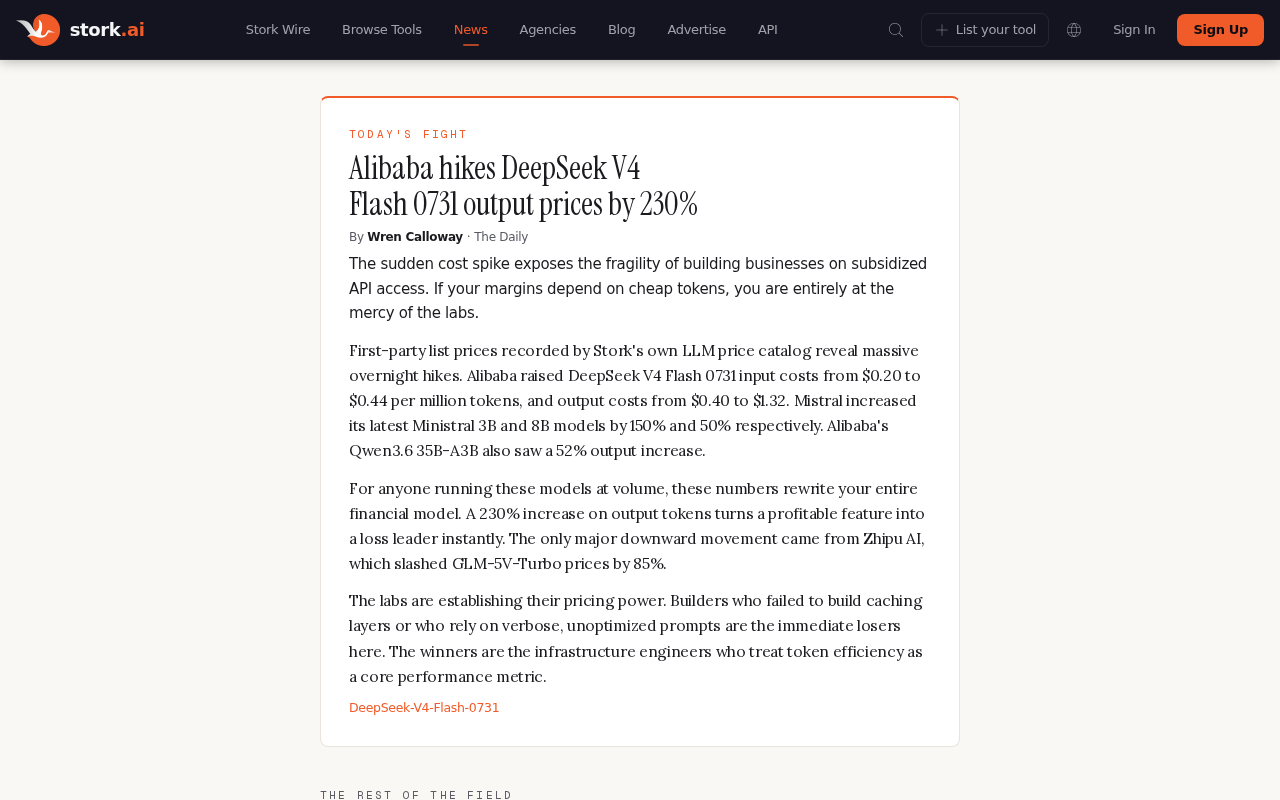
According to Hacker News discussion, Alibaba raised the output price of DeepSeek V4 Flash 0731 by 230%, about 3.3 times the original, quickly drawing developer attention to inference costs. Output tokens are more price-sensitive than input because they are generated serially token by token, and conversational, agent, and content-generation apps are hit hardest. Developers can respond by recalculating unit economics, evaluating model switching and routing, and optimizing output length. The scope and reasons remain unclear.
According to discussions in the Hacker News community, Alibaba has raised the output price of the DeepSeek V4 Flash 0731 model on its platform by 230%. A price hike of this magnitude is uncommon in the AI model services market and has quickly drawn developer community attention to the trajectory of inference costs.
The Price Change Itself: A Signal Worth Heeding
According to the original post on Hacker News, this price adjustment targets output billing for the specific model version DeepSeekAd V4 Flash 0731. A 230% increase means that if generating one million output tokens previously cost some baseline amount, it will now cost 3.3 times that amount.
As a caveat, the original information contains only a title and minimal engagement data (5 points, 2 comments). It does not disclose the specific effective date of the price change, its scope (whether it is limited to specific regions or API tiers), or Alibaba's official explanation. Any inference about the reasons for the price change should therefore be made cautiously.
That said, industry convention holds that output tokens are typically priced higher than input tokens, because the autoregressive generation process requires per-token computation, concentrating compute consumption. A substantial price increase applied solely to the output side often points to inference resource constraints or a shift in commercial strategy.
Why Output Prices Are More Sensitive Than Input Prices
In the billing structure of large model APIs, the cost asymmetry between input and output is a long-standing feature. On the input side, unit costs can be amortized through batching, KV cache reuse, and similar techniques, whereas the output side is serial and generates token by token, making GPU utilization harder to optimize.
This also explains why, when supply pressure emerges on the inference side, vendors tend to adjust output prices first. For developers, higher output prices directly hit the marginal costs of conversational, agent-based, and content-generation applications—scenarios where output tokens typically account for a much higher share than input tokens.
Although the Hacker News discussion has only two comments, the fact that the post was submitted at all shows how sensitive the community is to price signals. As model capabilities gradually converge, unit token cost is becoming a core variable in model selection.
KV Cache is a key optimization mechanism in large model inference and deserves elaboration. During autoregressive generation, a Transformer must compute attention over all previous tokens each time it generates a new token. Recomputing everything each time would cause costs to grow quadratically with sequence length. KV caching works by storing the Key and Value matrices for historical tokens at each layer and reusing them in subsequent generation, computing only the portion corresponding to the new token. This mechanism is especially effective on the input side: when multiple requests share the same prefix (such as a system prompt), or when the same session is called repeatedly, cache hits can substantially amortize unit costs. But the output side is essentially serial sequence extension—each step must produce new KV entries, and caching cannot skip the computation of generation itself. Vendors therefore have far less room to optimize costs on the output side than on the input side, which constitutes the technical root of the pricing asymmetry between the two.
Practical Impact on Developers and Response Strategies
For teams already using this model in production, the cost increase will show up on their bills immediately. The impact can be assessed from several directions:
First, recalculate the unit economics. With output prices up 3.3 times, previously viable gross-margin structures may no longer hold, especially for product forms with long outputs and high call frequencies.
Second, evaluate the feasibility of switching models. If the application does not demand top-tier model capability, switching to another model of the same tier or a smaller distilled version may be a more pragmatic cost-control measure. The value of a multi-model router architecture becomes apparent in such situations.
Third, optimize output length. Reducing unnecessary output tokens through prompt constraints, structured output, and truncation strategies is a direct way to cut costs without changing vendors.
An LLM Router is an architectural pattern at the application layer that dynamically selects backend models based on request characteristics. A typical approach is to first use a lightweight classifier or rules to judge task difficulty, expected output length, and latency requirements, then route simple requests to small or low-cost models and only send complex requests to flagship models. The routing layer can also make weighted decisions based on real-time pricing, availability, and rate-limit status, automatically reducing the traffic share of a vendor when it raises prices. For cost-sensitive products, routing architecture turns "model selection" from a one-time decision into a continuous optimization process and also reduces lock-in risk to a single vendor. Note that routing itself introduces additional latency and consistency challenges, and output format and quality may differ across models, requiring accompanying evaluation and fallback mechanisms.
Industry Context of Pricing Volatility
A single price change should not be overinterpreted, but it reflects a broader question: has AI inference pricing entered a period of volatility? For some time, the industry's dominant theme has been falling prices—unit prices kept declining alongside improving model capabilities. But when inference demand grows faster than supply expansion, localized price increases become possible.
The DeepSeek model series is known for its high cost-effectiveness, and pricing changes for its models on third-party platforms can, to some extent, serve as a barometer of inference compute supply and demand. Alibaba's price adjustment for a hosted model, as a cloud service provider, may reflect upstream compute costs as well as platform-side commercialization considerations.
Given the limited information in the original material, it is impossible to confirm whether this price change is a temporary measure or a shift toward a long-term pricing strategy. It is advisable to watch for subsequent official pricing announcements for this model and for developer feedback on actual bills in the community.
The supply-demand structure of inference compute is the backdrop for understanding price volatility. Large model inference relies on GPU clusters, and the supply of high-end GPUs is constrained by multiple factors including production capacity, export controls, and data center power capacity, with expansion cycles measured in quarters or even years. At the same time, applications such as agents, code generation, and long-context conversation consume far more tokens than early chat scenarios, and demand can surge within weeks. When demand growth outpaces supply expansion and inference resources become locally tight, vendors may use pricing to regulate traffic. When cloud providers host third-party models, pricing also reflects their own compute procurement costs, platform operating costs, and commercial strategy, so the same model may be priced differently across platforms. This also means that a price change on a single platform does not necessarily represent a change in the model's official pricing.
Conclusion
A 230% output price increase is a clear cost signal. For developers, what matters is not this particular price change but establishing sensitivity to and mechanisms for dealing with fluctuations in model service costs—including cost monitoring, multi-vendor alternatives, and output-side optimization. At a stage when capability gaps between models are narrowing, cost engineering capability is becoming part of product competitiveness.
One-line Summary
Alibaba raised the output price of DeepSeek V4 Flash 0731 by 230%, drawing attention to inference costs.
Paragraph Summary
According to Hacker News community discussion, Alibaba raised the output price of the DeepSeek V4 Flash 0731 model on its platform by 230%, roughly 3.3 times the original price, quickly drawing developer attention to the trajectory of inference costs. The article notes that output tokens are more sensitive to price adjustments than input because they are generated serially token by token and GPU utilization is hard to optimize; conversational, agent, and content-generation applications with high output shares are hit most directly. Developers can respond by recalculating unit economics, evaluating model switching and multi-model routing, and optimizing output length. Because the original information comes only from a brief post, the scope and reasons for the price change remain unclear, and monitoring official announcements and developer bill feedback is recommended.
Related articles

5 Practical Ways Real Estate Agents Can Use AI to Boost Efficiency (2026 Edition)
How can real estate agents use AI to boost efficiency? Based on a YouTube walkthrough, this breaks down five methods — ChatGPT for listing descriptions, Canva for marketing materials, forms for open house leads, Zapier for automated follow-up, and seller meeting prep — and flags risk boundaries like fair housing laws, photo authenticity, and price verification.

Grok Bot vs ChatGPT Agent: Which AI Agent Is More Powerful?
How does Grok Bot differ from ChatGPT Agent? This comparison examines how they work: Grok Bot has a cloud computer and runs persistently inside tools to execute multi-step tasks automatically; ChatGPT Agent operates web pages in a browser and is more mature at general tasks. Includes selection advice.

Walmart Agent Gateway: AI Shops for You Automatically—Why Is Amazon Going the Opposite Way?
Walmart's Agent Gateway lets ChatGPT, Gemini and other AI assistants access its product catalog to search, compare and add to cart, with spending limits and per-purchase approval. Amazon blocks external AI agents—two retail giants, opposite paths. Currently US-only, India may follow.