Alibaba's Qwen3.8-Max-0902 Tops Code Arena Leaderboard
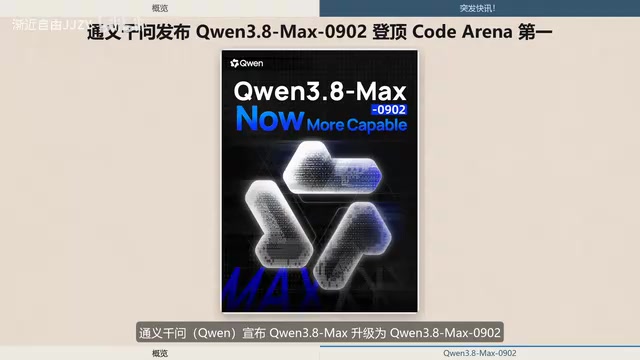
Qwen3.8-Max-0902 claims #1 on Code Arena, surpassing Claude Opus 3.5 with superior coding at lower cost.
Alibaba Cloud's Qwen3.8-Max-0902 has reached the top of the Code Arena overall leaderboard with a score of 1691, surpassing Claude Opus 3.5. Built on a 2.4T-parameter Mixture of Experts architecture with 128K context support, the model features deep post-training for coding and collaboration scenarios. With competitive pricing at $2/$6 per million tokens for input/output and aggressive caching discounts, it offers enterprise-grade AI coding capabilities at exceptional value.
Alibaba Cloud's Qwen (Tongyi Qianwen) recently released a major update. Its latest version, Qwen3.8-Max-0902, has achieved breakthrough results across multiple coding benchmark leaderboards, claiming the top spot on the Code Arena overall leaderboard with a score of 1691 and demonstrating formidable competitiveness in code generation.
Qwen3.8-Max-0902 Model Scale and Pricing Strategy
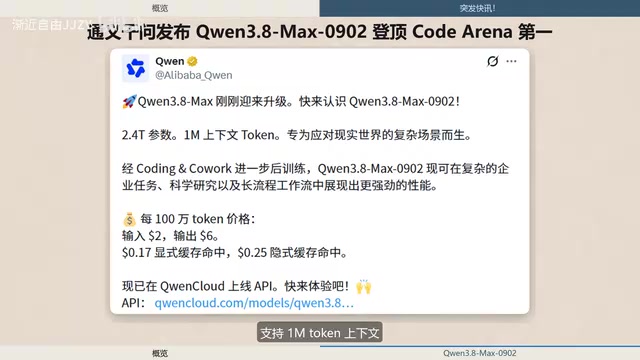
The new Qwen3.8-Max-0902 uses a 2.4T parameter Mixture of Experts (MoE) architecture and supports a 128K context length.
Mixture of Experts (MoE) Technical Explainer: Mixture of Experts is an advanced neural network design paradigm that improves efficiency by splitting a large model into multiple specialized sub-models ("experts"). During inference, a routing mechanism dynamically activates only a subset of experts based on the input, rather than invoking all parameters. This means that the 2.4T-parameter Qwen3.8-Max only activates a small fraction of its parameters at runtime (typically 10–20%), significantly reducing computational costs and response latency while maintaining strong capabilities. This architecture has been validated in Google's Switch Transformer and Mistral's models and is particularly well-suited for general-purpose large models that need to handle diverse tasks. Qwen's adoption of MoE allows it to demonstrate professional-level performance across coding, reasoning, multilingual tasks, and more — all while maintaining competitive pricing.
On the pricing front, the model adopts a highly competitive pricing strategy:
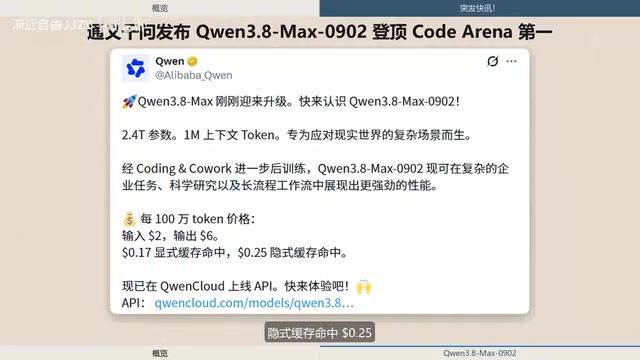
- Input cost: $2 per million tokens
- Output cost: $6 per million tokens
- Explicit cache hit: Just $0.17
- Implicit cache hit: $0.25
Context Length and Token Caching Mechanism: Context length refers to the maximum amount of text a model can process in a single pass. 128K tokens is roughly equivalent to 100,000 English words or 200,000 Chinese characters — enough to accommodate dozens of complete code files. A token is the smallest processing unit of text; in English, one word averages about 1.3 tokens, while in Chinese, one character is approximately 1–2 tokens.
Caching is a critical cost-optimization technique for LLM APIs. When users engage in multi-turn conversations or make repeated calls, the system can cache previously processed input content (such as project documentation or codebase context), so subsequent requests only incur charges for new content. Explicit caching is developer-initiated, where content to be reused is manually marked, yielding high hit rates. Implicit caching is automatically identified by the system. Qwen's cache pricing ($0.17–$0.25) is only 8–12% of the standard input price, which can reduce API costs by 70–90% for enterprise applications that frequently reference large codebases.
Targeted Coding Optimization: Focus on Coding and Cowork Scenarios
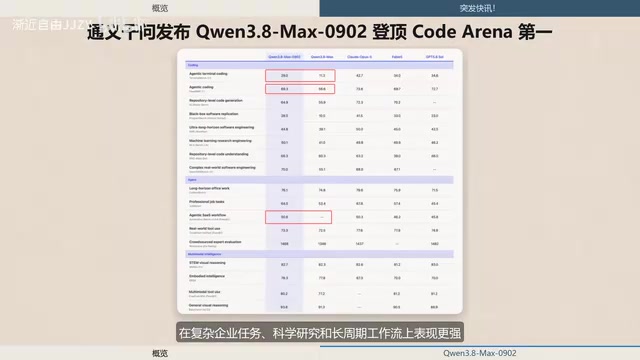
The core highlight of this update is the deep post-training specifically for Coding and Cowork scenarios. The Qwen team specifically enhanced the model's performance in the following areas:
- Complex enterprise tasks: Handling multi-module collaborative development in large projects
- Scientific research: Supporting research-oriented programming needs such as data analysis and algorithm implementation
- Long-cycle workflows: Adapting to development scenarios requiring continuous iteration
Post-Training and Vertical Scenario Optimization: Post-training refers to specialized capability enhancement for specific application scenarios after the base pre-training is completed. It primarily consists of two stages: Supervised Fine-Tuning (SFT) and Reinforcement Learning from Human Feedback (RLHF). Unlike pre-training, which covers broad knowledge, post-training uses high-quality vertical domain data and expert annotations to deeply adapt the model to specific task patterns.
Post-training for "Coding and Cowork" scenarios means the Qwen team specifically collected enterprise-level code collaboration data — such as cross-file code understanding, project-level refactoring instructions, multi-turn technical dialogues, and code review suggestions — and used reinforcement learning to teach the model developers' preferred coding styles and interaction patterns. This vertical optimization enables the model not only to "write code" but also to "understand development workflows" — for example, recognizing project architecture, following existing code styles, and providing context-aware refactoring suggestions. These capabilities are difficult to acquire through general pre-training alone and represent a key battleground in current LLM differentiation.
This targeted optimization allows Qwen3.8-Max-0902 to handle not just simple code completion tasks, but also complex development scenarios requiring multi-turn interaction, cross-file understanding, and project-level refactoring.
Code Arena Leaderboard Performance: 1691 Points to Top the Overall Rankings
Qwen3.8-Max-0902's performance across Code Arena leaderboards has been particularly impressive:
- Code Arena WebDev Leaderboard: Jumped from a previous score of 1669 to 1691, successfully surpassing Claude Opus 3.5 to claim the #1 spot on this sub-leaderboard
- Code Arena Overall Leaderboard: Took the championship position with 1691 points
- Pareto Frontier Leaderboard ($5/MTok price tier): Also claimed the top spot, leading Claude Opus 3.5 by 3 points
Code Arena Benchmark System: Code Arena is an arena-style benchmark platform for evaluating AI coding capabilities. It uses an ELO rating system (similar to chess rankings) to measure code generation quality. Tests cover real-world programming tasks including algorithm implementation, web development, system design, and bug fixing. Generated code is evaluated by human reviewers or automated testing frameworks across multiple dimensions including functional correctness, code quality, and adherence to best practices.
The WebDev sub-leaderboard focuses specifically on frontend and full-stack web development capabilities, assessing a model's ability to generate practical HTML/CSS/JavaScript/React code. The Pareto Frontier leaderboard evaluates both performance and cost dimensions simultaneously, identifying models with the best "value for money" — those with the strongest performance within a given price tier, or those achieving a given performance level at the lowest cost. Qwen's lead in the $5/million-token tier means it offers the best coding capability in that price range, making it extremely attractive to cost-conscious enterprise users.
From a cost-effectiveness perspective, Qwen3.8-Max-0902 delivers optimal performance within its price range, offering significant cost advantages for enterprise users.
Technical Significance and Industry Impact
This Qwen update reflects several important trends:
Chinese-developed LLMs reaching world-class levels: Qwen3.8-Max-0902's coding capabilities can now surpass flagship models from OpenAI and Anthropic on public benchmarks, marking a major breakthrough for Chinese AI coding capabilities.
More flexible cost control: Through the introduction of caching mechanisms, the model achieves more granular cost management while maintaining high performance, making top-tier AI coding capabilities affordable for small and medium-sized enterprises.
Vertical scenario post-training as a key differentiator: Post-training strategies targeting specific vertical scenarios such as enterprise-level code collaboration are becoming a core direction for LLM differentiation.
For developers and enterprises, Qwen3.8-Max-0902's rise to the top not only provides a high-performing AI coding assistant option — its relatively low usage costs and deep adaptation to Chinese-language development scenarios give it a unique competitive advantage in the domestic market. As model capabilities continue to improve, AI-assisted programming is evolving from a code completion tool into a true development partner.
Related articles
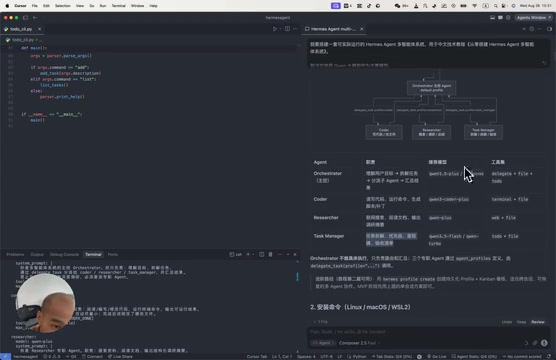
Hermes Multi-Agent System Setup Tutorial: Master Orchestrator + Sub-Agent Collaboration
Learn how to build a Hermes multi-agent system from scratch using Qwen models, with a master Orchestrator coordinating Coder, Researcher, and Task Manager agents through delegate task workflows.
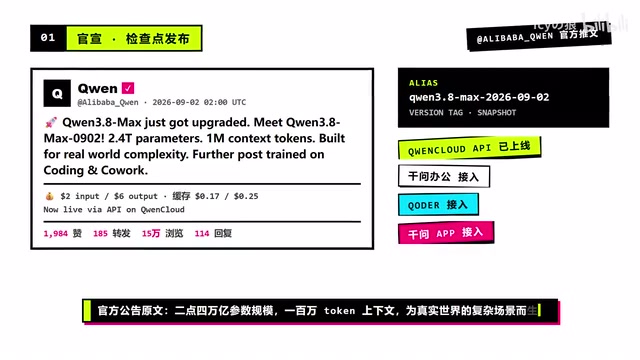
Qwen2.5-Max-0902 Released: Tops Coding Leaderboard with 1691 Points, Priced at Just $5
Alibaba Cloud's Qwen2.5-Max-0902 tops LiveCodeBench at 1691 points with a 22-point surge, surpassing GPT-4.5. Just $5 per million tokens with 1M context window.

Qwen3.8-Flash-Next Deep Dive: How a Static Embedding Table Architecture Takes on DeepSeek
Deep dive into Alibaba's Qwen3.8-Flash-Next: 181.5B params, 51B static embedding table, 6B active params, FP8/BF16 VRAM needs, and how it compares to DeepSeek V4 Flash.