All 748 Episodes of AI Agent Development Tutorial: Building Enterprise-Grade Agents from Scratch

Bilibili's 748-episode AI Agent tutorial covers principles to enterprise deployment across three chapters.
The article outlines a 748-episode AI Agent tutorial on Bilibili, divided into Cognition (ReAct, memory, planning with analogies and a first Demo), Advanced (LangChain, AutoGen, Function Calling, RAG+Agent, evaluation/debugging/security), and Hands-On (customer service ticket routing, automated data analysis, multi-Agent production line). The author argues the core challenge is understanding the Agent's observe-plan-act-feedback loop, not just calling APIs, and notes the long learning cycle and framework version timeliness concerns.
In an era of rapid AI iteration, AI Agents have become a key link in moving from large models to real-world productivity. A video course on Bilibili titled "Complete 748-Episode AI Agent Development Tutorial" attempts to explain Agents from foundational understanding to enterprise-grade deployment across three chapters. The creator claims to have gone through nearly all Agent-related content on Bilibili and YouTube, finding that over 90% of tutorials either pile up concepts like "autonomous planning" and "tool calling" without grounding them, or throw code at learners and have them start calling APIs without understanding the problem context.
This article doesn't pile on concepts. It first outlines the course's knowledge framework, then combines that with the core challenges of Agent development to clarify exactly which puzzle pieces are missing on the path "from zero to enterprise-grade."
Course System: The Progressive Logic of Three Chapters
The course breaks down core Agent knowledge into a Cognition chapter, an Advanced chapter, and a Hands-On chapter. The creator says it took four months to refine.
Cognition Chapter aims to build foundational understanding: What's the difference between an Agent and a large model conversation? Concepts like the ReAct framework, planning and reasoning, and memory mechanisms—which sound intimidating—are explained with everyday analogies, and learners run their first Agent Demo.
Advanced Chapter ramps up the intensity: hands-on with LangChain and AutoGen frameworks, multi-Agent collaboration, Function Calling tool use, RAG + Agent hybrid architecture, plus evaluation, debugging, and security boundaries. Each lesson comes with code materials.
Hands-On Chapter delivers enterprise-grade projects: an intelligent customer service Agent system (from intent recognition to automatic ticket routing), an automated data analysis Agent (upload Excel and get reports and charts automatically), and a multi-Agent collaboration production line.
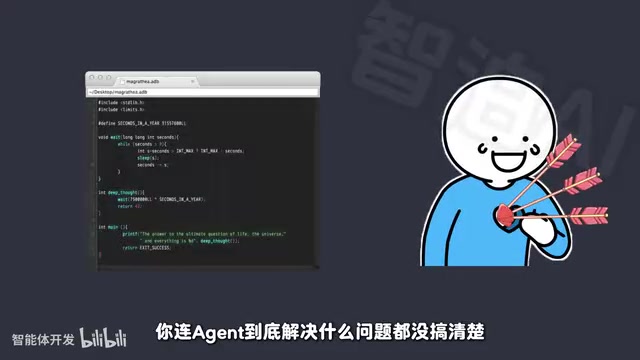
This three-stage design of "cognition—framework—project" aligns with how skills are acquired. Many beginners get stuck in the middle: they understand the concepts, but don't know how LangChain's Chain differs from an Agent, let alone when to use multi-Agent systems versus when it's over-engineering. The course dedicating a separate chapter to framework practice at least shows the creator is aware of this gap.
The Real Challenge Isn't Calling APIs—It's Understanding How Agents "Think"
The creator emphasizes at the outset: "First, let you understand how Agents think, then take action step by step." This statement points to the biggest misconception in Agent learning today.
Large model conversations are single-turn input-output mappings; an Agent is a loop: observe the environment, plan the next step, call tools, get feedback, adjust strategy. The ReAct framework interweaves "Reasoning" and "Acting," allowing the model to re-decide at each step based on the latest observation.
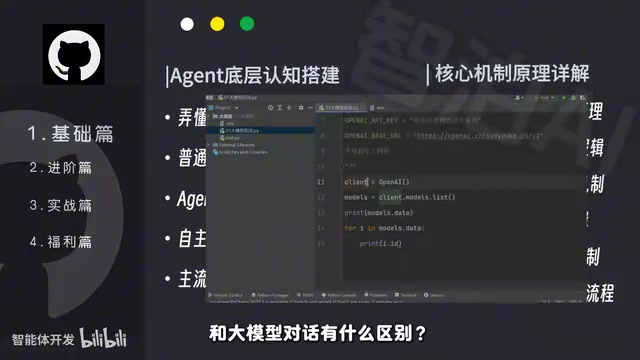
Memory mechanisms are another watershed. Short-term memory corresponds to the context window; long-term memory requires vector databases or external storage. Planning and reasoning determine whether an Agent can break complex tasks into executable sub-steps. If these concepts remain at the level of terminology explanations, the resulting Agent will most likely be a "wrapped chatbot" rather than an intelligent customer service system capable of automatically routing tickets.
The Cognition chapter uses everyday analogies to lower the barrier, and this approach is commendable. Analogies can't replace engineering details, but without analogies, beginners easily give up at the first Demo.
ReAct Framework (Reasoning + Acting) was proposed by Shunyu Yao et al. in 2022. The core idea is to have the large model alternately output "thoughts" and "actions": the model first reasons about the current state, decides which tool to call next, then revises subsequent reasoning based on the actual observations returned by the tool. Unlike traditional Chain-of-Thought, which only reasons internally, ReAct brings external feedback into the reasoning loop, significantly reducing hallucinations and performing better on tasks requiring external information. It's typically implemented as a prompt template and doesn't require model fine-tuning, but demands strong instruction-following and format-output capabilities from the model.
Function Calling is an interface feature introduced by OpenAI in 2023 that allows developers to declare a set of available functions as JSON Schema in a request. The model returns structured function names and parameters when needed, and the application actually executes them before passing results back to the model. It decouples "what the model wants to call" from "what actually gets executed," ensuring security boundaries while allowing the tool ecosystem to scale in a standardized way. Compared to early approaches that parsed model text output with regex, Function Calling's reliability has improved by orders of magnitude and has become the de facto standard for Agent tool calling.
Framework Practice: Hybrid Architecture of LangChain, AutoGen, and RAG
The technical points covered in the Advanced chapter essentially cover the current mainstream stack for Agent engineering.
LangChain provides abstractions like Chain, Agent, and Tool, suitable for quickly building single-Agent applications. AutoGen leans toward multi-Agent conversation and collaboration, letting multiple agents divide tasks through message passing. Function Calling is the standard interface for Agents to call external tools, determining how many real business systems an agent can reach. The RAG + Agent hybrid architecture, in knowledge-intensive scenarios, lets Agents retrieve before acting, reducing hallucinations.
Evaluation, debugging, and security boundaries are listed separately, which is crucial. Agent evaluation is harder than traditional models: a task may have multiple correct paths, retry strategies after tool call failures, loop termination conditions, and permission boundaries—all questions that must be answered before deployment. Including these in the syllabus shows the creator has some awareness of production environment pitfalls.
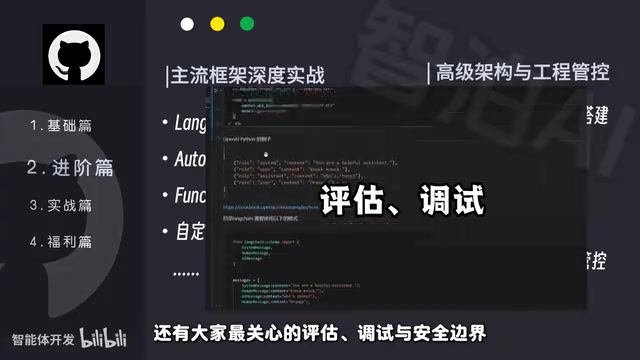
However, framework versions iterate quickly, and LangChain's API has changed frequently over the past two years. Whether the course's accompanying code can be continuously updated is a practical concern learners should keep in mind.
LangChain is a Python/JS framework for building LLM applications, providing abstraction layers like Prompt templates, Chain, Memory, Retriever, Tool, and Agent, encapsulating common engineering patterns into composable components. Its advantages are a rich ecosystem and quick onboarding; its drawbacks are thick abstraction layers, often requiring reading source code or bypassing the framework to call APIs directly in complex scenarios.
AutoGen, introduced by Microsoft Research, focuses on multi-Agent conversational collaboration: through role definitions like ConversableAgent, multiple Agents exchange messages, call code executors or human proxies, forming a "group chat" style problem-solving process. Compared to LangChain's single-Agent orchestration, AutoGen is better suited for tasks requiring role division and repeated negotiation, but is also more prone to non-converging conversations and high token consumption, requiring termination conditions and round limits.
Enterprise-Grade Practice: Customer Service, Data Analysis, and Multi-Agent Production Lines
The three projects in the Hands-On chapter point to the most typical deployment scenarios for Agents.
The intelligent customer service Agent system covers intent recognition to automatic ticket routing—a classic scenario where Agents replace traditional rule engines. Intent recognition determines routing; ticket flow tests tool calling and state management. The automated data analysis Agent lets users upload Excel files and automatically generates reports and charts, essentially a closed loop of "code generation + execution + result interpretation." The multi-Agent collaboration production line simulates team division of labor, suitable for businesses with long processes and many roles.
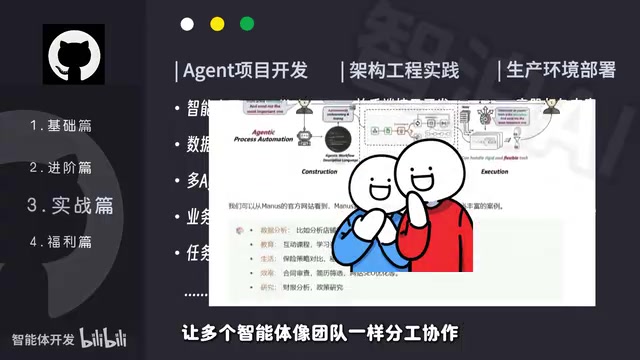
These three projects share a common trait: all require combining LLMs, tools, memory, and evaluation rather than single-point calls. Being able to independently complete one of them essentially means having the practical skills for Agent application development.
RAG (Retrieval-Augmented Generation) combined with Agents is the mainstream approach in knowledge-intensive scenarios: first use vector databases or keyword retrieval to recall relevant document fragments, then hand them to the model to generate answers or decide the next action based on the recalled content. Compared to cramming knowledge into system prompts, RAG allows an Agent's knowledge to be updated anytime with traceable sources, and significantly reduces hallucination rates. Engineering-wise, key concerns include document chunking granularity, embedding model selection, hybrid retrieval (vector + BM25), and reranking of recalled results—these details often determine whether the final result is "usable" or "useless."
Learning Advice and Rational Expectations
The course positions itself as "zero foundation to enterprise-grade," but looking at actual content density, zero-foundation learners need to invest considerable time to digest the framework practice in the Advanced chapter. The creator provides source code, course materials, Prompt templates, and a learning roadmap as companions, lowering the startup cost.
What needs rational perspective: the 748-episode volume means a large amount of information, but also a long learning cycle; the framework practice section depends on specific versions and may have timeliness issues; enterprise-grade projects are mostly simulated scenarios, and real business concerns like permissions, compliance, and cost control still need to be filled in through actual work. Treating the course as a systematic introductory skeleton, then combining it with official documentation and real project practice, is the more pragmatic path.
The core competitiveness of Agent development isn't which API you can call, but whether you can break down business problems into executable plans, tools, and feedback loops for agents. This course at least provides a complete map from cognition to hands-on practice.
One-line Summary
Bilibili's 748-episode AI Agent tutorial covers principles to enterprise-grade deployment across cognition, advanced, and hands-on chapters.
Paragraph Summary
The article outlines the knowledge framework of a 748-episode AI Agent development tutorial on Bilibili. The course is divided into Cognition, Advanced, and Hands-On chapters: Cognition explains underlying concepts like ReAct, memory, and planning/reasoning with everyday analogies and runs the first Demo; Advanced covers LangChain, AutoGen, Function Calling, RAG + Agent hybrid architecture, and evaluation/debugging/security boundaries; Hands-On delivers three projects—intelligent customer service ticket routing, automated data analysis Agent, and multi-Agent collaboration production line. The author argues the core challenge of Agent development isn't calling APIs but understanding its "observe—plan—act—feedback" loop thinking, and notes the 748-episode volume means a long learning cycle with potential timeliness issues from framework version iterations.
Related articles

How Big Can Stars Really Get? The Physical Limits of the Largest Stars
Red supergiants are the largest stars by volume, with radii up to 2,000 times the Sun, engulfing the inner solar system. But there is no precise upper limit on stellar size—models predict up to 15,000 solar radii. The most massive blue stars are far smaller than red supergiants—biggest and heaviest are two different things.

Apple HomeView Smart Display Full Feature Breakdown: Wall-Mount or Desktop, $299
Apple launches HomeView, a $299 smart display with wall-mount and desktop options, 12MP camera for facial recognition, smart home control, music playback, and recipe step-by-step cooking. Full breakdown of watch faces, apps, privacy, and cooking integration.

Where Did the Promised New Studio Go? Craft Computing Answers After Five Years
Craft Computing's host responds to viewer questions: the new studio promised five years ago was shelved as construction costs soared from $30,000 to $75,000, and was replaced by a 168-square-foot garage conversion.