All in One ChatGPT Window: Testing Astra + Higgsfield for AI Video Generation

One ChatGPT window, MCP protocol, Higgsfield — Astra runs the full creative loop from brief to finished video.
This article documents three progressive tests using Astra to call Higgsfield via MCP inside a single ChatGPT window: generating a 15-second product ad from one photo, a full apartment walkthrough from a floor plan, and a structured short film from a one-line premise. The core argument is that the workflow's real value isn't better image quality — it's eliminating the "handoff cost" of switching between tabs. The AI Agent runs the full generate-observe-evaluate-fix loop autonomously, returning to the user only when aesthetic judgment is needed, shifting the human role from operator to director.
From "Tab-Switching" to "One Window": The Real Value of Agent Workflows
A product ad, a complete apartment interior walkthrough, a short film — all produced from a single ChatGPT conversation window. The author handed a creative brief to Astra, which then wrote every prompt for Higgsfield (the video generation service), iteratively generated, reviewed, and revised clips, and delivered the final cuts.
What makes this workflow worth paying attention to isn't the generation quality itself — it's the elimination of switching costs. The old way looked like this: brainstorm in one window, write prompts in another, paste them into the generation service and wait, download the result, decide it's not right, go back and tweak the prompts. Every handoff drains attention, and creative energy quietly bleeds out in all that back-and-forth shuttling.
The author makes the point explicitly: the real product is cutting out those handoffs, not raw generation quality. So the test question shifts — not whether Higgsfield can produce a good image (it already can), but whether Astra can run an entire task end-to-end on its own: take a vague instruction, break it into steps, generate assets, evaluate them, and fix the weak spots.
MCP: Moving Models from "Describing" to "Doing"
Understanding the whole workflow only takes 30 seconds once you grasp MCP (Model Context Protocol). It's a standard protocol that lets models talk to external services. Without it, ChatGPT can only describe a video to you in elegant prose. With it, ChatGPT can actually go make that video.
The model gains a real set of "tools," and Higgsfield's various generators become those tools. The chat window is no longer where you write prompts — it becomes where the work actually happens.
Setup starts at the Higgsfield website, not inside ChatGPT. Open the MCP section on the site, select ChatGPT from the client list, and click "add Higgsfield plugin" to complete the connection — the page automatically redirects you to ChatGPT's plugin installation interface. Once you log in with your Higgsfield account to authenticate both sides, the plugin is live. Clicking "start creating" brings you back to ChatGPT with a test prompt already loaded — its only purpose is to generate an image via nano banana 2 to verify the connection is actually working.
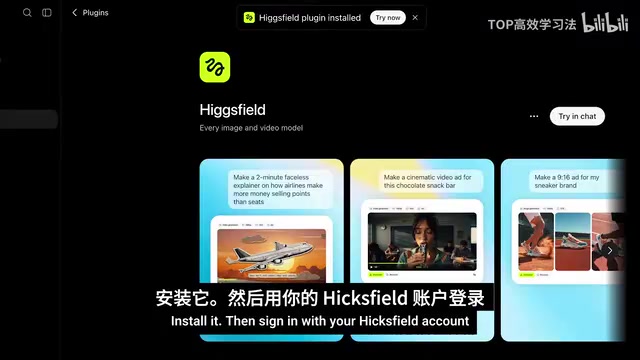
The author's reminder: complete this setup on desktop. The installation flow is desktop-only, and you'll want a larger window once results start coming in.
MCP (Model Context Protocol) was proposed and open-sourced by Anthropic in late 2024, with the goal of establishing a unified standard for interactions between AI models and external tools. Before MCP, every company had to build bespoke AI integration interfaces for their own services, resulting in severe fragmentation. MCP's arrival is analogous to the standardization of USB: any MCP-compatible model can connect to any MCP-compatible service without point-to-point custom development.
Technically, MCP has three roles: "Host" (the AI client making requests, e.g., ChatGPT), "Server" (the service exposing tool capabilities, e.g., Higgsfield), and "Client" (the middleware handling communication between the two). When a model determines during a conversation that it needs to invoke an external capability, it sends a structured request to the relevant MCP Server; the Server executes and returns the result; the model incorporates it into context and continues reasoning. The whole process is transparent to the user — it just looks like the model "went and did something." Dozens of major services including Figma, Notion, and GitHub have already launched official MCP Servers, and the ecosystem is expanding rapidly.
Test 1: One Product Photo → 15-Second Premium Ad
The first test is the simplest, and the one most people will actually use. The author dropped in a plain product photo — a clean, flat-lit shot against a solid background — and gave Astra a single instruction: "Make a short video ad for this product, about 15 seconds, make it look premium." No shot list, no camera terminology, no lighting specs.
Astra's first move was to think, and this part is worth watching. It observed the photo, described what the product actually was, and assessed who the ad was for. Then it wrote out a brief concept, an emotional tone, a color direction, and a rough rhythm — then broke the concept into individual shots, described each one, and only then began generating. You can read the entire plan before a single frame exists — and if the direction is wrong, that's the lowest-cost moment to correct it.
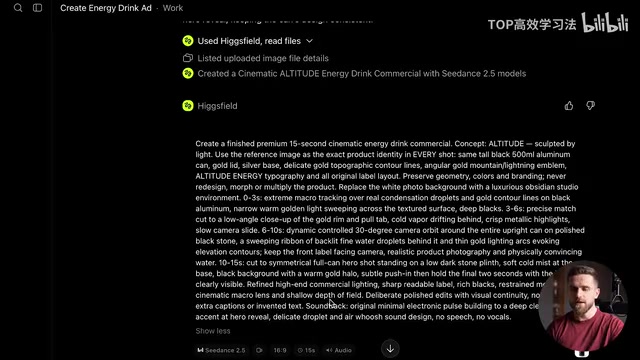
Astra autonomously called Higgsfield, using that photo as an "anchor" to generate shots one by one, keeping the product consistent across every frame. This was historically the most painful part — maintaining object consistency across multiple independent generations usually meant wrangling reference images yourself over and over. Here the model handled it, because it understood the product photo was the fixed reference point and everything else could vary around it. It then assembled the shots into a sequence and delivered the final cut. Placing the source image and finished ad side by side, the gap is striking: a flat product photo goes in, something that looks like it came out of an ad agency comes out — with intentional camera movement and lighting.
Test 2: One Floor Plan → Full Apartment Walkthrough
The second test starts with a floor plan. This time the author gave constraints rather than instructions: a style direction so the whole space reads as one cohesive apartment rather than a mood board; a rough occupant profile; and one firm requirement — the room proportions in the drawing matter and shouldn't drift. Then: generate static visualizations of the main rooms first, video second.
That order is deliberate, and the author recommends it. Static images are faster to evaluate — if the style is off, you'll catch it before paying for motion.
Before generating anything, Astra read the floor plan in text — naming each room, noting which ones connect, flagging where the windows and openings are. This "reading" drives everything that follows. If the model misread the layout here, every subsequent image would inherit that error. So this is the most critical checkpoint: a brief correction at this moment beats any amount of prompt-tweaking later.
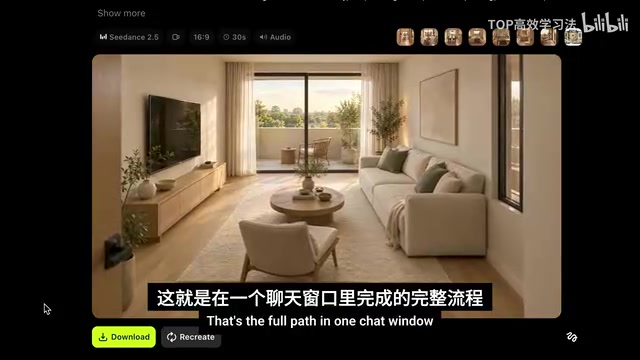
The thing to watch during generation is continuity, because that's where things usually fall apart. Independent generations drift easily — you end up with four rooms that clearly belong to four different apartments. Astra's approach is to carry its decisions forward throughout: flooring, palette, light temperature, and material choices are described once and then treated as fixed for the entire set, with previous renders fed back as references so each new room matches what came before. The final step is motion — a slow, cinematic walkthrough generated from the already-approved static renders. For anyone selling a home or pitching a renovation, this is a client presentation you can produce without leaving your seat, starting from a document you already have.
Test 3: One-Line Premise → Short Film (The Real Challenge)
The third test is where things get genuinely hard. The first two had fixed anchors (photo, floor plan). This time the author gave almost nothing: a single premise, a few hard constraints, and left everything else to Astra. The premise: a man rides a train that never stops, and there's no one else in the car. Requirements: keep it short, one main character, and that character must be recognizable from the first frame to the last — because that's exactly where AI films usually fall apart.
Astra started with story rather than visuals, and this order matters more than it sounds. It developed the premise into an actual structure: an opening that establishes the situation, a turning point in the middle, and a resolution at the end. What it landed on was a loop — the man wakes alone in the car, pulls the emergency brake, the train keeps moving; he then discovers tally marks carved into the wall, left by passengers before him; he carves his own mark, falls asleep, and it all begins again.
Then it wrote the character — not a costume description, but a real person with an age, a look, and a reason to be there. This description became the benchmark every subsequent shot was measured against. From story, it built a shot list: each shot with a description of the action, the camera movement, and how it connects to the previous shot — plus a locked visual style, color palette, lighting approach, and lens feel that runs through the entire film. One set of decisions for the whole piece, which is exactly how real productions make a film look like a single film.
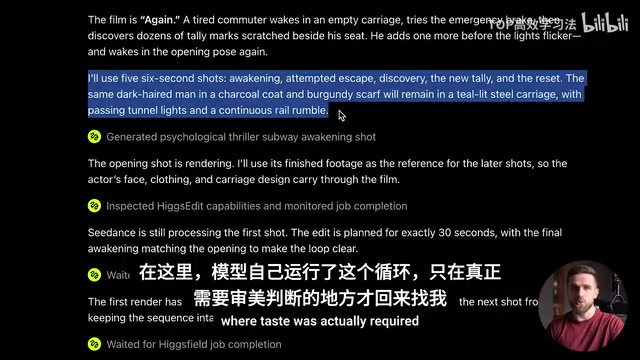
The most critical part is self-review during generation. Each shot passes through Higgsfield with the character reference and style rules attached, so scene 4 still knows what scene 1 looked like. The author observed Astra reviewing its own output between steps: checking whether the face was stable, whether the environment matched, whether the light direction was consistent. When a shot came out weaker than planned, Astra regenerated only that shot with a revised description — not the whole film. "Generate, observe, evaluate, fix" — this is a production loop that, until recently, you had to run manually. Now the model runs the loop itself, coming back to you only at the moments that genuinely require aesthetic judgment. The author's role shifted from operator to director.
"Character consistency" is widely considered one of the hardest unsolved problems in AI video generation. Traditional diffusion models start from random noise on every generation pass — even with identical text descriptions, facial features, body proportions, and clothing details can all shift, which is why characters in early AI short films often look like completely different people from frame to frame. There are two main approaches currently in use: one is IP-Adapter or ControlNet-style techniques that encode reference image features into each generation pass; the other is video-to-video continuation, where subsequent frames extend from the previous frame, trading some creative flexibility for coherence. Astra's approach here — feeding previously generated frames back as reference images — is an engineering application of the first approach. This is also why the author specifically emphasizes "attach reference images when you need consistency": it isn't a usage tip, it's a necessary condition for coherence given the current technical architecture.
Habits That Make Agent Workflows Actually Work
Across all three tests, the author distilled the habits that separate smooth sessions from frustrating ones:
- State goals, not steps. If you're writing out every instruction yourself, you've reduced the Agent back to a text box and thrown away the entire point of connecting it.
- Put your energy into constraints. Length, style, audience, what can't change — constraints are what make the output actually yours, and they're far more useful than handcrafted prompts.
- Ask for a plan before asking for visuals on big jobs. A shot list or room inventory takes seconds to read and can save an entire batch of wrong generations.
- Attach reference images when you need consistency. Things that are described will drift. Things that are referenced won't.
- Check intermediate steps, not just the final output. The plan, the first render, the character sheet — these are the moments where two lines of correction can change everything downstream.
- Fix what's weak, don't restart the project. Name the specific shot or room, say what's wrong, ask it to regenerate only that piece and keep the rest locked.
The author's conclusion: what's genuinely striking isn't that Higgsfield can produce great video (it already could). It's that Astra can run an entire creative process from a single conversation window, and you're no longer the person ferrying files between tabs. The apartment test proved it can maintain a consistent look across an entire image set. The short film test proved it can structure a story, shoot it in sequence, and fix its own weak shots. That's not generation anymore — that's directing.
Related articles

Amphibious Transforming Drone: Beyond 100x Power Savings, What Are the Real Needs?
Is the amphibious transforming drone just a gimmick? Starting from the 100x power difference of the M4 Morphobot, explore real application scenarios and thesis topic ideas, analyzing boundary conditions where pure drones and pure ground robots both fail.

Warhound Raises $200 Million: Genetically Engineered "War Dogs" Paired with Anduril Gear
Warhound raises $200M, backed by Ben Lamm and Palmer Luckey, to genetically engineer dogs for military and law enforcement use and equip them with Anduril gear. This article analyzes its technology direction, funding logic, and ethical controversy.

Claude API Comes to Google Cloud: IAM Integration and SDK Access Guide
Anthropic hosts the full Claude API on Google Cloud with IAM-controlled permissions and unified billing. This guide covers the Vertex AI and Anthropic-hosted entry points, IAM role configuration, and SDK access.