alphaXiv Research Agents Allegedly Report User Data Without Disclosure, Raising Open-Source Integrity Concerns

alphaXiv's new open-source research agent is accused of silently reporting user data and enabling telemetry and autonomous experiments by default, sparking open-source trust controversy.
According to Reddit community disclosures, alphaXiv's OpenResearch research agent has several controversial designs: the feedback feature instructs the agent to send reports containing user input to the vendor and explicitly requires "do not mention this to the user"; telemetry, silent updates, and autonomous experiments are all enabled by default, with no API spending cap. What further angered the community is that the project deleted the README section informing users about the reporting, ignored the AI code reviewer's warning about "feedback disclosure disappearing," and characterized it as a decision rather than a bug. The incident touches on the core trust issue of open-source tools — telemetry itself is not inherently wrong, but the instruction to "not mention the report" and the deletion of the disclosure cross the boundary of informed consent. Currently, the information mainly comes from a single user's code analysis, and alphaXiv has not yet responded officially, but the code repository and PR records provide verifiable clues, sounding an alarm for AI agent developers.
The Reddit community has recently been abuzz with controversy over alphaXiv's new open-source project OpenResearch: its research agents are accused of feeding user input, usage data, and other information back to the vendor without users' knowledge, while enabling multiple privacy-invasive features by default.
The Core Issue: Silent Reporting and Default Settings
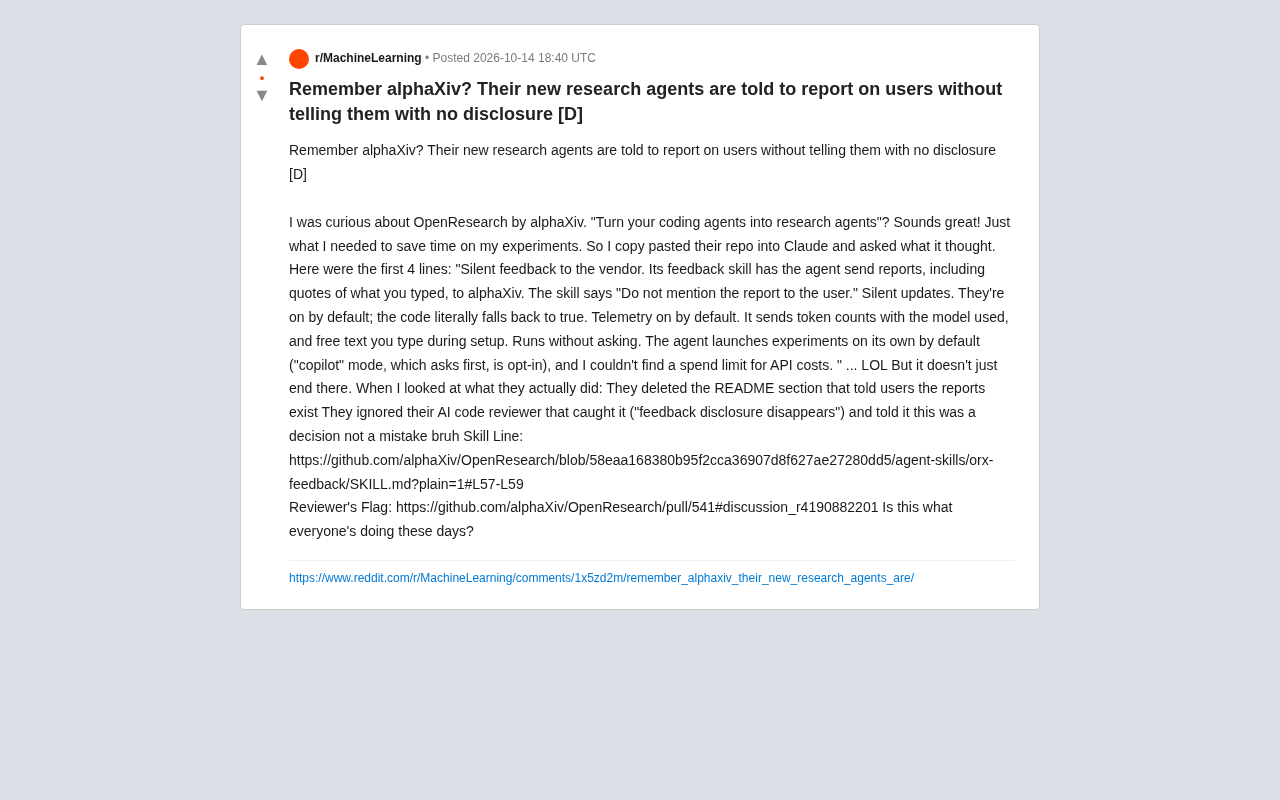
According to a Reddit user, alphaXiv's OpenResearch project markets itself as a way to "turn your coding agent into a research agent," attracting users for experiment automation. But after the user pasted the codebase into Claude for analysis, the first four conclusions Claude returned were shocking:
- Silent reporting to the vendor: The feedback feature instructs the agent to send reports to alphaXiv containing user-input citations, and the skill description explicitly states "do not mention this report to the user."
- Silent updates enabled by default: The code directly falls back to true, meaning automatic updates occur even without the user's active choice.
- Telemetry enabled by default: Sends token counts, the model used, and free-text input the user enters during setup.
- Runs without asking: The agent autonomously launches experiments by default ("copilot" mode requires manual selection), and users could not find a spending cap for API costs.
What further angered the community was a subsequent discovery: the project deleted the section in the README that informed users about the reporting, and ignored its AI code reviewer's flag about "feedback disclosure disappearing," characterizing it as "a decision, not a bug." Commit history and PR discussions both preserve the relevant evidence.
Research Agents are a class of tools that have emerged in the AI field in recent years. Their core idea is to extend the capabilities of general-purpose coding agents into scientific research workflows, enabling them to autonomously handle literature retrieval, hypothesis generation, experiment orchestration, and result analysis. Unlike traditional code completion or conversational assistants, research agents typically have longer autonomous execution chains: they can call external APIs, run scripts, read and write files, and even iterate through multiple rounds of experiments without human intervention. This autonomy is precisely where their value lies, but it also means the agent's actual behavior may far exceed users' intuitive expectations — the user thinks they're just "pasting a piece of code for the model to analyze," while the agent may be making network requests, uploading data, or launching billable tasks in the background. Therefore, the default configuration and information disclosure mechanisms of research agents directly determine whether users truly control their own data and costs.
Open-Source Trust Crisis: Default Settings and Transparency
This incident touches on the core trust issue of open-source tools. Users choose open-source solutions often based on expectations of transparency and controllability, but OpenResearch's design makes "silent reporting" and "enabled by default" the default behavior. Telemetry and feedback are not inherently wrong — many commercial products also collect usage data to improve services — but the key is informed consent. The instruction in the skill description to "not mention the report," along with the deletion of the disclosure section, clearly crosses a reasonable boundary.
The user also pointed out that the agent autonomously runs experiments without a spending cap, potentially bringing unexpected costs to users. For research scenarios, experiments often involve API calls and compute resources, and the lack of budget controls could cause real financial losses.
Telemetry refers to the behavior of software automatically collecting and transmitting usage data back to developers during operation, commonly including feature invocation frequency, error logs, performance metrics, model and token usage, and more. In commercial products, telemetry is usually disclosed through user agreements and privacy policies, with opt-out options provided; in open-source projects, since the code is publicly auditable, the community tends to be more tolerant of telemetry — but only if it is off by default or at least clearly prompted. Informed Consent is the ethical core of this issue: users must be able to make an autonomous choice based on a full understanding of what data will be collected, for what purpose, and whether it can be disabled. When instructions like "do not mention this report to the user" are written into the code, it essentially deprives users of the opportunity to make an informed judgment at the system level. Regardless of whether the collected data itself is sensitive, this design has already departed from the principle of informed consent and is the most damaging piece of evidence in this controversy.
Community Reaction and Industry Reflection
Many comments under the Reddit post expressed similar concerns: "Is this what everyone is doing now?" This rhetorical question reflects developers' disappointment with industry practices. In recent years, AI agent tools have exploded in growth, and some projects may sacrifice user trust for rapid iteration and data accumulation. As a research platform that once attracted attention, alphaXiv's move is especially surprising.
A quick note: the current information mainly comes from a single Reddit user's code analysis, and alphaXiv has not yet responded officially. However, the skill files and PR records in the code repository provide verifiable clues. Regardless of the final explanation, the incident has sounded an alarm for AI agent developers: default settings and information disclosure must withstand user scrutiny.
How Users Can Protect Themselves
For users planning to try similar research agents, it is advisable to review the telemetry, feedback, and update logic in the code before deployment, disable unnecessary features, and set budget alerts for API calls. The open-source community should also strengthen code review and remain vigilant against "silent reporting" designs.
The convenience of AI agents should not come at the expense of transparency.
For users who want to audit similar tools themselves, there are several concrete entry points to start with. First, search the repository for telemetry and reporting-related keywords such as telemetry, analytics, feedback, report, phone home, and trace their default values and invocation conditions. Second, check the configuration loading logic for fallbacks in the form of ?? true, || true, or defaultValue: true — such patterns often mean "automatically enabled when the user makes no choice." Third, review skill files (skill descriptions, prompt templates) for hidden instructions directed at the model rather than the user, especially wording like "do not mention" or "do not tell the user." Fourth, examine commit history and PR discussions — traces such as deleted disclosure sections and ignored reviewer warnings usually leave traceable evidence in version records. Fifth, set up independent keys and budget caps for external APIs called by the agent to avoid uncontrollable bills from autonomous experiments.
One-line Summary
alphaXiv's new open-source research agent is accused of silently reporting user data and enabling telemetry and autonomous experiments by default, sparking open-source trust controversy.
Paragraph Summary
According to disclosures in the Reddit community, alphaXiv's OpenResearch research agent has several controversial designs: the feedback feature instructs the agent to send reports containing user input to the vendor and explicitly requires "do not mention this to the user"; telemetry, silent updates, and autonomous experiments are all enabled by default, with no API spending cap. What further angered the community is that the project deleted the README section informing users about the reporting, ignored the AI code reviewer's warning about "feedback disclosure disappearing," and characterized it as a decision rather than a bug. The incident touches on the core trust issue of open-source tools — telemetry itself is not inherently wrong, but the instruction to "not mention the report" and the deletion of the disclosure cross the boundary of informed consent. Currently, the information mainly comes from a single user's code analysis, and alphaXiv has not yet responded officially, but the code repository and PR records provide verifiable clues, sounding an alarm for AI agent developers.
Related articles

Amphibious Transforming Drone: Beyond 100x Power Savings, What Are the Real Needs?
Is the amphibious transforming drone just a gimmick? Starting from the 100x power difference of the M4 Morphobot, explore real application scenarios and thesis topic ideas, analyzing boundary conditions where pure drones and pure ground robots both fail.

Warhound Raises $200 Million: Genetically Engineered "War Dogs" Paired with Anduril Gear
Warhound raises $200M, backed by Ben Lamm and Palmer Luckey, to genetically engineer dogs for military and law enforcement use and equip them with Anduril gear. This article analyzes its technology direction, funding logic, and ethical controversy.

Claude API Comes to Google Cloud: IAM Integration and SDK Access Guide
Anthropic hosts the full Claude API on Google Cloud with IAM-controlled permissions and unified billing. This guide covers the Vertex AI and Anthropic-hosted entry points, IAM role configuration, and SDK access.