Amazon Alexa+ Arrives in India: The Hindi-Speaking AI Assistant Is Here

Amazon launches Alexa+ in India with Hindi support, intensifying the global multilingual AI assistant race.
Amazon is expanding Alexa+, its LLM-powered next-generation AI assistant, into India with Hindi language support. The move targets over 800 million internet users in the world's second-largest online market, where 75% prefer local languages. Alexa+ features improved multi-turn dialogue, contextual memory, and complex task handling. The launch intensifies competition with Google, OpenAI, and Meta in the accelerating global race for multilingual AI assistants.
Amazon Alexa+ Accelerates Global Expansion: India Becomes the New Battleground
Amazon is expanding its next-generation conversational AI assistant, Alexa+, into the Indian market and has begun inviting local users to test a Hindi-supported version. This move marks a pivotal step in Amazon's global strategy for AI assistants.
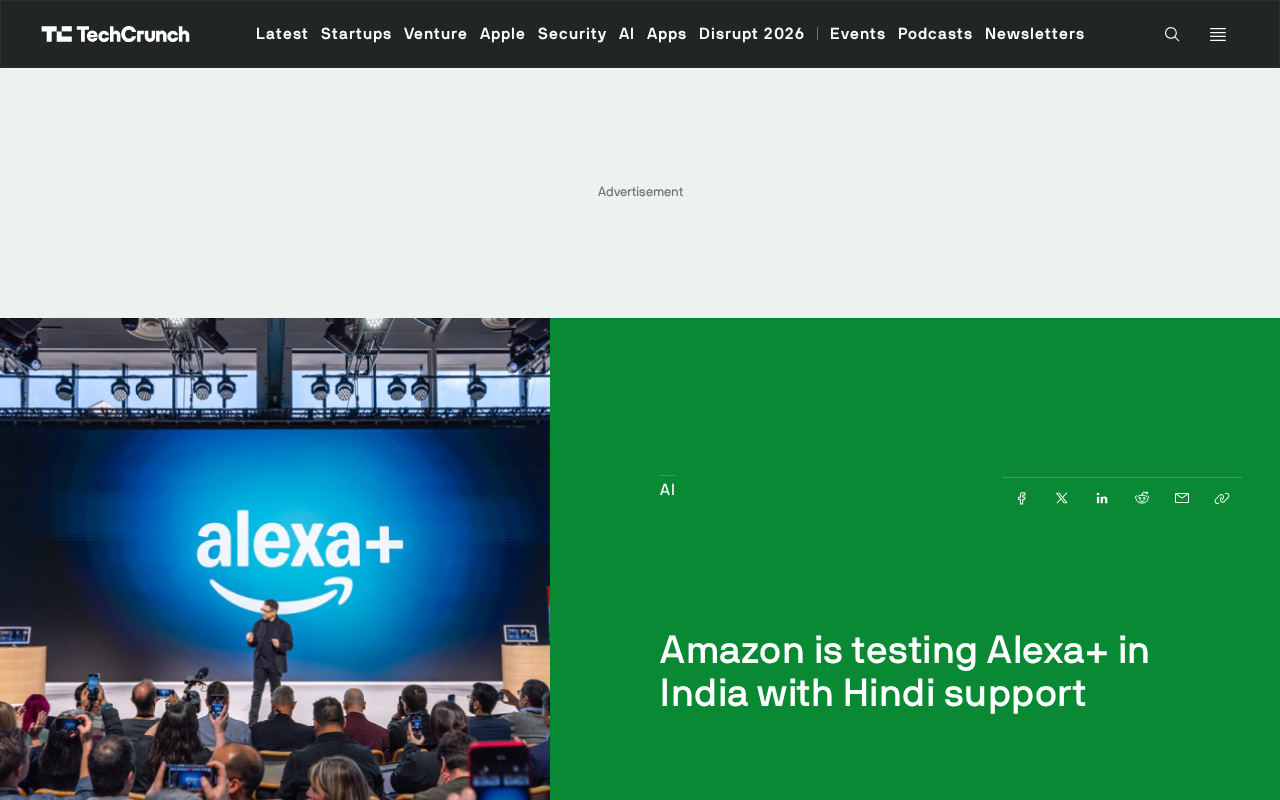
What Exactly Has Alexa+ Upgraded?
Alexa+ is Amazon's entirely new conversational AI assistant built on top of the original Alexa, integrating more advanced large language model (LLM) technology under the hood. The goal is to deliver a more natural and intelligent interaction experience. LLMs represent one of the most significant breakthroughs in natural language processing in recent years — by pre-training on massive text datasets, they learn the statistical patterns and semantic relationships of language, enabling them to understand and generate natural language. Unlike the traditional Intent-Slot architecture that the original Alexa relied on, LLMs can understand users' open-ended expressions in a far more flexible manner, no longer constrained by predefined command templates. Reportedly, Alexa+ integrates Amazon's proprietary LLMs alongside capabilities from external models such as Anthropic's Claude, forming a multi-model hybrid architecture that balances response speed, accuracy, and cost.
Compared to the traditional Alexa, Alexa+ shows clear improvements across several dimensions:
- Multi-turn conversation understanding: Better tracking of conversational context, reducing irrelevant or off-topic responses
- Contextual memory: Remembering user preferences and historical information across conversations
- Complex task handling: Supporting the decomposition and execution of multi-step instructions
It's worth diving deeper into why multi-turn conversation understanding and contextual memory are among the most challenging technical problems in conversational AI systems. Traditional voice assistants typically use a stateless design, processing each interaction independently without effectively linking preceding and following dialogue. The context-tracking mechanism introduced in Alexa+ requires maintaining a dynamically updated dialogue state throughout the conversation, recording entities, intents, and preferences mentioned by the user. Cross-conversation memory goes even further, involving a delicate balance between building long-term user profiles and protecting privacy — the system needs to remember user habits (such as frequently ordered takeout or preferred music genres) while ensuring data storage and usage comply with regional privacy regulations.
Previously, Alexa+ was primarily tested and promoted among English-speaking users. The introduction of Hindi support signals that Amazon is actively expanding its AI assistant's multilingual capabilities to reach a broader global audience.
Why Is India a Priority Market for Alexa+'s Global Expansion?
A Massive Base of Over 800 Million Internet Users
India is the world's second-largest internet market, with over 800 million internet users. India's internet ecosystem has extremely unique characteristics — according to data from the Internet and Mobile Association of India (IAMAI), approximately 75% of these users primarily access the internet in non-English local languages. The Indian Constitution recognizes as many as 22 official languages, and the number of languages and dialects in daily use exceeds 1,600. While Hindi is the most widely spoken language, covering hundreds of millions of potential users, in southern Indian states like Tamil Nadu and Karnataka, Tamil, Kannada, and other languages are the mainstream. This means Amazon's Hindi support is only the first step — to truly cover the Indian market, it will need to gradually expand to Tamil, Telugu, Bengali, and many more languages.
For Amazon, the Indian market represents not only enormous user growth potential but also an ideal testing ground for validating AI assistant multilingual capabilities.
Fierce Competition in the Smart Home Market
In India's smart speaker and smart home market, Amazon's Echo series has consistently held a significant share. According to data from IDC and Counterpoint Research, the Amazon Echo series has long held approximately 60%-70% of India's smart speaker market, far exceeding Google's Nest series. Amazon's advantage comes not only from its hardware pricing strategy (the Echo Dot is frequently priced as low as 3,000-4,000 rupees in India, roughly $35-$48 USD) but also from its deep integration with India's local service ecosystem — including partnerships with local platforms like Zomato (food delivery), BigBasket (groceries), and Gaana (music).
However, Google is steadily closing the gap, leveraging the natural advantages of the Android ecosystem and its long-term investment in Indian language technology (Google's Indian language translation and speech recognition technology got an early start). By adding Hindi support to Alexa+, Amazon can further solidify its leading position in the Indian market while gaining additional leverage in its head-to-head competition with Google Assistant, Apple Siri, and other rivals.
Language Localization Is the Make-or-Break Factor for AI Assistants
Language localization has always been the key factor determining whether an AI assistant can truly integrate into users' daily lives. Hindi belongs to the Indo-Aryan branch of the Indo-European language family and uses the Devanagari writing system, presenting unique technical challenges from a natural language processing perspective.
First, Hindi follows SOV (Subject-Object-Verb) word order, fundamentally different from English's SVO order, requiring models to have different syntactic parsing capabilities. Second, Hindi has extremely rich morphological inflection — verbs undergo complex changes based on gender, number, tense, mood, and other factors. Third, there is a significant gap between spoken and written Hindi, with everyday conversation heavily using abbreviated forms and slang. Additionally, Indian users commonly engage in "code-mixing," blending Hindi and English within a single sentence (for example, "Mujhe ek pizza order karna hai" — "I want to order a pizza"), which poses additional challenges for NLP systems' recognition capabilities. On top of all this, high-quality annotated data for Hindi remains scarce compared to English, creating a data bottleneck for model training.
Amazon's choice to roll out gradually through an invite-only testing approach reflects its cautious attitude toward localization quality — collecting real user usage data and feedback before an official launch to ensure the product experience meets acceptable standards.
Global AI Assistant Competition: Multilingual Expansion Is Accelerating
Amazon's move reflects an important trend in the AI assistant industry: multilingual, multi-market global expansion is clearly accelerating. As LLM technology matures, the cost of migrating AI assistants from a single language to multiple languages continues to decline.
From a technical perspective, multilingual expansion primarily follows three approaches: first, training multilingual models from scratch by incorporating corpora from multiple languages during the pre-training phase, such as Google's mBERT and PaLM; second, performing cross-lingual transfer learning on existing English models, using multilingual alignment techniques to transfer English capabilities to target languages; and third, using fine-tuning combined with Reinforcement Learning from Human Feedback (RLHF) for language-specific optimization. While transfer learning has significantly reduced the marginal cost of multilingual expansion, achieving native-level naturalness and accuracy still requires large volumes of high-quality target language data, localized evaluation benchmarks, and continuous feedback from native speakers.
Currently, all major global tech giants are ramping up their multilingual AI assistant efforts:
- Google's Gemini already supports dozens of languages with broad coverage, backed by years of accumulated expertise in Indian language technology
- OpenAI's ChatGPT continues to expand its language coverage, with its GPT-4 series models delivering outstanding performance on multilingual benchmarks
- Meta's AI assistant is also advancing simultaneously across multiple markets, leveraging social platforms like WhatsApp and Instagram that have massive user bases in India for distribution
In this global race, whoever can achieve localization faster and more precisely will seize the advantage in emerging markets.
Conclusion: What Does the Hindi Version of Alexa+ Mean?
Amazon's testing of the Hindi version of Alexa+ in India is both a critical move in its AI assistant globalization strategy and a real-world test of its multilingual AI capabilities. For Indian users, it means they'll have the opportunity to converse naturally with a smarter AI assistant in their native language. For the industry as a whole, the localization competition among AI assistants is entering an entirely new phase — language is no longer the barrier; experience is the true differentiator.
Related articles

Coze Beginner's Guide: A Complete Tutorial for Building AI Agents with Zero Code
A detailed guide to ByteDance's Coze platform covering core features, China vs. international version differences, and practical use cases. Learn to build AI agents with zero code through drag-and-drop.

Hands-On Tutorial: Building a Godot Game AI Agent with DeepSeek + Harness
Learn how to build a dedicated AI agent plugin for the Godot game engine using DeepSeek models and the Harness framework, with auto code fixes and real-time editor refresh.

Model Distillation: The Core Technology for Compressing Large Model Intelligence into Your Phone
A clear explanation of model distillation (Knowledge Distillation) principles and process. Learn how teacher-student knowledge transfer compresses large model capabilities onto phones for offline face recognition, translation, and more.