Amazon CEO: $220 Billion Bet on AI Infrastructure, AWS AI Revenue Tops $25 Billion in Three Years

Amazon CEO Jassy explains AI infrastructure investment logic: sold-out capacity, in-house chips lowering costs, organizational restructuring, and security risks.
In a podcast interview, Amazon CEO Andy Jassy laid out his strategic judgments for the AI era. He revealed that Amazon's capital expenditures this year will be about $220 billion, yet 2026 capacity is already sold out and demand far exceeds supply. AWS's AI business surpassed $25 billion in annualized revenue in its first three years, hundreds of times faster than the early cloud business. In-house chips began with Annapurna; Graviton offers 40% better price-performance and Trainium 30-40%, and lowering inference costs is key to AI adoption. Organizationally, the Bedrock team rewrote the inference engine with 6 people in 76 days, and AI is driving smaller cross-functional teams. Jassy sees cybersecurity, not sci-fi scenarios, as the most urgent AI risk, and companies need to compress vulnerability response to minutes. He also advises young people to embrace AI while maintaining independent thinking.
Amazon CEO Andy Jassy rarely offers such a systematic account of his views on infrastructure building in the AI era as he did in a recent podcast interview. He revealed that Amazon will spend roughly $220 billion in capital expenditures this year, but even so, the company will still "leave a lot of demand on the table"—2026 capacity is already sold out, 2027 is essentially sold out, and a substantial portion of 2028 has also been sold. The conversation was extremely dense with information, covering the logic of data center investment, the in-house chip strategy, organizational restructuring, and AI's impact on employment structure.
Demand Far Exceeds Supply: The Investment Logic Behind Sold-Out Capacity
The numbers Jassy gave were quite blunt: AWS's AI business reached more than $25 billion in annualized revenue within the first three years of the generative AI wave, whereas the AWS cloud business took three years to reach just $60 million in annualized revenue—a speed difference of hundreds of times. For that reason, he made it clear that "even if we spend $220 billion, we still leave a considerable amount of demand unmet."
Such investment decisions are not blind. Jassy broke down the cash cycle into two layers: data centers require investment about two years in advance, but have a useful life of up to 30 years and are built only once; servers and networking equipment require decisions only a few months ahead, pay back in about three years on average, depreciate over five to six years, and most contracts are five-year terms. This "build the shell first, install the chips later" rhythm allows Amazon to start server procurement only after seeing clear customer demand, thereby controlling risk. But he also acknowledged that free cash flow will come under pressure during rapid expansion, and will only reverse after several years when the data centers are fully online and monetized.
A Decade of In-House Chips: From Annapurna to Trainium
The most technical part of the interview was Jassy recalling the 2015 decision to acquire Annapurna Labs. At the time, it was not for AI chips, but because Amazon found that too much compute in EC2 servers was being consumed by virtualization, networking, security, and other functions, and it wanted to leave as many server resources as possible for customer compute. The Annapurna team first built network cards that offloaded these functions, and was then entrusted with the task of developing in-house CPUs, which ultimately gave rise to Graviton—now used by 99% of Amazon's top 1,000 EC2 customers, with roughly 40% better price-performance than comparable x86 processors.

The same playbook is repeating in the AI era. Jassy pointed out that when a market is dominated by a single supplier, that supplier tends not to focus on price-performance but on adding more features and revenue. That is exactly why Amazon spun off a team to develop the Trainium AI accelerator, which likewise offers 30% to 40% better price-performance than comparable products. He emphasized that inference costs are still "an order of magnitude too expensive"; only by bringing costs down will enterprises have the incentive to rewrite existing CPU applications for AI accelerators—and that is the key lever for AI to move from a handful of labs into widespread adoption.
Annapurna Labs is an Israeli chip startup acquired by Amazon in 2015, which has since become the core team behind Amazon's in-house chip system. Its first product was a network offload card used to offload functions such as virtualization, networking, and security from the main CPU to dedicated hardware, thereby freeing up more compute for customers. The team subsequently developed the Graviton series of ARM-based server CPUs, as well as the Trainium and Inferentia series of AI accelerators. Graviton's success proved that Amazon has full-stack capability from requirements definition to chip deployment, and laid the foundation for the rapid iteration of subsequent AI chips. This vertically integrated model of "in-house chips + cloud services" enables Amazon to control costs, optimize performance, and reduce dependence on a single supplier.
Data Center Controversy: Exaggerated Water Consumption and a Real Grid Deficit
Jassy responded directly to the current anti-data-center sentiment. He cited a comparison: golf courses and almond farming consume far more water than data centers—a golf course uses more water in two days than all of Amazon's data centers use in a year. On pollution, he noted that regulators require emissions to be registered based on backup generators running at full load, but in reality they run only about 10 hours a year for maintenance.

But he did not shy away from the real problems: U.S. grid infrastructure investment has been insufficient for a long time, and the AI boom has simply pushed the issue to a tipping point. He cited St. Joseph County, Indiana, as an example, where Amazon has already paid about $3 billion in taxes and pledged another $1 billion over the next five years for community development. He judges that once grid capacity catches up, data centers will become the largest taxpayers in these areas, and electricity prices will eventually stabilize or even decline—similar trends have appeared in Indiana, Georgia, and Mississippi.
Organizational Restructuring: Six People Rewrote the Inference Engine in 76 Days
Jassy shared a case that is repeatedly cited inside Amazon: the Bedrock team rewrote the inference engine with 6 engineers in 76 days, whereas the traditional approach would have required 40 people for a year. Similar was an agent prototype in the consumer business—a decision was made on Thursday, four or five people worked over the weekend, and by Sunday they had an 80% deliverable version.
These cases are changing Amazon's understanding of organizational design. Jassy believes that in the past, the more successful a company and the bigger its products, the more finely it divided work, with a product manager responsible only for pricing or a single slice. But AI allows models to handle 80% of the foundational work, so teams can be smaller and more cross-functional, with everyone starting from a higher baseline. He predicts that companies will employ fewer people in the future, but not no people—new jobs will emerge in areas such as AI, robotics, and space development. He also offered a judgment: every company will have to rewrite almost all of its code to make it agentic, or else it will have no chance of winning in a new world where security threats must be responded to in minutes.
Bedrock is a generative AI managed service launched by Amazon Web Services (AWS), providing API access to a variety of foundation models (such as Anthropic's Claude and AI21 Labs' Jurassic), and supporting model fine-tuning, retrieval-augmented generation (RAG), and agent building. Its core value lies in lowering the barrier for enterprises to use large models without managing underlying infrastructure. Bedrock's inference engine is responsible for efficiently scheduling model inference requests and optimizing latency and cost. The "six people rewrote the inference engine in 76 days" that Jassy mentioned refers to the restructuring of this component, aimed at improving performance and reducing inference costs, reflecting the disruptive improvement in development efficiency brought by AI tools.
Security Is the Most Urgent AI Risk Today
Jassy offered a different view on the prioritization of current AI risk discussions. He believes the industry is overly focused on sci-fi scenarios like "an evil botnet taking over everything" while ignoring the immediate cybersecurity threat. Models are far better than humans at finding vulnerabilities, the attack surface is expanding rapidly, and corporate response times will be compressed from days to minutes. Amazon has launched the Continuum service for this purpose to identify vulnerabilities and generate patches, but Jassy acknowledged that security engineers are scarce, security work is not "sexy" enough, and as a result most companies' security practices are inadequate.

Continuum is an AI-driven security service launched by Amazon that can automatically identify software vulnerabilities and generate remediation patches, aimed at addressing the challenges of faster vulnerability discovery and an expanding attack surface in the AI era. The service uses large models to analyze code and system configurations, compressing vulnerability response that traditionally took days or even weeks down to minutes. Jassy emphasized that as AI dramatically lowers the cost of vulnerability discovery, enterprises must automate security response or they will struggle to withstand high-frequency attacks. The launch of Continuum also reflects Amazon's strategic direction of embedding AI capabilities into security operations (SecOps), but Jassy also noted that the shortage of security talent and cultural barriers remain the main bottlenecks for enterprises adopting such tools.
Advice for Young People: Embrace the Tools, but Don't Give Up Independent Thinking
At the end of the interview, Jassy offered advice to 18-year-olds. His attitude was clear: AI cannot be avoided, universities should not fight it, and young people need to use it extensively and try things outside their comfort zone. But he also emphasized that AI cannot replace critical thinking. He used business school case teaching as an example—AI can quickly bring everyone to a higher starting point, but piecing fragments into strategy, making judgments, and inventing still require human judgment and creativity. He also mentioned that in a writing culture like Amazon's, AI-written text "can be spotted at a glance," because the logical stitching is simply wrong.
The core message of the conversation can be summed up in one sentence: the race for AI infrastructure has only just begun, supply shortages will persist for years, and the real deciding factor is not who builds the most, but who can bring inference costs down, restructure the organization properly, and shore up security weaknesses.
One-line Summary
Amazon CEO Jassy explains the logic of AI infrastructure investment: sold-out capacity, in-house chips lowering costs, organizational restructuring, and security risks.
Related articles
Papermark Data Rooms: Live in 60 Seconds, Letting AI Agents Take Over Secure Data Rooms
Papermark Data Rooms launches on Product Hunt: set up an encrypted data room in 60 seconds with file permissions, audit logs, white-label domains, and API, CLI, and MCP access for AI agents.

Clips by Plastic: Generate Segmented Lyric Video Ads for Songs in One Click and Save a Full Year's Production Budget
Clips by Plastic automatically detects song tempo and structure, batch-generates vertical lyric video ads for each section, offers 54 effects and multiple backgrounds, and supports one-click export. Free trial, then a $99 one-time purchase.
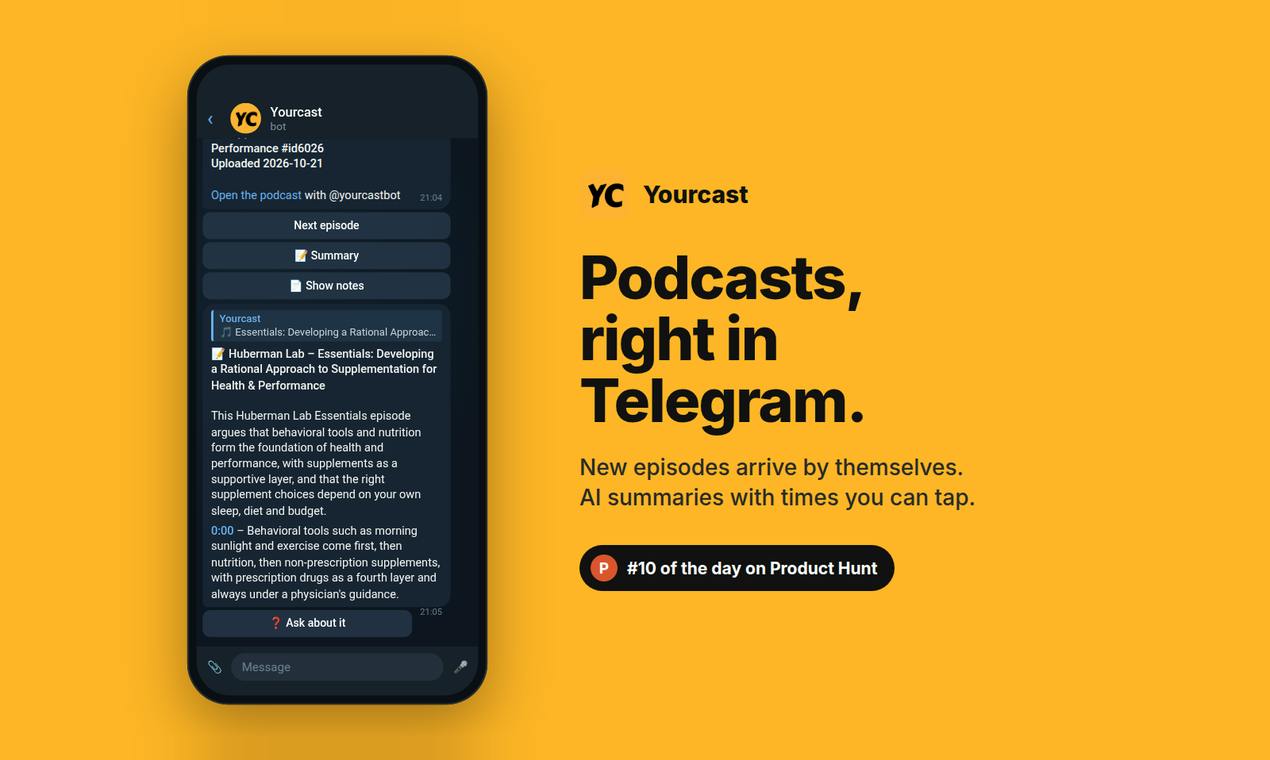
Yourcast 2.0: AI Podcast Summaries in Telegram with Clickable Timestamp Jumps
Yourcast 2.0 is a Telegram podcast bot with AI summaries and clickable timestamp jumps, per-episode Q&A, self-healing feeds, 2 GB file support, and OPML import. GPL v3 open source, free 10 episodes per week.