Papermark Data Rooms: Live in 60 Seconds, Letting AI Agents Take Over Secure Data Rooms
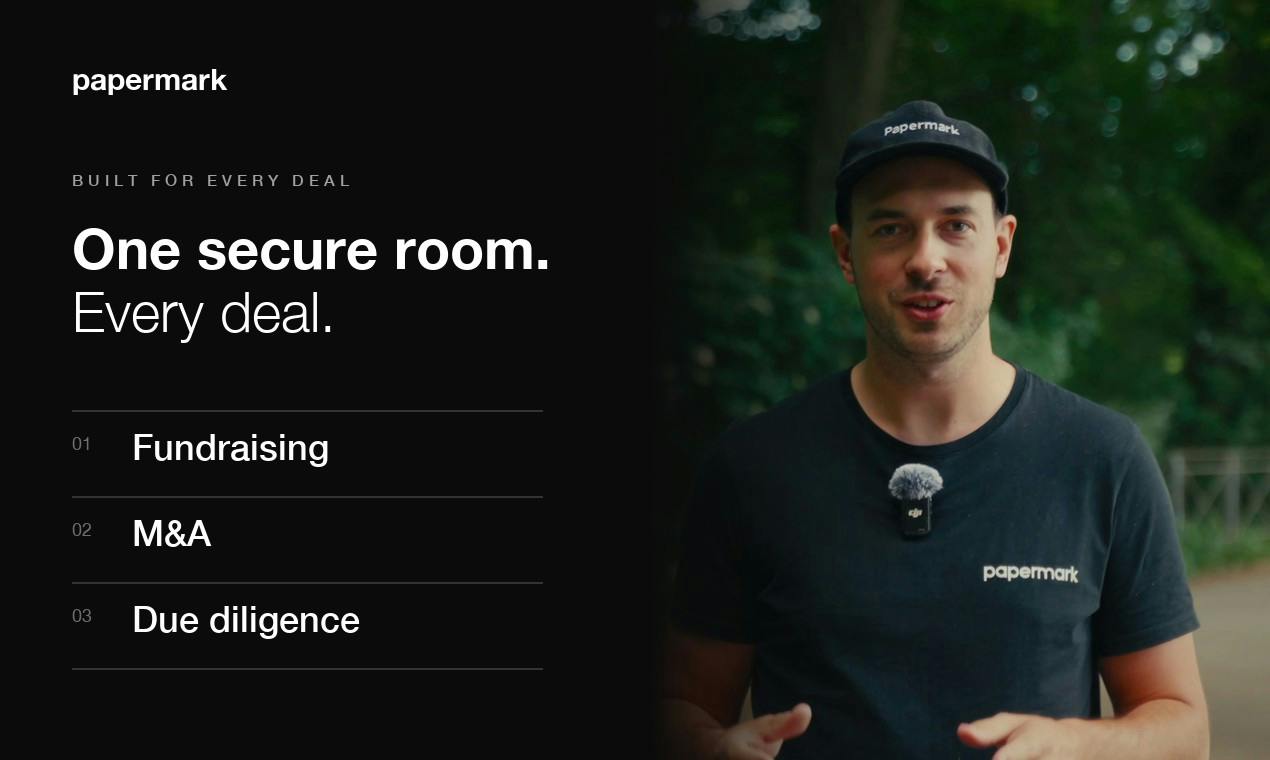
Papermark launches a 60-second data room and opens API, CLI, and MCP for AI agents to operate.
Papermark Data Rooms earned 80 upvotes and ranked #9 for the day on Product Hunt. Its core pitch is compressing enterprise data room setup to under 60 seconds, with built-in encryption, permission controls, Q&A, audit logs, and access analytics. It also offers API, CLI, and MCP integration so AI agents can read and even operate data room resources via a standardized protocol; white-label deployment to custom domains targets investment banks, law firms, and FAs that deliver data rooms as a service. The article notes that MCP's real value depends on the tool interfaces the server exposes, and that audit log retention, export formats, and permission granularity remain undisclosed—key gaps for entering regulated-industry procurement lists.
Papermark Data Rooms: Live in 60 Seconds, Letting AI Agents Take Over Secure Data Rooms
Papermark Data Rooms, which picked up 80 upvotes and ranked #9 on Product Hunt for the day, is playing a very specific card: compressing the setup time for an enterprise-grade data room from "days" to under 60 seconds, while letting AI agents operate that data room directly through API, CLI, and MCP.
This positioning is worth unpacking. The data room itself isn't a new category—it's been used for decades in fundraising due diligence, M&A transactions, and compliance audits. But the "AI agents can operate it" angle pushes it from a static document repository toward infrastructure that can be invoked by automated workflows.
The Old Problems with Data Rooms: Slow Setup, Messy Permissions, Difficult Auditing
Traditional data room products share a common contradiction: the stricter the security and compliance requirements, the heavier the configuration process. Setting up a data room often means first defining role hierarchies, setting access permissions folder by folder, configuring watermarks and download restrictions, then going through internal compliance approval. For teams that need to respond quickly to due diligence requests, this delay is itself a cost.
Papermark's solution is a combination of preset templates and self-service configuration. According to its product page, users can launch an encrypted data room with full authentication within 60 seconds, with built-in granular permission controls, a Q&A module, complete audit logs, and access analytics. These features aren't rare among mature data room products—what's rare is packaging them into a near-instant launch process.
Data Room is a virtual space used to securely share sensitive documents in scenarios such as fundraising, M&A, and compliance audits. Traditionally, it's a digital extension of a physical data room, and its core requirement is "controlled access": only authorized people, at authorized times, in authorized ways (view-only, no downloads, watermarked, etc.) can access specific files. For this reason, data room products tend to be built around capabilities like permission hierarchies, access auditing, and dynamic watermarks—the higher the security, the higher the configuration complexity. Understanding this is what makes it clear why "live in 60 seconds" is a difficult goal in the data room category: it requires preserving security controls while pre-configuring and templating work that was previously scattered across multiple configuration steps.
AI Agent Integration: Three Channels—API, CLI, and MCP
The most noteworthy design of this product is that it offers three integration methods at once: API, CLI, and MCP (Model Context Protocol).
The existence of API and CLI means the data room can be incorporated into CI/CD or automated workflows—for example, automatically archiving documents after a deal closes, or batch-adjusting access permissions according to preset rules. MCP goes further: it lets AI agents (such as assistants with tool-calling capabilities) read and operate resources in the data room through a standardized protocol.
This deserves a sober look. The actual form of MCP integration depends on which tool interfaces the server exposes. If it only reads document lists and metadata, then the AI agent's value lies mainly in information retrieval; if it opens write operations such as permission changes and link generation, the security boundary needs to be re-evaluated. The original article doesn't disclose the specific tool list, which is a point that needs follow-up verification regarding product maturity.
MCP (Model Context Protocol) is an open protocol proposed by Anthropic in late 2024 to let large model applications connect to external data sources and tools in a standardized way, often compared to a "USB-C port for AI applications." Before MCP, every AI assistant needed a separate adapter for every external system; MCP defines how a server declares the resources, tools, and prompt templates it exposes, and the client (AI assistant) discovers and invokes them accordingly. For a data room, an MCP server can expose only read-only document retrieval tools, or it can expose write-operation tools such as creating links and changing permissions—the protocol itself doesn't define the boundary; the security responsibility falls on which tools the server exposes and how authentication and auditing are handled.
White-Label and Custom Domains: Positioning for B2B Service Providers
Papermark supports deployment to custom domains in white-label mode. This feature points to a clear customer profile: not enterprises that use the data room themselves, but organizations that sell the data room as a service to clients—investment banks, law firms, consulting firms, and FAs.
For these organizations, the branding of the data room directly affects the client experience. A custom domain plus white-label effectively turns Papermark into a layer of infrastructure that can be rebranded. This also explains why the product emphasizes "authentication" and "encryption": rebranders need to deliver compliance assurance to their own clients.
White-label is a product delivery model: the original vendor provides the underlying capability, and the service provider sells it externally under its own brand, domain, and interface, usually without the end customer perceiving the underlying supplier. In SaaS, white-labeling is common in categories such as website building, customer service, and email marketing. Its business logic is to let organizations with customer relationships (such as investment banks, law firms, and consulting firms) package tool capabilities into their own services without having to build them in-house. For products like data rooms, white-labeling also involves compliance attribution: the rebrander needs to be able to prove data security and auditing capabilities to its own clients, so the underlying vendor's encryption, authentication, and logging capabilities effectively become the rebrander's credibility endorsement, not just a line item on a feature list.
A Signal Worth Noting
80 upvotes, 7 comments, #9 for the day—on Product Hunt, this falls into the "got exposure but didn't blow up" range. For a product aimed at B2B transaction scenarios, this isn't surprising—target users don't make purchasing decisions on Product Hunt.
The real test lies in the depth of audit logs and the permission system. The core value of a data room isn't "being able to upload files," but "being able to prove who viewed what and when." The original article mentions complete audit logs but doesn't disclose the log retention period, export formats, or whether third-party SIEM integration is supported. These details determine whether it can make it onto the procurement lists of regulated industries.
Who Should Pay Attention
If you're a startup that needs to respond frequently to due diligence requests, or an organization that wants to embed data room capabilities into your own services, Papermark's 60-second launch and white-label capabilities are worth a try. If your scenario involves heavy regulation (such as healthcare or licensed financial businesses), it's advisable to first verify the compliance depth of the audit logs and the permission granularity of the MCP interface before deciding whether to put sensitive documents into it.
AI agents taking over data rooms currently feels more like opening up imaginative space than delivering a complete answer.
One-line Summary
Papermark launches a data room that goes live in 60 seconds and opens API, CLI, and MCP for AI agents to operate.
Paragraph Summary
Papermark Data Rooms received 80 upvotes and ranked #9 for the day on Product Hunt. Its core selling point is compressing enterprise-grade data room setup to under 60 seconds, with built-in encryption, permission controls, Q&A, audit logs, and access analytics. The product also offers three integration methods—API, CLI, and MCP—enabling AI agents to read and even operate data room resources through a standardized protocol; white-label deployment to custom domains targets institutions such as investment banks, law firms, and FAs that deliver data rooms as a service. The article notes that the actual value of MCP integration depends on the tool interfaces the server exposes, while the audit log retention period, export formats, and permission granularity have not been disclosed—a key gap in assessing whether it can enter the procurement lists of heavily regulated industries.
Related articles

Core Course in Agent Development: A Practical Path with Python and Large Model Agents
Breaking down the seven-chapter path of a core agent development course on Bilibili: from Python syntax, virtual environments, and Jupyter, to intelligent computing platforms, the Hugging Face model community, and on to Gradio interfaces and Flask APIs, outlining the complete core workflow and learning order for large-model Agent development.

What Is Loop Engineering? A Full Breakdown of AI Agent Automated Workflows
What is loop engineering? This article explains how AI agents build automated workflows through goal setting, action-observation loops, context management, MCP tool calls, and sub-agent verification, and analyzes human-in-the-loop pitfalls like comprehension debt, intent debt, and cognitive surrender.

Apple Releases New iPad mini: OLED Display and A20 Pro Chip
Apple releases the new iPad mini with an OLED display and faster A20 Pro chip, featuring a thinner and lighter design than its predecessor. This article covers design changes, screen and chip upgrades, and the positioning of small-sized tablets.