Amazon Echo New Products Almost Fully Launched, Hardware Release Strategy Shifts Toward Refinement

Amazon changes its hardware release strategy: new Echo products launch independently and quickly reach market, reflecting a shift toward refined operations.
Amazon is quietly adjusting its hardware release rhythm, moving from unveiling dozens of products at annual events to separate launch windows for individual product lines or devices. The latest Echo products include smart speakers and smart displays, nearly all already available, with the launch-to-market cycle greatly compressed. The shift reflects intensifying smart home competition, where consumers prioritize device collaboration and overall experience over the "smart" label; refined launches help build product recognition and differentiated marketing. This may prompt industry imitation and accelerate Alexa ecosystem updates, but Amazon must balance sales with concerns about too-fast iteration.
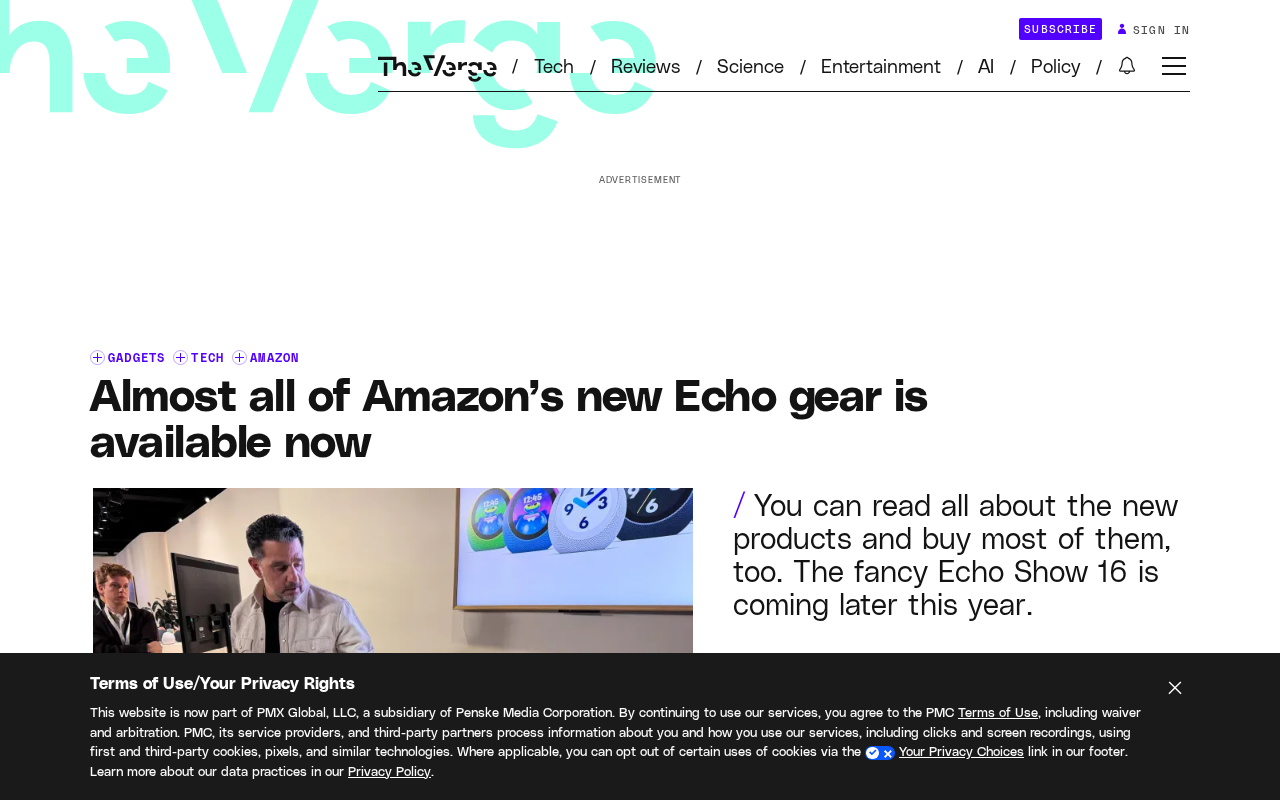
Amazon is quietly changing the rhythm of its hardware product releases. In the past, the company was accustomed to unveiling dozens of products at once during its annual hardware event, but now it seems to prefer giving each new product its own launch stage. The latest round of releases focuses on the Echo series, covering speakers, smart displays, and other devices, and nearly all of them are already available for purchase.
From "Bombardment-Style" Launches to "Refined" Operations
Amazon's past hardware events often resembled an intensive product show, with dozens of devices hastily appearing on stage, making it hard for consumers to leave a deep impression of each product. According to recent observations, this strategy is changing. The company has begun arranging separate launch windows for individual product lines or single devices, giving each new product more exposure and discussion space.
This shift is no accident. As competition in the smart home market intensifies, consumers have become more discerning in their awareness and choices of products, and extensive launches make it difficult to establish product recognition. Concentrating resources on a few products helps Amazon more clearly communicate the core selling points of each device. The latest round of Echo product releases exemplifies this approach—categories such as speakers and smart displays are being brought to market one by one rather than unveiled as a bundle.
Echo New Product Lineup and Market Rhythm
This round of Echo products covers the core categories of Amazon's smart home ecosystem: smart speakers and smart displays. These devices are the primary carriers of the Alexa voice assistant and key entry points for Amazon to connect home scenarios. You may not have noticed that nearly all of these new products are already available for purchase, meaning the cycle from launch to market has been significantly compressed.
For consumers, a faster time to market reduces waiting; for Amazon, it enables quicker access to market feedback and adjustment of subsequent strategies. This "launch and ship" approach is uncommon in the hardware industry. It reflects Amazon's confidence in supply chain and inventory management, and also suggests the company wants to shorten the feedback loop of product iteration.
Alexa voice assistant is Amazon's cloud-based AI assistant, launched in 2014 alongside the first-generation Echo smart speaker. It receives voice commands through a far-field microphone array and relies on Amazon Web Services (AWS) for natural language understanding and skill orchestration, enabling functions such as playing music, querying information, and controlling smart home devices. Alexa uses an open skill system, allowing third-party developers to build extensions, which continuously expands the functional boundaries of Echo devices. As the interaction hub of Amazon's smart home ecosystem, Alexa's response speed, comprehension accuracy, and skill richness directly determine the user experience of Echo hardware.
Smart display is a device category that combines the voice interaction capabilities of a smart speaker with a tablet touchscreen, represented by products such as the Echo Show series. Compared with pure speakers, it adds scenarios such as video calls, streaming media viewing, and visual smart home control panels, extending Alexa's feedback from pure voice to graphics and video. Such devices typically include cameras, which also raises additional privacy concerns among users; Amazon has addressed this with designs such as physical lens covers.
The Logic Behind the Strategy Adjustment
Why would Amazon change a launch strategy it has used for years? One reasonable explanation is that the smart hardware market has moved from a stage where "novelty alone attracts attention" to one where "experience and ecosystem determine purchase." Consumers no longer buy simply because a device carries a "smart" label; they care more about collaboration between devices, the practicality of the voice assistant, and the overall user experience.
Against this backdrop, concentrating resources on polishing and promoting a single product can build user trust better than piling up dozens of products at once. Independent launches also give Amazon the opportunity to develop differentiated marketing messages for different product lines, rather than being drowned out in a noisy event. In addition, phased releases help maintain topic heat throughout the year, avoiding a long silence after a once-a-year big show.
Smart home ecosystem refers to a system that interconnects home devices such as lighting, security, temperature control, and audio-visual equipment around unified protocols and voice platforms. Its value lies not in a single hardware device but in the linkage between devices and a unified control entry point. Amazon has built a vast ecosystem with Echo and Alexa and brings third-party devices in through the "Works with Alexa" certification program. Once ecosystem stickiness forms, the cost for users to switch platforms increases significantly—this is the deeper reason Amazon emphasizes device collaboration and experience rather than simply stacking up new product quantities.
Impact on the Smart Home Market
Amazon's adjustment may have a ripple effect on the smart home industry. As the leader in the global smart speaker market, Amazon's release rhythm is often watched by competitors. If refined launches prove effective, other manufacturers may follow suit, changing the marketing conventions of the entire industry.
On the other hand, the rapid market availability of new Echo products also means the Alexa ecosystem updates faster. For developers, new hardware means new interaction scenarios and skill adaptation requirements; for consumers, more frequent product updates may drive stronger replacement demand, but may also raise concerns about "too-fast iteration." Amazon needs to find a balance between driving sales and maintaining user satisfaction.
Product iteration cycle refers to the time span from a hardware product's launch to its replacement by the next generation. Traditional consumer electronics often have cycles of 12 to 24 months, while categories such as smart speakers have shown a shortening trend in recent years. Too-fast iteration can have two effects: on one hand, existing users face the awkward situation of devices with outdated features that are still usable, reducing replacement motivation; on the other hand, new buyers worry about "being obsolete right after purchase." Manufacturers usually alleviate the conflict by extending the life cycle of old devices through software updates and offering trade-in programs.
Conclusion
The near-full market availability of Amazon's new Echo products may appear on the surface to be merely an update on product availability, but it reflects a maturing shift in hardware release strategy. From casting a wide net to cultivating with precision, Amazon is telling the story of each product with a more restrained rhythm. Whether this change can bring better market performance for the Echo series is worth continued observation.
One-line Summary
Amazon changes its hardware release strategy: new Echo products launch independently and quickly reach market, reflecting a shift toward refined operations.
Paragraph Summary
Amazon is quietly adjusting the rhythm of its hardware product releases, moving from unveiling dozens of products at once during annual events to arranging separate launch windows for individual product lines or single devices. The latest round of Echo products includes smart speakers and smart displays, nearly all of which are already available for purchase, with the launch-to-market cycle significantly compressed. The article argues that this shift stems from intensifying competition in the smart home market: consumers care more about device collaboration and overall experience than the "smart" label, and refined launches help establish product recognition and differentiated marketing. This move may prompt industry imitation and accelerate Alexa ecosystem updates, but Amazon also needs to balance driving sales against user concerns about too-fast iteration.
Related articles

Zero-Cost Local Jarvis: Open-Source Voice Cloning and Task Automation in Practice
AI Workshop shows how to build a zero-cost local Jarvis with Ollama and Voice Studio: local model switching, open-source voice cloning, file retrieval, and tool-calling tests, with setup steps and hardware trade-offs.

Mistral Large 4 Released: 1T-Parameter MoE Tops Western Open-Source Leaderboard
Mistral releases its flagship Mistral Large 4: a 1T-parameter MoE architecture activating only 49B parameters at inference, trained from scratch on 3,800 Grace Blackwell GPUs, topping the Western open-weight leaderboard with third-party endorsements in law, finance, and cybersecurity.

Mistral Large 4 Review: Can Europe's Strongest Open-Source Model Challenge the US and China?
Mistral Large 4 (L-Charm) review: trillion-parameter MoE, standout cybersecurity benchmarks but behind Kimi K3 in software engineering, 3,800 GPUs, a key step for European sovereign AI.