Amazon's Bee Wearable Upgrade: Always-Listening AI Assistant Now Helps You Shop

Amazon releases the upgraded Bee Frontier, pushing its always-listening AI wearable from recording conversations to facilitating transactions.
After acquiring startup Bee, Amazon released two new devices, including the $74.99 Bee Frontier (up from the original's $50), plus a subscription service. The key shift is the commercial loop: Bee now integrates Amazon's e-commerce capabilities to identify purchase intent during conversations and drive orders, leveraging Amazon's unique position with both a hardware entry point and the world's largest product catalog and fulfillment network. Yet privacy tensions around always-listening persist. The article argues AI wearable competition is shifting from AI capability to proximity to transactions.
Amazon is pushing its ambitions in AI wearables from "recording conversations" to "closing transactions."
According to RSS sources, Amazon acquired the relatively low-profile startup Bee last year — the company had launched a $50 always-listening AI wearable whose core function was automatically summarizing every conversation you experienced. Now, the e-commerce giant has officially released two new Bee devices along with a new subscription service. One of them is the $74.99 Bee Frontier, an upgraded version of the first-generation Bee.
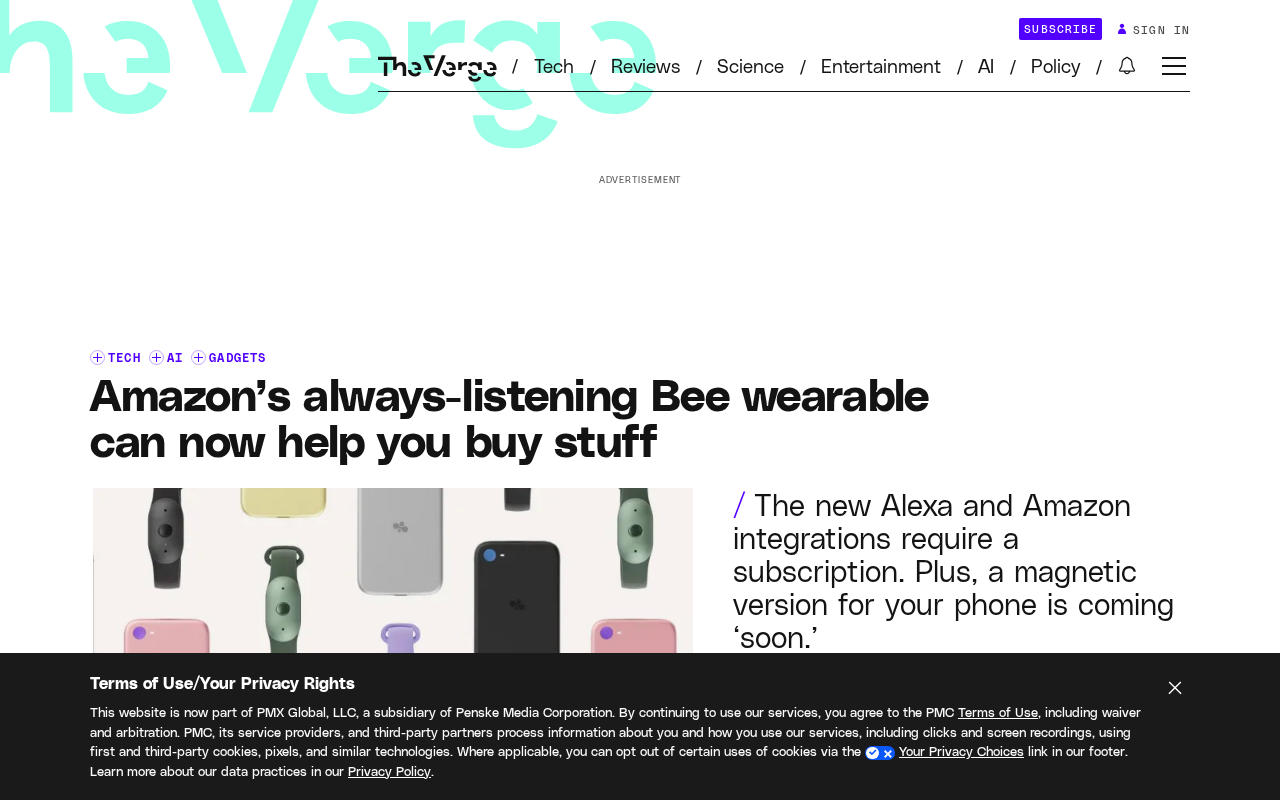
The Functional Leap from "Recording" to "Transactions"
The positioning of the original Bee was clear: an AI recorder worn on your body that continuously listens. It converts everyday conversations into searchable text summaries, addressing the need to outsource memory — "What did I just agree to?" "What key information did the other person mention?"
What's changed with the new generation is the commercial loop. The headline explicitly states it "can now help you buy stuff" — meaning Bee is no longer just a passive information collector, but has begun integrating Amazon's e-commerce capabilities, identifying purchase intent during conversations and driving orders. This direction is almost inevitable for Amazon: it has both a hardware entry point and the world's largest product catalog and fulfillment network. Shortening the path between "hearing a need" and "fulfilling a need" is a structural advantage other AI hardware makers can hardly replicate.
Worth noting is the pricing strategy. The Bee Frontier is priced at $74.99, a clear step up from the original's $50, but still within the "acceptable impulse purchase" range. Combined with the new subscription service, Amazon is clearly attempting the classic playbook of low hardware margins with recurring service revenue.
The Privacy Question Always-Listening Devices Can't Avoid
The phrase "always-listening" itself is the focal point of controversy. A device that continuously captures ambient audio inherently treads on others' privacy — when you wear it, the people around you haven't consented to being recorded or analyzed.
Amazon's approach will most likely follow industry conventions: local wake word, on-device processing, cloud encryption, and clear indicator lights. But technical measures can only mitigate, not eliminate, the fundamental tension. When the device evolves from "help me take notes" to "help me buy things," the purpose of data usage expands from personal efficiency to commercial recommendations, and users' sensitivity to data flows will rise significantly. There's a real trade-off here: the more proactive and convenient the features, the more audio data permissions users relinquish.
For Amazon, whether Bee's commercialization succeeds may not depend on its AI capabilities, but on whether it can build a sufficiently trustworthy privacy narrative.
The technical implementation of always-listening devices typically relies on a layered processing architecture. The device is equipped with a low-power wake word detection module, and only after detecting a specific trigger word does it activate the full audio capture and upload process — this avoids sending ambient audio to the cloud most of the time. Uploaded audio is converted to text by automatic speech recognition (ASR), then handed to a large language model for summarization, intent recognition, and other processing. The core of the privacy controversy isn't the wake word itself, but rather: whether false wake triggers upload clips that shouldn't be uploaded, whether raw audio is retained, and whether the textualized data can be persistently linked to user identity. Amazon has previously faced repeated regulatory and public scrutiny over recording retention and human review issues with its Echo line, and this experience will directly shape Bee's compliance design orientation.
New Variables in the AI Hardware Race
Bee is entering a rapidly crowding赛道. AI wearables have gone through a complete cycle over the past period, from conceptual hype to practical skepticism, with many products receiving lukewarm receptions because "their features can be replaced by a phone."
Bee's differentiation lies in its attachment to a parent company with real transaction scenarios. A standalone AI recording device struggles to answer "why would users wear it all the time," but if it can directly complete an order when you mention wanting to buy something, its value becomes concrete. This may be the real reason Amazon acquired Bee — not to buy a hardware team, but to buy an entry point for embedding an AI assistant into everyday consumption decisions.
There are two things to watch next: first, exactly how far "helping you buy" goes — is it simply redirecting to a link, or deeply participating in price comparison and decision-making; second, the pricing and benefits design of the subscription service, which determines whether Bee goes for volume or profit.
Amazon has not yet disclosed all the details, but this launch confirms one trend: competition in AI wearables is shifting from "whose AI is smarter" to "who is closer to the transaction."
The "phone replaceability" dilemma of AI wearables is the structural reason this赛道 keeps hitting walls. Form factors like earbuds, watches, glasses, and pins have all been tried, but most products' features — timekeeping, step counting, voice assistants, notifications — can all be handled by the smartphone you already carry, leaving users with little reason to wear an additional device. To break through this impasse, products typically need to meet one of two conditions: first, provide capabilities a phone physically cannot, such as always-in-ear hands-free operation or first-person perspective recording; second, tap into scenarios a phone cannot directly close the loop on, such as instant transactions. Bee has chosen the second path, turning the wearable into a front-end touchpoint in the e-commerce chain rather than a standalone general-purpose computing device.
One-line Summary
Amazon releases the upgraded Bee Frontier, pushing its always-listening AI wearable from recording conversations to facilitating transactions.
Paragraph Summary
After acquiring the startup Bee, Amazon has released two new devices, including the Bee Frontier priced at $74.99 — up from the original's $50 — accompanied by a subscription service. The core change is the commercial loop: Bee no longer just records and summarizes conversations, but integrates Amazon's e-commerce capabilities to identify purchase intent during conversations and drive orders. This leverages Amazon's structural advantage of owning both a hardware entry point and the world's largest product catalog and fulfillment network. However, the privacy tension of always-listening remains — as data usage expands from personal efficiency to commercial recommendations, user sensitivity will rise. The article argues that competition in AI wearables is shifting from AI capability to proximity to transaction scenarios.
Related articles

"Black October": Did AI Uncover 3% of All Critical Vulnerabilities Ever?
A Reddit post claims 3% of all critical software vulnerabilities ever were found in the past month, dubbed 'Black October.' We break down the statistical issues, how AI-assisted code auditing accelerates discovery, and how developers should respond.

Microsoft Project Gecko: Using AI to Bridge Language Gaps for African Farmers
Microsoft's Project Gecko launches PharmaChat, letting African farmers ask questions in their native language and get precise video clips and farming book chapters via AI. The project also releases three interactive manuals to advance inclusive AI.

Musk's Space Dominance: How Starlink Throttling Undermines Ukraine's Defense
SpaceX's Starshield throttling disabled Ukraine's high-speed interceptor drones, exposing how Musk's private control over low Earth orbit communications affects battlefield dynamics and national security, and highlighting the risks of commercial space militarization and space governance dilemmas.