Amazon's Zoox Robotaxis Join Uber, Debut in Las Vegas
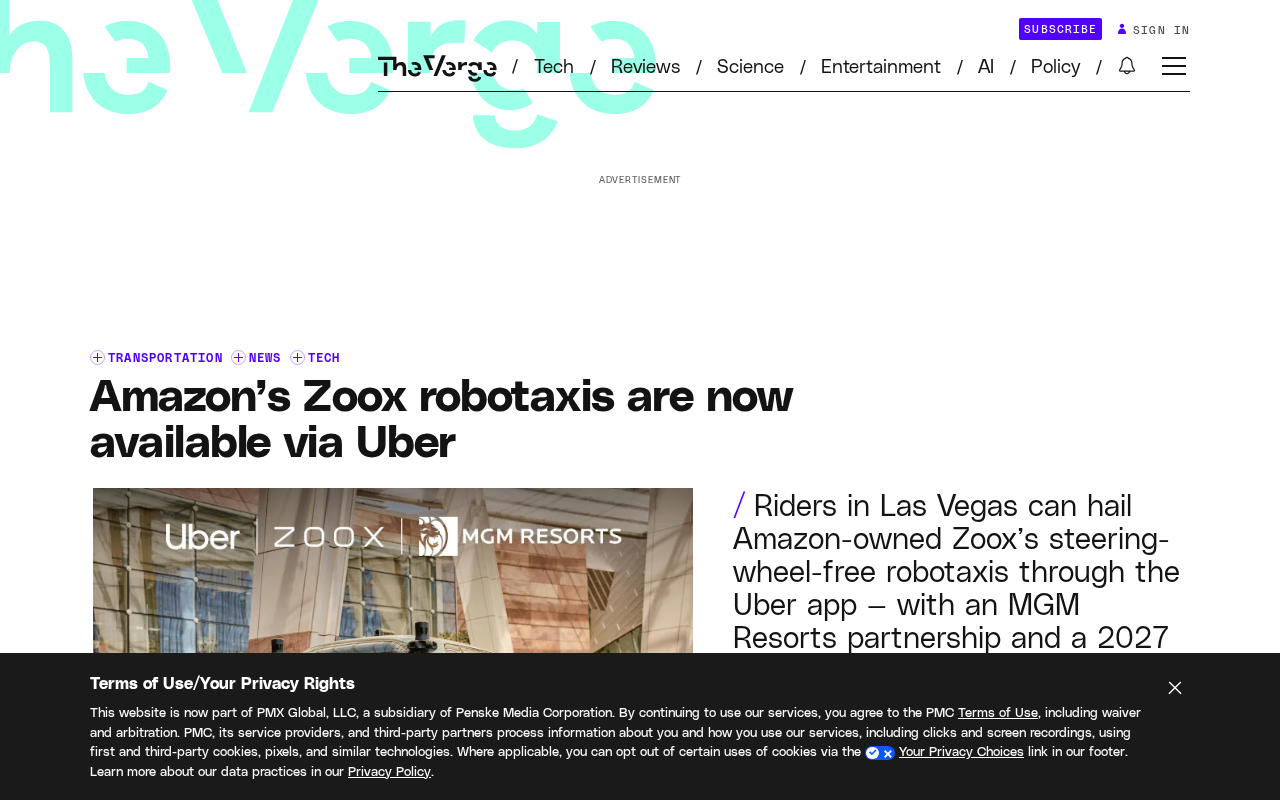
Uber integrates Zoox's steering-wheel-free robotaxis in Las Vegas for the first time, launching a new platform aggregation model.
Uber has partnered with Amazon-owned Zoox to bring Zoox's purpose-built, steering-wheel-free, bidirectional robotaxis to the Uber app in Las Vegas. It's Uber's first integration of purpose-built autonomous vehicles and Zoox's first opening to the public via a third-party platform. The article analyzes why Las Vegas was chosen—regular roads, concentrated demand, and a relaxed testing environment—and notes Uber's multi-partner aggregation strategy, partnering with both Waymo and Zoox. Zoox's differentiation lies in its driverless cabin and face-to-face seating, but it faces high regulatory and public acceptance barriers. The partnership is currently limited in scale but signals the trend of robotaxis moving from independent operations to platform aggregation.
Uber's relationship with Waymo remains uncertain, but Uber has found a new autonomous driving partner—Amazon-owned Zoox. Starting today, Uber users in Las Vegas will have the chance to be matched with Zoox's purpose-built bidirectional robotaxis. This marks the first time Uber has added vehicles with no steering wheel, designed specifically for autonomous driving, to its network, and it's also the first time Zoox has opened its robotaxi service to a third-party platform.
A Two-Way "First"
This partnership is a milestone for both sides. For Uber, it's the first time its platform has integrated "purpose-built" autonomous vehicles—fully self-driving models designed from the ground up without human driving in mind, with no steering wheel or pedals. Previously, Uber's autonomous vehicle partners mostly used modified conventional models. For Zoox, this is the first time its robotaxi service has been opened to the public through an external platform; until now, Zoox only offered ride-hailing through its own app in specific areas.
According to the original report, Uber passengers in Las Vegas can hail a ride normally through the Uber app, and the system will randomly match them with a Zoox vehicle. This means users don't need to download a separate Zoox app to experience a driverless ride.
Purpose-built autonomous vehicles refer to models built entirely around an autonomous driving system from the outset, without retaining human driving interfaces such as steering wheels or accelerator/brake pedals. This contrasts with "retrofit autonomous driving," where sensors and computing platforms are added to production vehicles that still retain a driver's cabin. Purpose-built models typically feature symmetrical or bidirectional designs, face-to-face seating layouts, and redesigned crash safety structures, offering more passenger space and greater flexibility in direction of travel. The trade-off is that they must go through entirely new regulatory approval pathways and cannot be taken over by a human when needed, placing higher demands on system redundancy and safety validation.
Why Las Vegas?
Las Vegas becoming the first launch city is no accident. The city has a relatively simple road grid, concentrated tourist travel demand, and a more relaxed autonomous driving testing environment. Zoox had already conducted extensive testing and operational preparation in Las Vegas. Placing its first third-party platform partnership here allows it to validate mixed dispatching, user acceptance, and operational efficiency within a controlled scope.
For Uber, Las Vegas is also an ideal testing ground: frequent tourist trips and dense short-distance orders make it suitable for demonstrating the convenience of robotaxis. If the model works, it could expand to more cities in the future.
A robotaxi's operational design domain (ODD) is the defined area in which an autonomous vehicle is permitted to operate, typically determined by road types, weather, time of day, and geofencing. Las Vegas has a regular road grid, a dry climate with little rain, and tourist travel concentrated in specific corridors, making it easy to define and manage the ODD. Zoox had already been testing in the city, indicating that its ODD covers some public roads. Incorporating third-party platform orders into the same ODD requires solving mixed dispatching challenges: Uber's dispatch system must identify which orders can be handled by robotaxis and handle pickup and drop-off points that vehicles cannot reach. This "platform + restricted area" model is the mainstream path for robotaxi commercialization today.
What It Means for Uber's Autonomous Driving Strategy
Uber's autonomous driving strategy has always been a "multi-partner" approach. It partners with Waymo in some cities and has agreements with multiple autonomous driving companies. Integrating Zoox further reinforces Uber's positioning as an aggregator platform: it doesn't build cars itself but brings autonomous driving capacity from different companies into its own network.
The advantage of this strategy is asset-light operations and rapid expansion, but the challenges are obvious—vehicle standards, operational areas, and user experiences across different partners are difficult to unify. Zoox's steering-wheel-free vehicles offer an experience vastly different from traditional taxis, and Uber needs to ensure user expectations are properly managed.
Zoox's Differentiation: A Taxi Without a Steering Wheel
Zoox's vehicle is its biggest selling point. This bidirectional, symmetrically designed model has no traditional driver's cabin, with four seats facing each other in the cabin, giving passengers an experience closer to a small lounge. The vehicle runs entirely on sensors and algorithms, with no need for human driver intervention.
This design faces higher barriers in regulation and public acceptance. Opening up to a broader user base through the Uber platform is also an important step for Zoox to gather real user feedback and prove its safety.
Bidirectional travel and symmetrical design mean the vehicle has no traditional "front" and "rear," with either side capable of serving as the direction of travel and seats arranged face-to-face. This layout eliminates the driver's cabin and increases cabin space utilization, but it also brings unique engineering and regulatory challenges: the vehicle needs two equivalent sets of steering, braking, and perception redundancy; crash safety standards must be redefined (for example, how front structures for pedestrian protection remain consistent when traveling in either direction); and passengers sitting face-to-face may experience motion sickness or discomfort due to the lack of forward visibility. In addition, steering-wheel-free vehicles cannot be taken over by a safety driver in emergencies, so they must rely on remote assistance and highly redundant system architectures—which is why their regulatory approval is more complex than that of retrofit vehicles.
Subtle Shifts in the Market Landscape
Uber partnering with both Waymo and Zoox reflects the coexistence of competition and cooperation in the autonomous ride-hailing market. Waymo is the leader in U.S. robotaxis, while Zoox, backed by Amazon, has ample funding and resources. As a platform, Uber can benefit from competition among multiple parties, but it also needs to balance relationships among its partners.
For Amazon, Zoox joining Uber means its autonomous driving technology reaches large-scale user traffic for the first time, which is more efficient than building its own ride-hailing platform. For Uber, introducing steering-wheel-free robotaxis is an opportunity for brand differentiation and can also show investors its progress in autonomous driving.
Outlook
Currently, the partnership is limited to Las Vegas, and the number of vehicles is limited. But the signal is clear: robotaxis are moving from independent operations toward platform aggregation. Whether Uber can become the "aggregator" of the autonomous driving era depends on whether it can seamlessly integrate vehicles from different partners into a single user experience. Zoox's addition is an important test of this step.
For ordinary users, the most direct change is: when hailing an Uber in Las Vegas, the car that arrives might have no driver and no steering wheel. It's novel, and it will take time to get used to.
Related articles

Two Cursors: A Hopeful Song About Writing Software with AI
YouTube music video *Two Cursors* uses lyrics to portray AI-assisted programming: from a single cursor to two-cursor collaboration to a three-party debugging scene, offering a hopeful view of conversational collaboration between developers and AI.

No API Key Needed: Manage Your WordPress Site Directly With Your AI
Anti-Manual releases MCP Connector, letting Claude, ChatGPT, Cursor and 14 AI tools manage WordPress without an API Key—draft writing, internal links, SEO audits, broken link checks, reusing existing subscriptions with no extra bills.
Cursor vs Claude Code: Terminal Agents Face Off Against Editor Completion
Cursor vs Claude Code compared: Cursor excels at editor tab completion; Claude Code is a full-repo autonomous terminal agent. Context windows, costs, and use cases.