Two Cursors: A Hopeful Song About Writing Software with AI
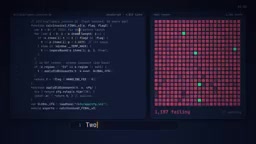
*Two Cursors* poetically portrays the collaborative relationship between developers and AI in AI programming.
The YouTube music video *Two Cursors* uses the "dual cursor" image to express the AI-assisted programming experience. It starts with a single blinking cursor, symbolizing a developer facing a blank editor; then introduces a "second life" representing the AI collaborator born in dialogue, making abstract assistance a visible partner. The third scene brings in "the oldest bug," suggesting debugging shifts from a lonely struggle to a three-way conversation among developer, AI, and bug. The "sad kid" image adds emotional depth—frustration and nostalgia for programming's original innocence. The article notes the song offers a technical perspective beyond efficiency metrics, emphasizing emotional and relational changes in programming, and sets a tone of hope, viewing AI as a partner rather than a threat.
When Code Becomes Lyrics: A Music Video About AI Programming
In tech communities, discussions about how AI is changing programming are often filled with tool reviews, benchmarks, and efficiency data. But a music video on YouTube titled Two Cursors expresses the same theme in a completely different way—by singing it.
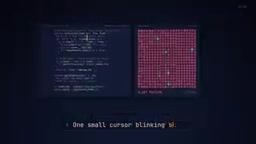
The song's narrative begins with the most basic programming image: a blinking cursor. The lyrics go "Ha, ha, one small cursor, blinking slow." That slow blink is both the state of a screen waiting for input and something like breathing—the starting point for a developer facing a blank editor.
From One Cursor to Two Lives
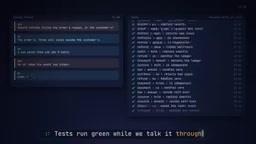
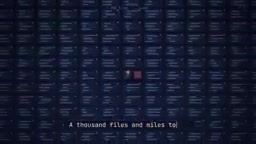
The song's core turn comes in the second set of images: "Thousand files and miles to go," followed immediately by "Then a second life while we talk it through." Here a "second life" appears—another presence born in conversation.
This is a poetic summary of the current AI programming experience. Traditional programming is one cursor, one developer facing thousands of files. Now the developer brings in an AI collaborator through dialogue, and a "second cursor" appears on screen. The image is powerful because it turns abstract AI assistance into a visible, simultaneously present collaborator.
The second cursor is not a tool but more like a conversational partner. The lyrics emphasize "while we talk it through"—advancing work through dialogue, which is precisely the core interaction mode of today's AI programming tools.
The core interaction mode of AI programming tools is often called "conversational programming" or an AI version of "pair programming." Traditional pair programming involves two human developers—one writes code, the other reviews. AI pair programming replaces one side with a large language model (LLM), using natural language dialogue to generate, explain, and modify code. Representative tools include GitHub Copilot, Cursor, and Replit Ghostwriter, which can provide real-time completion suggestions in the editor or refactor code based on conversational instructions. The "second cursor" in the lyrics is a visual metaphor for this interaction: the AI's input cursor and the developer's cursor blink alternately on the same screen, forming an asynchronous yet synchronized collaborative rhythm.
The Oldest Bug and Three-Party Collaboration
Most intriguing is the third set of images: "The oldest bug, three of us, sad kid." Here three participants appear—the developer, the AI, and that "oldest bug."
The phrase "the oldest bug" carries a humorous self-deprecation. Some bugs in software engineering seem as old as programming itself, recurring and hard to eradicate. And "three of us" brings the bug into this collaborative scene, suggesting that debugging is no longer a lonely struggle but a multi-party conversation.
The "sad kid" image adds an emotional layer. It can be read as the developer's frustration when facing a stubborn bug, or as a kind of nostalgia for the original innocence of programming. In the era of AI-assisted programming, the relationship between the person writing code and the code is being redefined—and in that redefinition there is both hope and a certain loss.
In software engineering, "the oldest bug" is not literally ancient in time but refers to classic defect patterns that recur and are rooted in human cognition or system complexity. Examples include null pointer exceptions, off-by-one errors, and race conditions, which have reappeared in new forms since the birth of programming. Debugging is usually seen as the most solitary part of a developer's work, requiring long periods of focus and hypothesis testing. The involvement of AI-assisted debugging tools (such as LLM-based code interpreters and automated fix suggestions) is changing this process: AI can quickly propose hypotheses, generate test cases, or locate suspicious code segments, turning debugging from a solo battle into a three-way conversation among "developer—AI—bug." The "three of us" in the lyrics is an anthropomorphic expression of this shift.
Why This Song Deserves Technologists' Attention
Setting the music aside, the value of this song lies in offering a perspective different from technical documentation. Discussions about AI programming usually focus on efficiency gains, code quality, and tool choices, but Two Cursors reminds us that there is also an emotional and relational side to the programming experience.
The image of two cursors resonates because it accurately captures a real feeling among today's developers: the way we work is shifting from facing the screen alone to advancing together with a tireless, always-responsive collaborator. This shift brings not only changes in efficiency but also subtle adjustments in work rhythm, problem-solving approaches, and even professional identity.
The song chooses to set its tone with "hope"—the title explicitly says "a hopeful song." This may be the most noteworthy aspect: amid anxieties about AI replacing developers, the song chooses an optimistic narrative, seeing AI as a second life in the conversation rather than a threat.
Of course, one song cannot answer all the controversies around AI programming. But it at least opens a space for discussion: when we talk about AI-assisted development, beyond looking at metrics, we can also talk about feelings.
Related articles
Claude Code Advisor Mode: Two-Model Collaboration for Cost-Effective Coding
Explaining Claude Code's experimental Advisor Mode: primary model writes code, strong model intervenes at key points. Covers version requirements, three activation methods, model pairing rules, and real cost boundaries, clarifying the community's 3.4x savings claim.
Build a Money-Making App from Scratch Without Code: The 8-Step Process and a $151 Bill
A YouTube creator breaks down the full eight-step process to build a money-making app without code: AI coding, GitHub, Cloudflare hosting, D1 and R2 backend, a New Mexico LLC, a free EIN, Stripe payments, and legal pages—totaling $151.
No API Key Needed: Manage Your WordPress Site Directly With Your AI
Anti-Manual releases MCP Connector, letting Claude, ChatGPT, Cursor and 14 AI tools manage WordPress without an API Key—draft writing, internal links, SEO audits, broken link checks, reusing existing subscriptions with no extra bills.