Amazon Turns Alexa Robot into Ring Patrol Camera
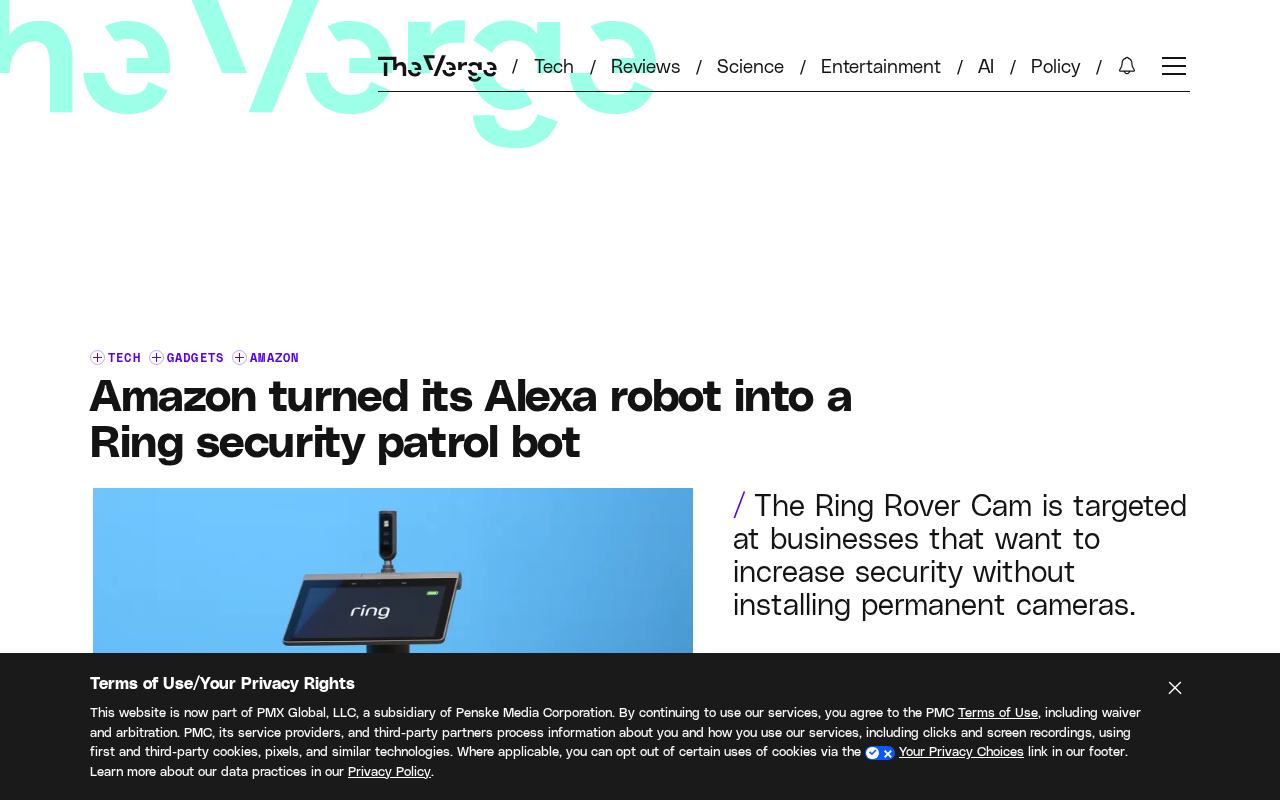
Amazon launches Ring Robotics brand and Ring Rover Cam mobile security camera, shifting from passive monitoring to active patrol.
Amazon announced the new Ring Robotics brand and its first mobile security camera, Ring Rover Cam, built on the Astro home robot platform. Stripping away home assistant features, it focuses on autonomous patrol, anomaly detection, and active deterrence, enabled by edge computing and computer vision. However, privacy concerns and Ring's prior police data-sharing policies pose trust challenges that Amazon must balance against innovation.
Amazon is redefining the boundaries of home security. According to RSS sources, Amazon has announced the launch of a new brand called Ring Robotics and released a mobile security camera named Ring Rover Cam. This product borrows heavily from the design and functionality of Amazon's previous Astro home robot, marking a key step for Amazon in the security sector from passive monitoring to active defense.
From Astro to Ring Rover Cam: A Genetic Recombination
Ring Rover Cam didn't emerge from nowhere. Its predecessor Astro was once seen as Amazon's bold attempt in the home robotics space, but market reception was lukewarm. Now, Amazon has chosen to combine Astro's hardware platform with Ring's security ecosystem, repackaging it as the first patrol camera under the Ring Robotics brand. This "old wine in new bottles" strategy both reduces R&D costs and leverages Ring's brand recognition among security users.
In terms of design, Rover Cam inherits Astro's wheeled mobile chassis and camera module, but the software layer focuses more on security patrol functions. It no longer emphasizes the role of a home assistant, but rather concentrates on mobile monitoring, anomaly detection, and active deterrence. This shift in positioning reflects Amazon's reassessment of home security market demands—users don't need a talking robot, but an "electronic security guard" that can patrol automatically.
Astro is a home robot released by Amazon in 2021, initially positioned as "Alexa on wheels," featuring the ability to follow users, play music, make video calls, and monitor the home. Its hardware includes a wheeled chassis, a retractable camera module, and a ring-shaped display, priced at $1,499 (later reduced to $999). However, due to its high price and limited use cases, Astro never gained mainstream market traction, and Amazon even temporarily paused the product line. Ring Rover Cam is built on Astro's hardware platform but strips away the home assistant attributes, focusing solely on security patrol. This "platform reuse" strategy is not uncommon in the tech industry—for example, Google has reused some Pixel phone technology in Nest devices. For Amazon, this both absorbs Astro's sunk R&D costs and leverages Ring's brand advantage in the security space to quickly launch new products.
Active Security: The Ambition of Ring Robotics
The launch of the Ring Robotics brand represents a strategic upgrade of Amazon's security business. Traditional security cameras can only be fixed in one position, passively recording footage, while Rover Cam can move autonomously, covering a larger monitoring range. According to RSS sources, the new brand aims to "take a more proactive security approach, not just monitoring." This means Rover Cam may feature automatic patrol route planning, motion-detection-triggered responses, and even proactively drive toward suspicious areas when anomalies are detected.
This proactive security concept is closely tied to advances in AI technology. By combining computer vision and edge computing, Rover Cam can process sensor data locally, reducing reliance on the cloud and enabling faster responses. Although official technical details have not yet been disclosed, Astro's existing obstacle avoidance and navigation capabilities suggest that Rover Cam's mobile patrol functionality is technically feasible.
Edge computing refers to migrating data processing tasks from the cloud to local devices to reduce latency and bandwidth consumption. In the context of Ring Rover Cam, edge computing means the camera can perform image recognition, motion detection, and anomaly behavior analysis locally without uploading all video streams to the cloud. This not only improves response speed (e.g., immediately initiating patrol upon detecting a suspicious person) but also reduces privacy risks—sensitive data doesn't need to leave the home network. Currently, many smart cameras integrate dedicated AI chips (such as Google Coral, NVIDIA Jetson) to support running lightweight computer vision models locally. If Rover Cam adopts a similar approach, it can maintain basic patrol functions even when offline, while reducing reliance on Amazon's cloud services and thereby lowering long-term operating costs.
Market Impact and Challenges
Amazon's move to "rebrand" the Alexa robot as a security patrol device has sparked widespread discussion in the smart home market. On one hand, it lowers the barrier for users to deploy mobile security devices—users no longer need to purchase expensive professional security systems; a single Rover Cam can provide dynamic monitoring. On the other hand, privacy concerns remain a sword of Damocles hanging overhead. How a camera that can move around the home ensures data security and avoids intruding into private spaces is a question Amazon must answer.
Additionally, the Ring brand has previously been controversial due to its data-sharing policy with police. Incorporating mobile cameras into the Ring ecosystem may exacerbate public concerns about privacy leaks. Amazon needs to find a balance between product features and user trust, otherwise Rover Cam may repeat Astro's fate of being well-received but commercially unsuccessful.
Ring's data-sharing policy with police began in 2019, with its Neighbors app allowing users to upload videos of suspicious activity, and police can request footage from users. The policy has been heavily criticized for lacking transparency and potentially exacerbating racial bias; civil rights organizations have protested multiple times, and some cities have even banned police from using Ring data. In 2021, Ring announced that police requests would be made through public posts, but the controversy has not fully subsided. Incorporating mobile cameras into the Ring ecosystem means devices could enter neighbors' property or public areas without the user's knowledge, raising more complex legal and ethical issues. Amazon needs to clarify data storage periods, access permissions, and third-party sharing rules, and may face regulatory scrutiny. If handled poorly, privacy concerns could severely inhibit Rover Cam's market acceptance and repeat Astro's predicament.
Conclusion: Re-exploring Robot Form
The launch of Ring Rover Cam represents a pragmatic pivot for Amazon in the consumer robotics space. It no longer pursues an all-purpose home assistant but focuses on security—a rigid-demand scenario—using mobility to compensate for the blind spots of fixed cameras. Although details have not been fully disclosed, this direction is commendable. For users concerned about smart home security, Rover Cam may be a new option worth looking forward to.
One-line Summary
Amazon launches Ring Robotics brand and mobile security camera Ring Rover Cam, shifting from passive monitoring to active patrol.
Paragraph Summary
Amazon announced the new brand Ring Robotics and its first mobile security camera, Ring Rover Cam. Built on the hardware platform of the previously lukewarm Astro home robot, the product strips away home assistant functions and focuses on autonomous patrol, anomaly detection, and active deterrence. Ring Robotics aims for a more proactive security strategy rather than passive monitoring, enabled by advances in edge computing and computer vision. However, the product faces privacy controversies and trust challenges from Ring's prior data-sharing policies with police. Amazon must balance feature innovation with user trust, or risk repeating Astro's fate.
Related articles

Gemini 4 Hydrogen Released: A 2.5x Faster Everyday AI Model
Google releases Gemini 4 Hydrogen, claiming 2.5x the speed of Gemini 3.8 Flash, with four-tier thinking control, a million-token context, and Orchestrator multi-model collaboration. API pricing is $1.50 per million input tokens.

Gemini 4 Hydrogen Hands-On: Google's Fastest and Cheapest AI Model
Hands-on with Gemini 4 Hydrogen: the fastest, cheapest model in the Gemini 4 family. We break down the Carbon/Argon/Hydrogen split, API pricing traps, free-tier limits, and the cost trade-offs of four thinking levels—with a real bug-debugging demo.
Gemini 4 Hydrogen vs Sonnet Comparison Test: Uses Only 1% of Weekly Quota, Performance on Par
Hands-on test: Gemini 4 Hydrogen vs Sonnet on the same CRUD task—Hydrogen used only 1% weekly quota with comparable performance and better UI details, while Anthropic's model used 7%. Developer says daily tasks don't require expensive models.