Ambient Intelligence: The Next Paradigm for Developer Interaction

GitHub argues the developer interface is shifting from operating tools to expressing intent, with ambient intelligence as the carrying paradigm.
GitHub's official blog proposes that software development is shifting from "operating tools" to "expressing intent," with Ambient Intelligence as the interaction paradigm carrying this shift. Traditional interfaces require humans to adapt to machines, with learning costs rising as tools grow more capable; Ambient Intelligence instead lets AI understand context, agents take on multi-step tasks, and voice and physical controls replace keyboards and screens, turning developers from tool operators into intent expressers. The article notes that AI, agents, voice, and physical controls—four technological threads—are converging to form a "faceless" development experience. Its core product goal isn't showing off, but helping developers stay focused and reducing the cognitive load of context switching. For developers, interaction entry points will become dispersed, prompt organization and agent boundary-setting will become new engineering skills, and the core moat will shift further toward problem definition and system judgment.
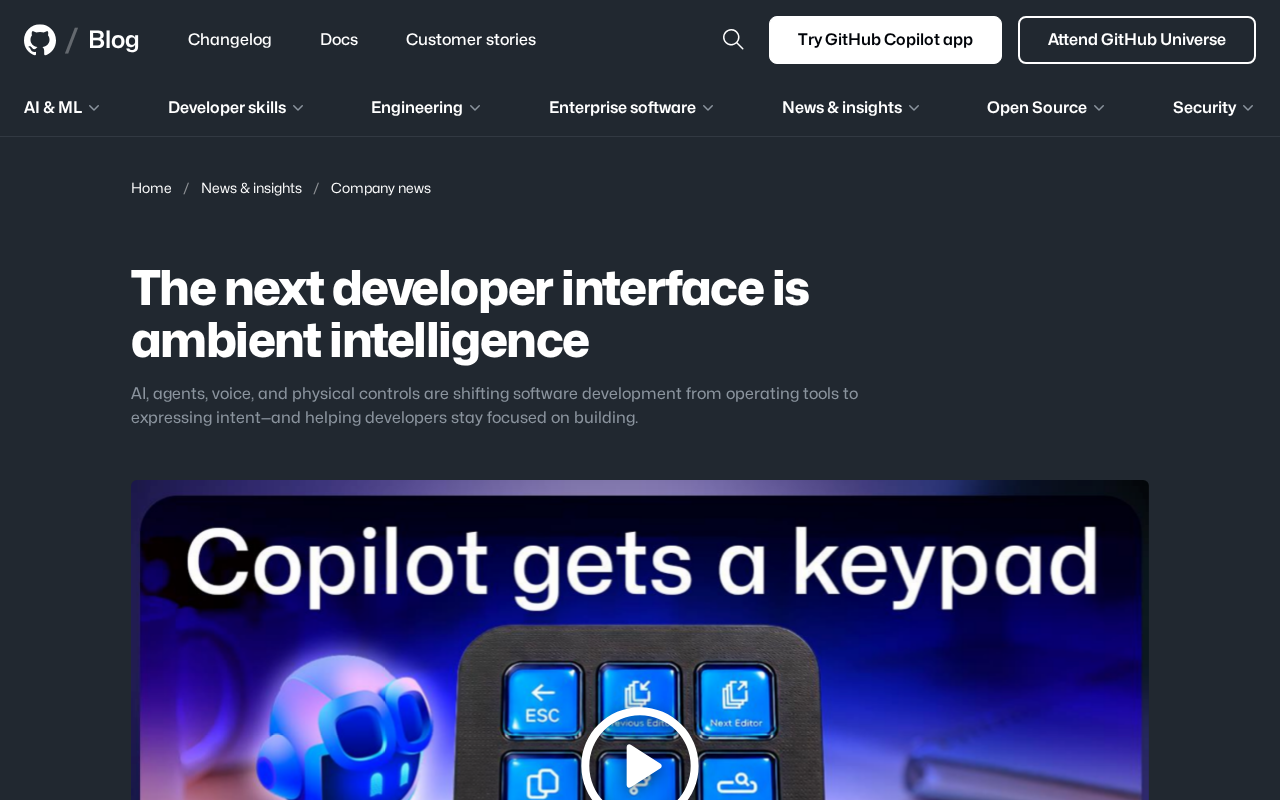
The official GitHub blog recently put forward a bold claim: software development is shifting from "operating tools" to "expressing intent," and the interaction paradigm that carries this shift is Ambient Intelligence. The convergence of AI, agents, voice, and physical controls is gradually pushing the development interface into the background, giving attention back to the act of building itself.
From Operating Tools to Expressing Intent
The core logic of traditional developer interfaces is "humans adapting to machines": memorizing commands, configuring environments, digging through IDE menu trees for features, writing a dozen lines of scripts for a single deployment. The more powerful the tool, the higher the learning cost.
Ambient Intelligence changes this relationship. When AI can understand context, agents can take on multi-step tasks, and voice can replace keyboard input, the developer's role shifts from "tool operator" to "intent expresser"—you describe what you want, and the system reasons out and executes the rest.
This isn't simply "AI code completion." Completion still happens inside the editor, and it's still "you operating a tool." The ambition of Ambient Intelligence is to make the interface itself no longer require conscious operation.
Ambient Intelligence (AmI) was first introduced by the European Information Society Technologies Advisory Group (ISTAG) around 1999. It originally described an ideal form of ubiquitous computing: sensors, devices, and networks embedded in the environment work together to proactively sense people's needs and provide services, without the person explicitly operating any terminal. Its intellectual roots trace back to Mark Weiser's 1991 concept of "ubiquitous computing"—the most profound technologies are those that disappear into everyday life. In the consumer space, smart homes, in-car voice, and wearables are early implementations of AmI; GitHub bringing it into the software development context means applying this "sense—reason—serve" logic to IDEs, terminals, and CI/CD pipelines, giving the development environment itself context-awareness and proactive responsiveness. This is fundamentally different from the traditional passive interaction of "user initiates, tool executes."
Four Technological Dimensions Converging
GitHub's article identifies four technological threads that previously developed independently but are now beginning to converge:
AI provides understanding and generation capabilities—the foundation for intent parsing. Agents extend single-shot generation into orchestratable task chains, making "help me refactor this module and get the tests passing" an executable instruction. Voice frees interaction bandwidth from the keyboard, with clear advantages especially in multi-task switching and quick idea capture. Physical controls is an easily overlooked dimension—knobs, gestures, peripheral lighting feedback, and other channels that let state awareness no longer depend on the screen.
Individually, each has mature real-world applications; together, they form a "faceless" development experience: tools appear when you need them and recede when you don't.
Agent here refers to an AI system capable of autonomous planning, tool invocation, multi-step task execution, and strategy adjustment based on feedback—distinct from single-turn Q&A chatbots. Its key technical components typically include: task decomposition and planning, tool calling (function calling / MCP and similar protocols), memory and context management, and result verification with self-correction loops. In software development, a typical agent form is "receive a natural language instruction and autonomously complete an end-to-end flow of reading code, modifying files, running tests, and submitting a PR." It upgrades AI's "generation capability" to "execution capability," which in turn raises new engineering questions—how to set permission boundaries for agents, how to audit each of their actions, and how to roll back when they make mistakes. This is precisely why the article notes that "setting boundaries and verification mechanisms for agents" will become an everyday skill.
Why "Staying Focused" Is the Real Product Goal
A key stance in the article: the ultimate value of Ambient Intelligence isn't showing off technology, but helping developers stay focused.
This judgment deserves serious consideration. The biggest killer of developer productivity has never been typing speed—it's context switching: checking docs, switching windows, configuring environments, waiting for builds. Each switch consumes working memory. If Ambient Intelligence can truly make these steps invisible, the payoff won't be linear efficiency gains, but a structural reduction in cognitive load.
Conversely, if a so-called "intelligent" interface frequently pops up suggestions, interrupts flow, and demands confirmation, then it isn't Ambient Intelligence—it's just a rebranded source of distraction. This distinction can be used to evaluate most AI-branded development tools on the market.
Context switching cost is a classic topic in cognitive psychology: when a person switches from task A to task B, working memory must reload relevant information, and this "reconstruction cost" typically takes tens of seconds to several minutes to return to the previous depth of focus. Researcher Sophie Leroy's concept of "attention residue" further points out that even after a person has switched to a new task, thought traces from the previous task continue to occupy cognitive resources. For developers, checking a doc, switching a window, or waiting for a build seems to take only a dozen seconds, but the real cost is the repeated interruption of flow state. This also explains why many "productivity tools" actually reduce output—they increase interruption frequency rather than decrease it. For Ambient Intelligence to hold up, the metric should be a decrease in "interruptions per minute," not an increase in feature count.
What It Means for Developers
In the short term, the most realistic change is the dispersion of interaction entry points: the code editor is no longer the sole center—chat windows, terminals, voice assistants, and even phones all become entry points for initiating development tasks.
In the medium term, how prompts and configurations are organized will become a new engineering skill. How to express intent precisely enough, how to set boundaries and verification mechanisms for agents—these will become part of everyday skill sets.
Further out, if Ambient Intelligence truly matures, developers' core moats will shift further toward "problem definition" and "system judgment"—knowing what to build and knowing whether the result is right will be worth more than knowing how to write code.
GitHub's article offers no timeline, which is itself honest. Ambient Intelligence is currently more a direction than a finished product, but the technological convergence from AI and agents to voice and physical controls has already happened. The remaining question is: who will be first to build that interface that truly doesn't get in the way.
Related articles

Random Pruning of the DPO Computation Graph: 1.4x Training Speedup and Lower Peak Memory
DPO training too slow and memory-hungry? This paper proposes a random pruning framework for the DPO computation graph, sampling independently across position, sequence, and branch dimensions; branch pruning achieves a 1.426x step-time speedup and cuts training time by about 30%, with in-depth attribution of memory and time gains.

Why Does JEPA Underperform MLM in Longitudinal EHR Representation Learning?
New study compares JEPA and MLM for longitudinal EHR representation learning on MIMIC-IV: three JEPA variants train stably without collapse but underperform MLM; target size, not heterogeneity, drives prediction error.

Transfer Learning + Visible Light Communication: A New Approach to Energy-Efficient Indoor Positioning
A study proposes a transfer learning-based visible light communication indoor positioning method, achieving 47% accuracy improvement on the BOSCH factory dataset, 67.5% model efficiency under high noise, and introducing the ME composite metric for energy-efficient positioning in energy-constrained industrial IoT scenarios.