AMD Ryzen AI Halo Hands-On: Can x86 Architecture Challenge NVIDIA's DGX Spark?

AMD's Ryzen AI Halo takes on NVIDIA's DGX Spark—x86 and 128GB unified memory versus CUDA prefill dominance.
AMD's $4,000 Ryzen AI Halo, built on the Strix Halo chip with 128GB unified memory, goes head-to-head with NVIDIA's DGX Spark. It ties on token generation but trails on prefill due to CUDA's maturity. Its edge: x86 compatibility, dual OS support, an extra NPU, and out-of-the-box AI software.
AMD's Mini AI Box Takes on NVIDIA's DGX Spark
In the race for local AI inference devices, NVIDIA's DGX Spark was once the center of attention. Now AMD has formally delivered its own answer—a mini box powered by the Ryzen AI Max Plus 395 chip (widely known in the industry as Strix Halo), officially named the Ryzen AI Halo. Tech blogger Alex Ziskind got his hands on a unit early for an in-depth review, and his conclusions are quite insightful: the deciding factor in this battle isn't the silicon itself, but everything surrounding the chip.
The Strix Halo Chip: A Culmination of Unified Memory Architecture
Strix Halo (officially the Ryzen AI Max Plus 395) is AMD's flagship APU launched in 2025, representing a major breakthrough for AMD in unified memory architecture. Built on TSMC's 4nm process, the chip integrates 16 Zen 5 CPU cores with a 40-compute-unit RDNA 3.5 GPU. Most importantly, it supports up to 128GB of an LPDDR5X unified memory pool—the CPU, GPU, and NPU share the same memory space, eliminating the data-shuffling bottleneck between CPU and GPU found in traditional discrete GPU architectures.
Understanding the value of unified memory architecture requires looking back at the pain points of the discrete GPU era: in traditional architectures, CPU memory and GPU memory are physically isolated, and data transfer is limited by the PCIe bus. PCIe 4.0 x16 offers a theoretical bidirectional bandwidth of around 64GB/s, whereas on-chip unified memory bandwidth can exceed 256GB/s—a difference of more than fourfold. For large language model inference, weight matrices must be read repeatedly during each forward pass, so memory bandwidth directly determines the ceiling on token generation speed. This design philosophy closely resembles Apple's M-series chips, but running on the x86 ecosystem gives it unique competitiveness in local AI inference scenarios.
Here's a detail worth noting: the Strix Halo chip has already been packed into numerous devices—the Beelink GTR 9, GMK Tech Evo X2, Framework Desktop, Minisforum, ASUS laptops, and more. This time, AMD simply put this off-the-shelf chip into a smaller, dedicated box, priced at $4,000.
At first glance, spending $4,000 on an existing chip seems like a bad deal. But Alex found that the entire market has quietly converged toward the $4,000 mark: the Framework 128GB version, Minisforum, and GMK Tech have all gradually climbed to this price point. In other words, AMD isn't gouging—it's positioned at the industry's general price level. This Halo is also the smallest machine in his collection—much smaller than the Framework and even slightly smaller than the Spark—yet it packs 128GB of unified memory (directly accessible by the GPU).
Three Types of Target Users and Real-World Performance
Alex divides the potential buyers of this device into three categories, analyzing whether each is worth the $4,000.
Category One: Developers
For routine development work—writing code, running tech stacks, compiling—the Halo, Spark, and M4 Pro actually perform very similarly. Alex verified this with a Mandelbrot test (a chunk of interpreted Python code that maxes out all cores): the Halo drew 164 watts at full load, the Spark also 164 watts, and the Mac around 80 to 90 watts. In compilation scores, the Mac hit 17.3, the Spark 15.4, and the Halo 18.4—not much difference.
The conclusion is straightforward: if you just want to compile code, there's no need to spend $4,000 on this machine—there are plenty of cheaper alternatives. Pure development use is not the Halo's main battleground.
Category Two: Local AI Tinkerers
This is the Halo's true target audience. The box ships with a full software suite preinstalled: LM Studio, Ollama (running llama.cpp under the hood), Lemonade, and ComfyUI, all ready to go. Alex used llama-benchy as the client to run the Gemma 4 12B model across all three machines for comparison.
In token generation speed (limited by memory bandwidth), the Spark and M4 Pro have 273GB/s of memory bandwidth, while the Halo is slightly lower at 256GB/s. Actual results: the Spark hit 26.4 tokens/s, the Halo 24.6 tokens/s, and the M4 Pro was fastest at 33.8 tokens/s. The three are quite close, and the Halo is perfectly adequate for everyday conversational scenarios.

Prefill Speed: The Spark's CUDA Legacy Advantage
The real gap opens up in prefill (prompt processing)—a compute-intensive phase handled by the GPU. To understand this gap, you first need to grasp the two-stage principle of large language model inference: the prefill stage processes the entirety of the user's input prompt and converts it into a KV cache (key-value cache). This is a highly parallel matrix operation extremely sensitive to GPU compute power (FLOPS). The decode stage, on the other hand, generates tokens one by one, reading the weight matrices only once per step—a classic memory-bandwidth-bound task. The performance bottlenecks of the two stages are entirely different, and comparing either one in isolation can be misleading.
The test data is quite telling: the Halo achieved around 650 tokens/s, while the Spark reached about 2,000 tokens/s—nearly three times faster. This is precisely the fruit of NVIDIA's years of accumulation in the CUDA ecosystem. CUDA (Compute Unified Device Architecture), introduced by NVIDIA in 2007, has evolved over nearly two decades into a complete acceleration library ecosystem encompassing cuBLAS (linear algebra acceleration), cuDNN (deep neural network primitives), and TensorRT (inference graph optimization and quantization). This ecosystem not only covers low-level hardware scheduling but has also amassed thousands of highly tuned operator implementations, enabling core operations like matrix multiplication to approach the hardware's theoretical peak. AMD's ROCm platform closely mirrors CUDA in architectural design, but its accumulation of fine-grained software-level optimizations still needs time to catch up—and the prefill scenario is especially sensitive to this gap.
But one key detail is worth noting: the Halo's score of 650 is nearly double what Alex measured on the same chip last year. The chip hasn't changed—the software has. By contributing code directly to upstream open-source projects like llama.cpp, AMD continues to advance the maturity of the ROCm ecosystem, and these optimizations are steadily translating into real performance gains—without requiring users to manually configure low-level environments.
For everyday use, the prefill gap is essentially imperceptible: chatting, streaming responses, and running agents in an editor rarely hit the bottleneck. It only becomes noticeable in heavy compute tasks like massive context injection or pure image and video generation. Alex's Stable Diffusion test showed the Spark at about 2.9 iterations/s versus the Halo's mere 1.3; in WAN 2.2 video generation, a five-second clip took the Spark about five and a half minutes, while the Halo needed 75 minutes. Alex also reminds us that these tests were done on Windows, and AMD's chip may show different prefill performance under Linux.
How to Interpret AMD's Official Benchmarks
AMD posted its own comparison data on its website, claiming the Halo outperforms the Spark on multiple models: 40% faster token generation on GLM Flash 30B, 12% faster on Qwen 3.5 122B, and 7% faster on GPT-OSS 120B. For image generation, it claims to leave the Apple M4 Pro behind by 3 to 7 times.
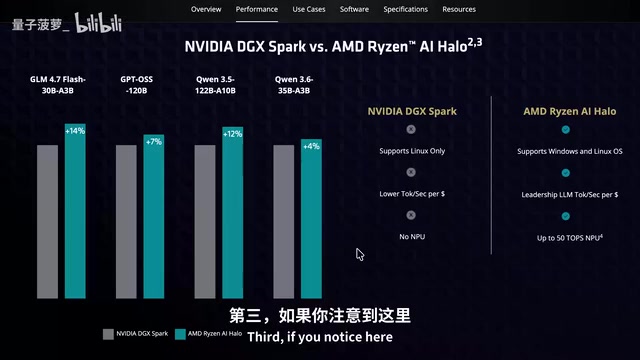
Alex offers a calm and professional interpretation of this data. First, credit where it's due: AMD provided real numbers rather than a vague "vibes" comparison chart. But vendor benchmarks are, by nature, all about showcasing the most favorable angle. Here are a few points worth keeping in mind:
- Only showing token generation, dodging prefill: When comparing against the Spark, AMD only showcased the Halo's strengths, skipping the prefill phase where the Spark leads by threefold—indirectly confirming that the Halo is positioned for tinkerers rather than professional heavy-compute scenarios.
- Swapping opponents for image comparisons: Those 3-to-7x image generation advantages were against the Apple M4 Pro, not the Spark—because in testing, the Spark led the Halo 2:1 on images and 16:1 on video.
- Favoring large MoE models: AMD chose Mixture-of-Experts (MoE) architecture models, which perform exceptionally well on machines with 128GB of memory. The MoE architecture was pioneered by Google's 2017 paper, and its core mechanism is the router network: during each forward pass, input tokens are dynamically routed to just a few "expert" subnetworks within the total expert pool for computation, while the rest remain idle. Take Qwen 3.5 122B as an example: although its total parameter count reaches 122B, only about 22B parameters are actually activated per inference—far less computation than a dense model of equivalent size. But routing decisions require all 122B parameters to reside in memory, ready to be called upon at any moment. This gives MoE models a distinctive "light on compute, heavy on memory" profile—the Halo's 128GB unified memory can fully load such massive model weights, whereas memory-constrained devices must quantize and compress the model, resulting in precision loss and additional dequantization overhead. AMD's prioritization of MoE models in its benchmarks is precisely aimed at showcasing the differentiated advantage of large memory.
- Fluctuating price figures: The footnotes listed the Spark's retail price at $4,699, but in reality it fluctuates between $4,000 and $4,700, making the "tokens per dollar" comparison hard to measure precisely.
x86 Architecture: The Core Differentiator of the AMD Ryzen AI Halo
Benchmarks aside, Alex believes the Halo has one fundamental advantage the Spark can't match—x86 architecture.
The DGX Spark is based on ARM (NVIDIA's Grace CPU) and can only run ARM-based Linux. The Halo, by contrast, is a standard x86 platform, which Alex calls "the highest compliment": x86 means the entire toolchain requires no emulation and no hunting for ARM versions—you can just install Visual Studio and get to work. For developers, this is genuine convenience. The software compatibility advantage of x86 stems from decades of ecosystem accumulation: the vast majority of enterprise internal toolchains, CI/CD systems, container images, and precompiled binaries are built for x86_64 by default. Even with translation layers like Rosetta, ARM platforms can still encounter compatibility issues or performance losses when it comes to low-level optimizations (such as numerical computing libraries accelerated by the AVX instruction set).

The Halo offers both Windows and Linux versions for users to choose from. The Windows version even comes with an activation key, and you can still install Linux afterward. The Spark, meanwhile, only offers Linux.
In addition, the Halo integrates an NPU rated at up to 50 TOPS—something the Spark lacks. The NPU (Neural Processing Unit) is a custom hardware accelerator designed for low-precision matrix operations. Its architecture is deeply pipeline-optimized for INT8/FP16 multiply-accumulate operations, delivering an energy efficiency several times higher than a general-purpose GPU when executing attention computations and feedforward networks in Transformers. Through the preinstalled Lemonade Server, users can adopt a hybrid inference approach: the NPU handles prefill while the GPU handles decode, offloading the compute-intensive phase to the NPU that consumes only about 50 watts—striking a unique balance between power consumption and performance. This is especially well-suited to AI agent scenarios that run in the background for long periods, where reduced standby power has real implications for both cooling and electricity costs. Alex demonstrated a pure-NPU version of DeepSeekAd—though not particularly fast, it consumed only 50 watts, with impressive energy efficiency.
The only trade-off is that x86 runs slightly hotter. Alex found the metal on the bottom of the machine got noticeably warm, and the vent design on all four sides means it can't be stacked like the Spark.
Ready Out of the Box: This Isn't Last Year's Strix Halo
When Alex reviewed the Spark last year, he criticized the Strix Halo platform as "a great chip, but the software is still catching up." This Halo is AMD's direct response to that critique. Unbox it, power it on, and the software is ready: no chasing drivers, no spending an afternoon fussing over ROCm configuration, no guessing at Python version compatibility. LM Studio, Ollama, ComfyUI, and the ROCm-supported Lemonade Server are all preinstalled and configured.
AMD also provides a step-by-step playbook on its website, filterable by beginner, intermediate, and advanced levels—even including advanced setups like a "dual-Halo cluster." Alex repeatedly emphasizes: "This isn't your grandma's Strix Halo—this is a brand-new Strix Halo."
Overall Review Conclusion: An Evenly Matched Trade-off
For local AI tinkerers, the Ryzen AI Halo sits in a rather ideal position. In raw performance, this is a give-and-take battle: the Spark takes prefill and heavy-compute scenarios, while the Halo ties on token generation and brings larger memory capacity—and token generation speed is precisely what directly determines the everyday chat experience. For frequent daily operations—chatting, Ollama, LM Studio, running agents in VS Code—this machine performs excellently.
Combine full x86 compatibility, the choice of dual Windows/Linux systems, the extra NPU hybrid-inference compute, and an out-of-the-box local AI inference software ecosystem, and AMD has indeed significantly narrowed the gap with NVIDIA "beyond the silicon" this time. As for who the third category of target users is, Alex kept us guessing—that will be the topic of the next review.
Key Takeaways
Related articles
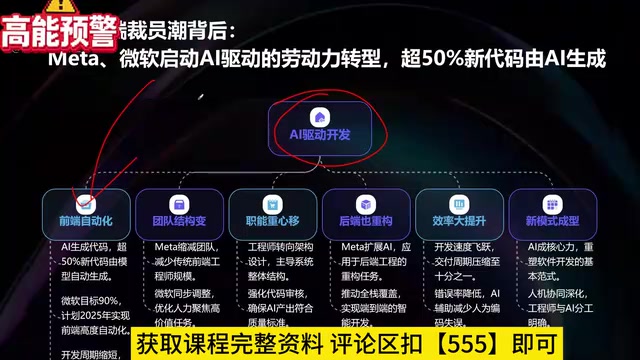
What Is Vibe Coding? The AI Programming Skill Every Developer Needs
What is Vibe Coding? Learn how AI programming is reshaping dev teams, why traditional programmers face displacement, and why Cursor & Claude Code matter.
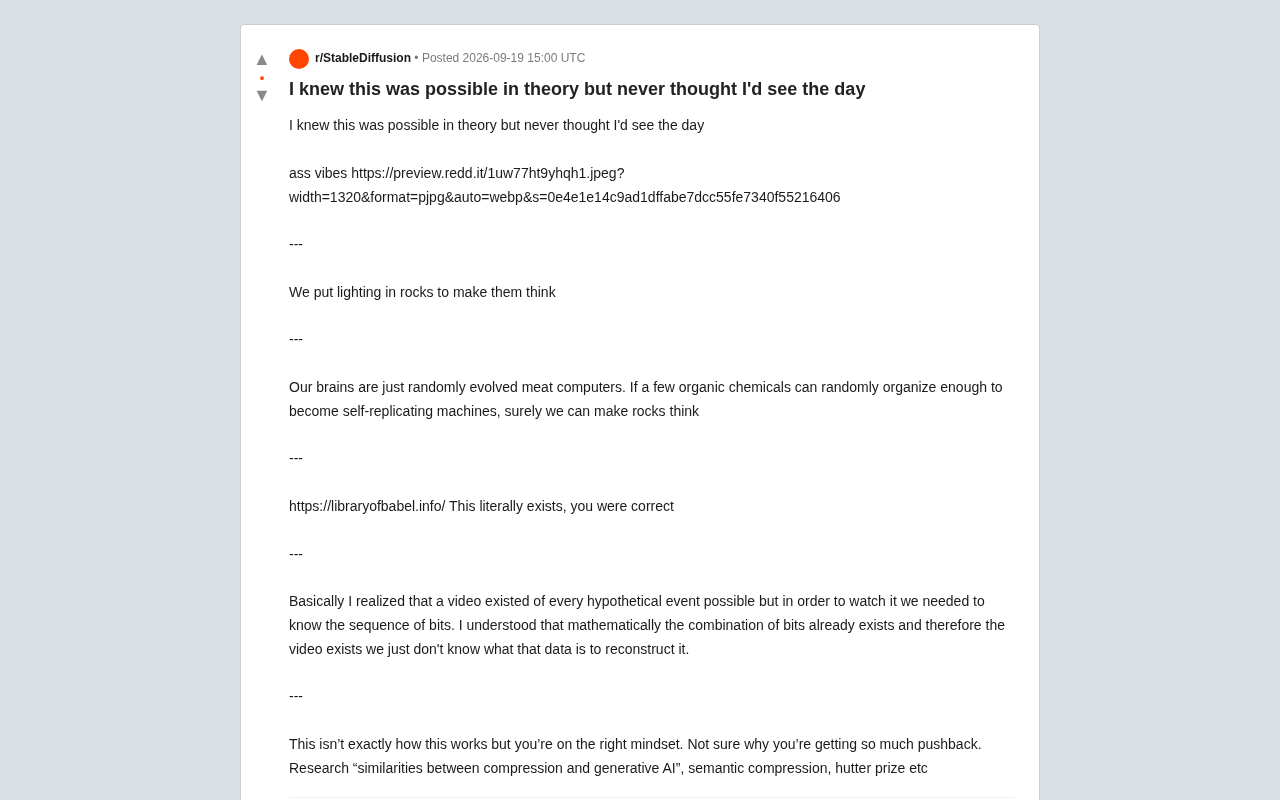
Making Rocks Think: A Philosophical Exploration of Generative AI and Information Compression
From a viral Reddit post to deep AI theory: why compression equals understanding, the Library of Babel thought experiment, semantic compression, and the Hutter Prize.

Irregular Warns: Four AI Lab Security Breaches Traced to the Same Root Cause
Irregular reveals four AI lab security breaches share a single root cause, exposing systemic risks from technology stack homogeneity across the AI industry.