What Is Vibe Coding? The AI Programming Skill Every Developer Needs
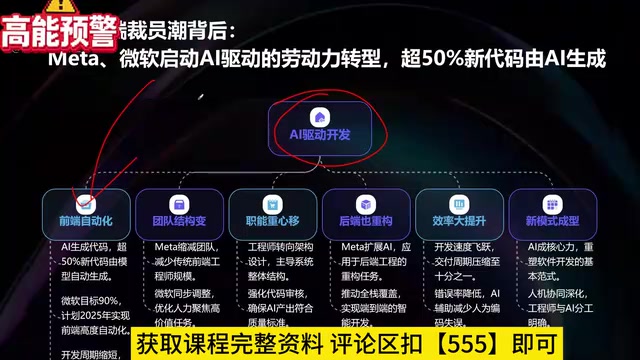
Vibe Coding shifts developers from writing code to directing AI — methodology is the key to stable output.
Vibe Coding is a development model where AI generates code and developers act as orchestrators, covering everything from requirements to deployment. Practitioners report it can shrink team sizes from 50 to 5, slashing labor and management costs. Frontend roles face pressure as AI easily replicates their output, while backend developers expand into full-stack territory. Cursor and Claude Code are the leading tools, but the real challenge lies not in the tools themselves — it's in applying systematic methodology to extract reliable engineering output from an inherently unstable AI. This skillset is also spreading to non-technical roles like PMs and operations, opening software creation to a much broader audience.
Vibe Coding: How AI Programming Is Reshaping the Development Pipeline
Vibe Coding — AI-assisted programming — has exploded in popularity over the past two years and become an unavoidable topic in software development. According to one prominent content creator on Bilibili, their team was an early adopter of AI programming and even made it mandatory for all members to use AI tools throughout their workflow. In their account, AI programming only truly matured recently, and since then the team has shipped a large number of production-grade projects and accumulated substantial hands-on experience.
At its core, Vibe Coding is a shift from writing code yourself to directing AI to generate code. The creator's team reportedly goes so far as to forbid manually writing code — AI takes the lead across the entire pipeline: requirements analysis, research, architecture design, tech stack selection, implementation, testing, and deployment. Behind this shift lies a fundamental transformation in both efficiency and cost structure.
Restructuring Efficiency and Labor Costs
The creator offers a striking comparison: work that previously required 50 engineers can now be handled by roughly 5. Labor costs drop dramatically, and management overhead follows suit — managing 5 people is obviously far simpler than managing 50. While this is a single-source claim and the numbers may be exaggerated, the directional trend it points to is real.
The creator also cites signals from the broader industry as supporting evidence — for example, the claim that engineers on the Claude Code CEO's team "barely write code." These observations converge on one conclusion: the value of coding as a discrete activity is being fundamentally redefined.
Who Gets Left Behind: Two Kinds of "Traditional Programmers"
The video puts forward a provocative claim — "traditional programmers will be displaced within a few months." The creator defines "traditional programmer" along two dimensions:
- Developers who only handle simple CRUD (Create, Read, Update, Delete) work
- Developers who haven't embraced AI programming or don't know how to use AI coding tools
This claim deserves nuanced interpretation. It's not saying the programmer profession will disappear — it's saying the required skill set is migrating. Developers who can leverage AI tools to amplify their output and who possess strong system design and architectural judgment will actually become more scarce and more valuable.
Frontend Jobs Under Pressure; Backend Roles Expanding
The creator describes a concrete trend: many companies are cutting frontend developers, for two reasons. First, frontend code is relatively easy for AI to generate quickly. Second, with AI assistance, backend developers can now cover frontend work. As a result, team structures are tilting toward the backend — situations where a frontend team shrinks from 10 people down to 1 or 2 are beginning to emerge, and some companies are pushing frontend developers to transition to backend roles.
This is a single-source observation and specific layoff numbers are hard to verify, but the broader trend of "AI blurring the frontend/backend boundary" is a legitimate conversation. For frontend developers, closing the gap on backend skills and AI tooling is the pragmatic response to this shift.
The reason frontend code is more readily replaceable by AI is closely tied to the technical nature of frontend work. Frontend development relies heavily on standardized UI component libraries (like Ant Design or Element Plus), common page layout patterns, and predictable interaction logic — precisely the kind of "boilerplate code" that large language models excel at generating. Backend code, by contrast, typically involves more complex business rules, data model design, concurrency handling, and system integration, all of which demand deeper domain knowledge and architectural judgment that AI cannot yet fully replicate autonomously. As a result, the cost of a backend developer "casually" covering frontend work with AI assistance has dropped sharply, while the reverse path — a frontend developer independently handling backend complexity — remains much harder. This asymmetry is the technical reason frontend roles are currently under pressure.
CRUD (Create, Read, Update, Delete) refers to the four basic operations performed on database records and forms the foundation of most business application backend logic. For years, writing standardized data interfaces, form submission handlers, and list query endpoints consumed a large portion of junior and mid-level developers' time. This type of code is highly repetitive and pattern-driven — and it was one of the first areas where AI code generation achieved high-quality, reliable output. When AI can produce a compliant CRUD module in seconds, the market value of developers whose skills don't extend beyond this is directly impacted. This doesn't mean business logic itself has become unimportant — it means the specific labor of "hand-writing CRUD" has lost its scarcity, and the skill premium has shifted to higher-level capabilities like architecture design, requirements decomposition, and AI-assisted orchestration.
Methodology Matters More Than Tools
A recurring theme in the video is this: AI programming sounds simple, but using it to build enterprise-grade, production-level projects is genuinely difficult and error-prone. The creator says their team burned through 70 billion tokens and shipped dozens of projects before distilling a reliable engineering framework built around AI collaboration.
The core insight here is: AI programming is inherently unstable. Getting stable output from an unstable system depends on methodology. Simply touring a tool's feature set adds little value. The real payoff comes from case-driven learning — extracting reusable engineering principles from real projects.
The Two Leading Tools: Cursor and Claude Code
At the time of recording, the creator considers Cursor and Claude Code to be the two best AI programming tools available globally, while anticipating that more strong contenders will emerge. The course is built primarily around these two tools, walking through everything from environment setup to advanced techniques.
Cursor is an AI programming IDE built on a heavily modified fork of VS Code. It features a built-in conversational interface with large language models, letting you describe requirements, modify code, and explain errors in natural language — all from within the editor. Its standout capability is "context awareness" — it can read the structure of an entire code repository, not just the current file, enabling suggestions that are grounded in engineering reality. Claude Code, developed by Anthropic, is a command-line AI programming tool that runs directly in the terminal. It can read and write files, execute commands, and interact with Git — essentially giving you an AI assistant at the shell level that understands code intent. The two tools occupy slightly different niches: Cursor leans toward GUI interaction and real-time code completion, while Claude Code excels at cross-file batch operations and automated task chains. In practice, they tend to complement each other — Cursor handles local edits and rapid iteration, while Claude Code tackles large-scale refactoring or automated scripting workflows.
The reason AI programming is error-prone in production-grade projects comes down to a fundamental limitation: large language models lack continuous tracking of the overall engineering context. Each conversation is a local, bounded view — the model cannot automatically maintain cross-file consistency, interface contracts, or business constraints. Common failure modes include generating functionally duplicate functions with different names, ignoring existing utility classes and reinventing them from scratch, and "forgetting" previously agreed-upon technology choices across sessions. This is precisely why methodology matters more than the tools themselves: structured prompt templates, layered task decomposition, and explicit documentation anchors (such as architecture specs and API docs) are what compensate for the model's inherent context window limitations — keeping the AI on a well-defined track so it produces stable output, rather than improvising freely every time.
Course Structure: Five Modules and Four Project Competencies
Based on the shared curriculum outline, the content follows a case-driven approach and covers a complete path from fundamentals to real-world application:
- Module 1: AI programming experience sharing, plus Cursor and Claude Code environment setup
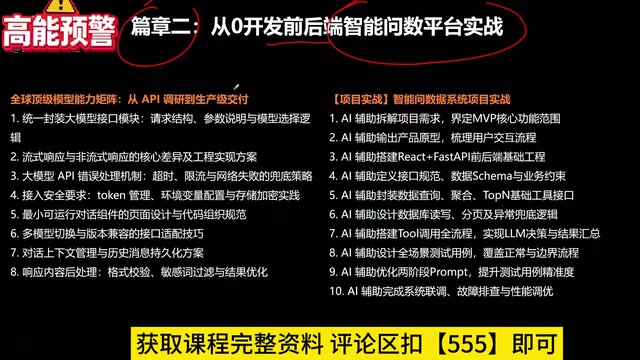
- Module 2: Building a full-stack intelligent data query system from scratch using Cursor
- Module 3: Advanced practice through secondary development on top-tier open source projects (e.g., Overclose / Crawlee)
- Module 4: Deep dive into Claude Code usage, again case-driven
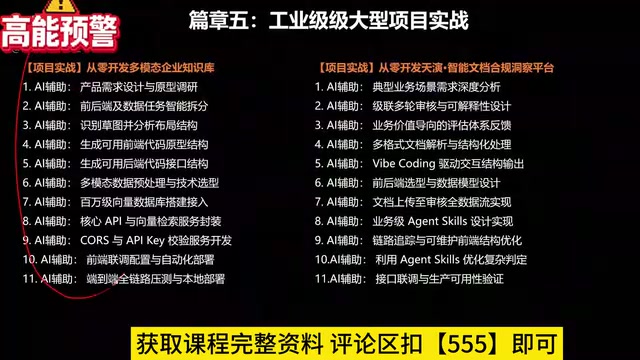
- Module 5: Two large-scale projects — end-to-end development of a multimodal knowledge base, and engineering delivery of an extra-large project requiring multi-person collaboration
What Each Project Is Designed to Deliver
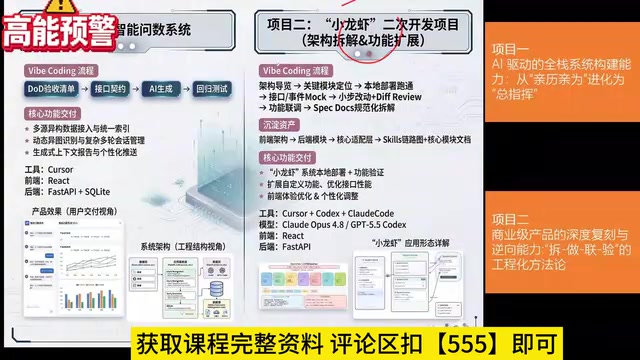
The four projects in the curriculum each target a distinct set of competencies:
- Intelligent data query system: The first hands-on demonstration of AI-driven full-stack development — helping developers experience the shift from "typing code" to "directing AI"
- Open source project secondary development: Addresses the common enterprise scenario where 80% of an existing solution fits your needs and 20% requires customization
- Complete system construction: Starting from a vague idea and iterating through continuous AI interaction to produce a maintainable, evolvable codebase
- Large-scale collaborative project: Standardized delivery in a multi-person team context, covering code management, build and compilation, deployment, and canary releases
Who Should Learn AI Programming
The creator argues that this skill set is no longer the exclusive domain of software developers:
- Senior developers who have hit a ceiling, or anyone who hasn't yet adopted AI programming
- Developers who use AI tools in a shallow, ad hoc way without seeing exponential productivity gains
- Frontend developers, or those looking to expand into backend work
- PMs, operations staff, and managers: They don't need to ship production-grade systems, but they do need to rapidly build MVPs to validate ideas
That last point deserves special attention. For non-technical roles, AI programming dramatically lowers the barrier to prototyping — you don't need to understand the underlying technical architecture; you just need to know how to interact with the tools to bring an idea to life quickly. This is Vibe Coding's most democratizing quality: it opens the door to "building software" to a much wider range of people.
Related articles

Vibe Coding in Practice: Developing Product Thinking and Turning Everyday Problems into Monetizable Apps with AI
Vibe Coding tutorial #2: how indie developers can build product thinking, find ideas through imitation and daily friction, and use AI Agents to automate research.
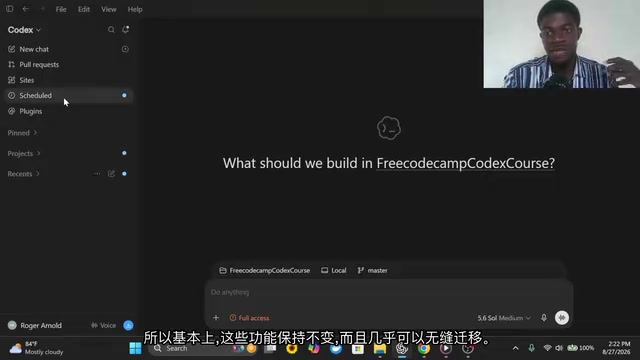
OpenAI Codex Quick-Start Guide: Building and Deploying Apps with an AI Coding Agent
A practical OpenAI Codex crash course: installation, pricing tiers, plugins, automation, Plan/Go commands, the Skills system, and a full voice-controlled Flappy Bird build-and-deploy walkthrough.

ICLR Submissions Approaching 50,000: Why Are Top AI Conferences Growing at an Explosive Rate?
ICLR submission numbers approaching 51,000 spark Reddit debate. We analyze why top AI conference submissions are exploding and the pressure on peer review systems.