AMD's Big Bet on Data Centers: The Era of Cheap GPUs May Be Ending

AMD prioritizes data centers, narrowing the cheap consumer GPU window, forcing consumers and small AI teams to adjust computing strategies.
AMD CEO publicly stated the company is "data center first," sparking Reddit community concerns about consumer GPU prospects. The article analyzes how the data center business's high profits and massive order volumes draw away advanced process capacity and R&D resources, leading to slower consumer graphics card iteration and profit-oriented pricing. There's a long-standing misalignment between consumer brand loyalty expectations and vendor capital return logic. For individual consumers, waiting for price drops may no longer work; for small AI teams, relying on consumer graphics cards for computing power is increasingly uncertain, requiring consideration of cloud rental or secondhand markets. The developer ecosystem may also see support priorities shift. The conclusion: "data center first" doesn't mean abandoning the consumer market, but resource weighting has clearly tilted, and all parties should adapt in advance.
What AMD Means When It Says "Data Center First"
AMD CEO's remark that "we are a data center-first company" has stirred up quite a discussion in the Reddit community. The statement seems ordinary enough, yet it sends a chill through many DIY enthusiasts and small-to-medium AI teams—if even AMD is putting data centers ahead of the consumer market, the window for "cheap GPUs" may be closing.
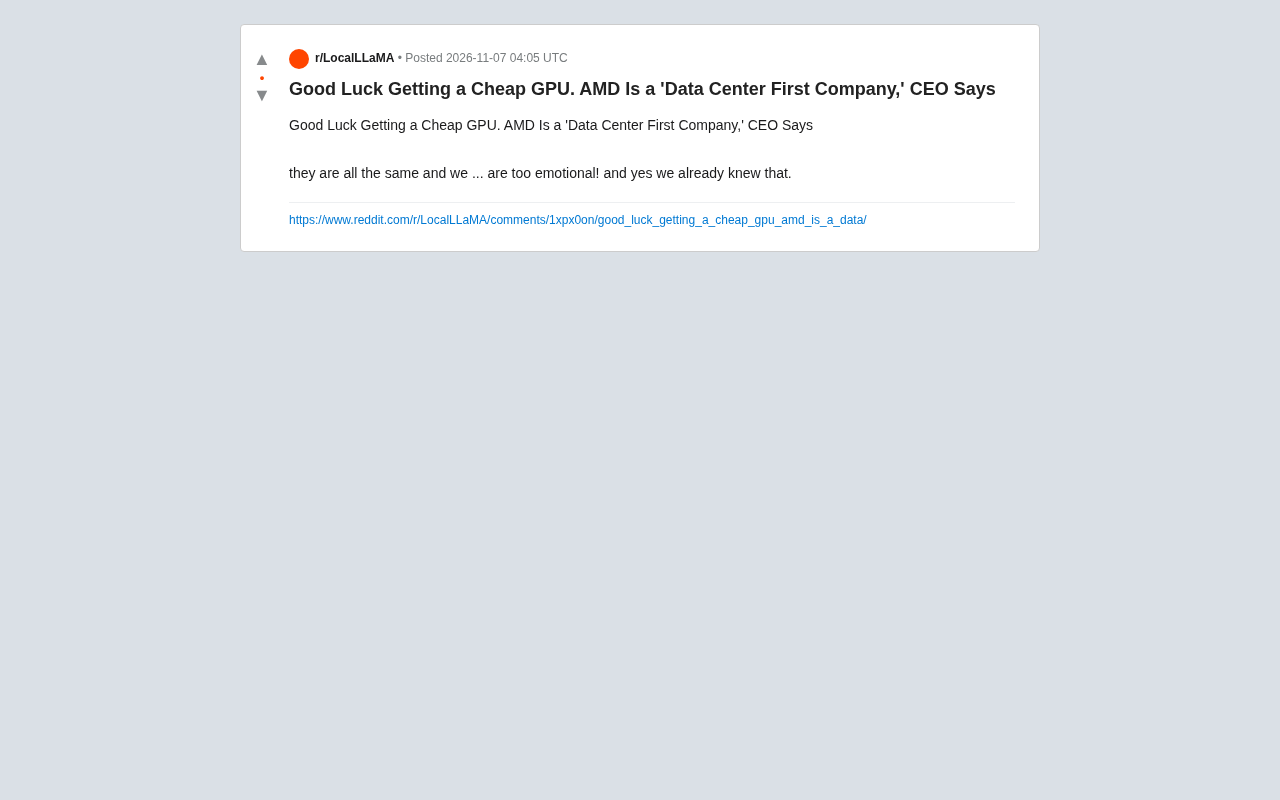
According to the title of the Reddit discussion thread, the core message points directly to a trend: access to cost-effective GPUs is becoming increasingly difficult. The post itself doesn't elaborate much, but the sentiment in the comments speaks volumes. One user put it bluntly: "They're all the same, and we're just too emotional." The remark reveals a sense of resignation—consumer and developer loyalty to hardware vendors seems insignificant in the face of business strategy.
Why "Data Center First" Means GPUs Get More Expensive
To grasp the weight of this statement, one needs to understand the competitive landscape AMD operates in. The profit margins and order volumes of the data center GPU market are far beyond what consumer graphics cards can offer. A single data center accelerator designed for AI training can cost several times—or even dozens of times—more than a consumer flagship card, while hyperscale customers purchase in units of tens of thousands.
When a chip company explicitly tilts its resources toward data centers, the ripple effects are comprehensive: advanced process capacity is prioritized for high-margin product lines, R&D teams iterate architectures around data center requirements, and channel and marketing resources shift accordingly. The "leftover attention" available for consumer GPUs naturally diminishes.
The concerns of Reddit users are not unfounded. Over the past few years, consumers have grown accustomed to oscillating between stock shortages and price hikes, and the computing demand brought by the AI boom has added fuel to the data center business. AMD's statement essentially confirms an implicit priority ranking: when capacity or resources require trade-offs, data centers come first.
Architectural Differences Between Data Center GPUs and Consumer GPUs
While data center accelerators (such as the AMD Instinct series) and consumer graphics cards (such as the Radeon RX series) share some underlying architecture, their design goals are fundamentally different. Data center GPUs typically feature larger high-bandwidth memory (HBM) capacities, sacrificing some general graphics performance in exchange for matrix computation throughput, and support high-speed multi-card interconnects (such as Infinity Fabric) to build large-scale training clusters. These characteristics make their per-unit cost far higher than consumer products.
More importantly, chip manufacturing depends on advanced process capacity, and the capacity of foundries like TSMC is a limited resource. When vendors allocate more wafers to data center products, the chip supply for consumer GPUs naturally tightens, further driving up market prices. This "capacity crowding-out effect" is the key mechanism for understanding why "data center first" affects the consumer market.
The Gap Between Consumer Sentiment and Business Logic
The comment about "we're just too emotional" actually points to a long-standing misalignment. Consumers are accustomed to understanding the market through brand loyalty—sticking to one brand for CPUs, following one series for graphics cards—but chip vendors make decisions based on return on capital, not fan sentiment.
This is not a problem unique to AMD. The entire semiconductor industry is undergoing a structural shift: AI computing demand is absorbing large amounts of advanced capacity, and the slice available for consumer electronics is relatively shrinking. AMD is simply saying it out loud. For DIY enthusiasts, this means that strategies of waiting for price drops and promotions may become increasingly ineffective in the period ahead; for small AI teams, the cost-effective approach of building computing clusters from consumer-grade graphics cards will also face greater pressure.
What This Means for Different Groups
Individual Consumers: Accepting the Reality of "Not Being a Priority"
If "data center first" becomes AMD's long-term strategy, the iteration pace and pricing strategy for consumer graphics cards may lean more toward profit protection rather than market share competition. A "dirt-cheap" high-end card is unlikely to appear in the short term. Consumers need to adjust their expectations: either pull the trigger decisively at the right price point, or accept longer upgrade cycles.
Small-to-Medium AI Teams: Computing Resource Acquisition Paths Need Replanning
Relying on consumer-grade GPUs for inference or small-scale training was once a realistic choice for budget-constrained teams. But as supply-side priorities shift, the uncertainty of this path is increasing. Renting cloud computing resources, watching the secondhand market, or turning to alternative acceleration solutions are all directions worth planning for in advance. The anxiety of "can't buy cheap cards" expressed in the Reddit thread is most directly felt by such teams.
Limitations of Consumer GPUs for AI Computing and Alternative Solutions
Small-to-medium teams have previously favored consumer-grade GPUs (such as the RTX 4090) for building computing clusters, mainly because of their lower cost per unit of computing power and flexible procurement. However, consumer-grade cards have bottlenecks in memory capacity (typically capped at 24GB), multi-card parallel efficiency, and stability under prolonged high-load operation, making them unsuitable for large-scale training.
As supply-side priorities shift, alternative paths include: renting cloud GPU instances (pay-as-you-go, avoiding hardware depreciation risk), watching for secondhand data center cards (such as retired MI series or V100), and exploring dedicated inference accelerators (emerging solutions like Groq and Cerebras). Teams should plan hybrid computing strategies in advance based on task type (training vs. inference) and budget cycles, rather than betting solely on consumer-grade graphics cards.
Developer Ecosystem: Following the Vendor's Shifting Focus
AMD directing resources toward data centers also means its software stack (such as ROCm) will focus more on optimization for data center scenarios. The driver support and ecosystem compatibility available to consumer users may correspondingly fall lower in priority. For those who rely on the AMD platform for development, this is a signal worth noting.
ROCm Ecosystem Positioning and Current State of Consumer Support
ROCm (Radeon Open Compute) is AMD's open-source software stack positioned against NVIDIA's CUDA, providing compilers, libraries, and toolchains to support GPU-accelerated computing. For a long time, ROCm's official support has been concentrated on the data center Instinct series, while support for consumer Radeon graphics cards has often been "community-driven" or released with delays.
Now that AMD has explicitly stated "data center first," ROCm's optimization resources will be more concentrated on AI framework adaptation for the Instinct platform (such as PyTorch and TensorFlow), and consumer users may face issues such as slow driver updates and missing new features. For individuals or small teams relying on the AMD platform for development, this means they need to more carefully evaluate the long-term availability of the software ecosystem, or consider multi-platform compatible development strategies.
Is the Era of Cheap GPUs Really Over?
What needs to be viewed calmly is that "data center first" does not equal "abandoning the consumer market." AMD will still sell consumer GPUs—only the weighting of resource allocation has changed. The Reddit community's reaction is more of an emotional release than a verdict on specific product lines.
What's truly worth paying attention to is the direction of the trend. When an industry leader publicly confirms its strategic focus, what smaller players can do is adapt in advance. Rather than hoping vendors will "change their minds" and offer cheap high-performance hardware, it's better to re-evaluate one's own computing resource acquisition strategy. The comment "we're all the same" says exactly this: business is business, and sentiment won't earn you a discount.
For ordinary users, the practical advice for the near term is: if you genuinely need a GPU, don't wait excessively for "a cheaper day"; for industry observers, AMD's statement is a clear signal—the AI computing race is reshaping the priorities of the entire hardware market, and the consumer market is, for now, standing in the back of the line.
One-line Summary
AMD states data center first, the cheap consumer GPU window narrows, and consumers and small AI teams need to adjust their computing strategies.
Paragraph Summary
AMD CEO publicly stated that the company is "data center first," sparking concerns in the Reddit community about the outlook for consumer GPUs. The article's analysis points out that the high profits and massive order volumes of the data center business will draw away advanced process capacity and R&D resources, leading to slower consumer graphics card iteration and pricing that favors profit protection. There is a long-standing misalignment between consumers' expectations of brand loyalty and vendors' capital return logic. For individual consumers, the strategy of waiting for price drops may become ineffective; for small-to-medium AI teams, the path of relying on consumer graphics cards to build computing power is becoming more uncertain, and alternatives such as cloud rental or the secondhand market need to be considered; the developer ecosystem may also see support priorities adjusted as the vendor's focus shifts. The article's conclusion is that "data center first" does not mean abandoning the consumer market, but the resource weighting has clearly tilted, and all parties should adapt to this trend in advance.
Related articles
 Tech Frontiers
Coldframe: A Honeypot Disguised as a Supermarket Freezer Controller
Coldframe is a honeypot disguised as Danfoss AK-SM 800A and Dixell XWEB freezer controllers, built as a single Python file that detects CVE-2025-41450 attempts and is identified as real devices on Shodan.
 Tech Frontiers
GRFNet: A Lightweight PyTorch Model Designed for Multichannel Time-Series Classification
GRFNet is a lightweight PyTorch model for multichannel time-series classification, originating from EEG decoding research. With only 3,847 parameters, it is based on the ROCKET architecture, combining random convolution kernels with learnable spatial filters, supports arbitrary input lengths, and will soon be evaluated on the PhysioNet dataset.
 Tech Frontiers
CUDA-Accelerated Rocket League Simulator: A Player-Made Hardcore Experiment
A Reddit post shows a "100% Accurate" Rocket League simulator accelerated with CUDA. We analyze its technical context, CUDA's value in game physics simulation, and the significance and limitations of such community projects.