Ami AI: The AI Sales Outreach Agent That Plans Backwards from Your Goals
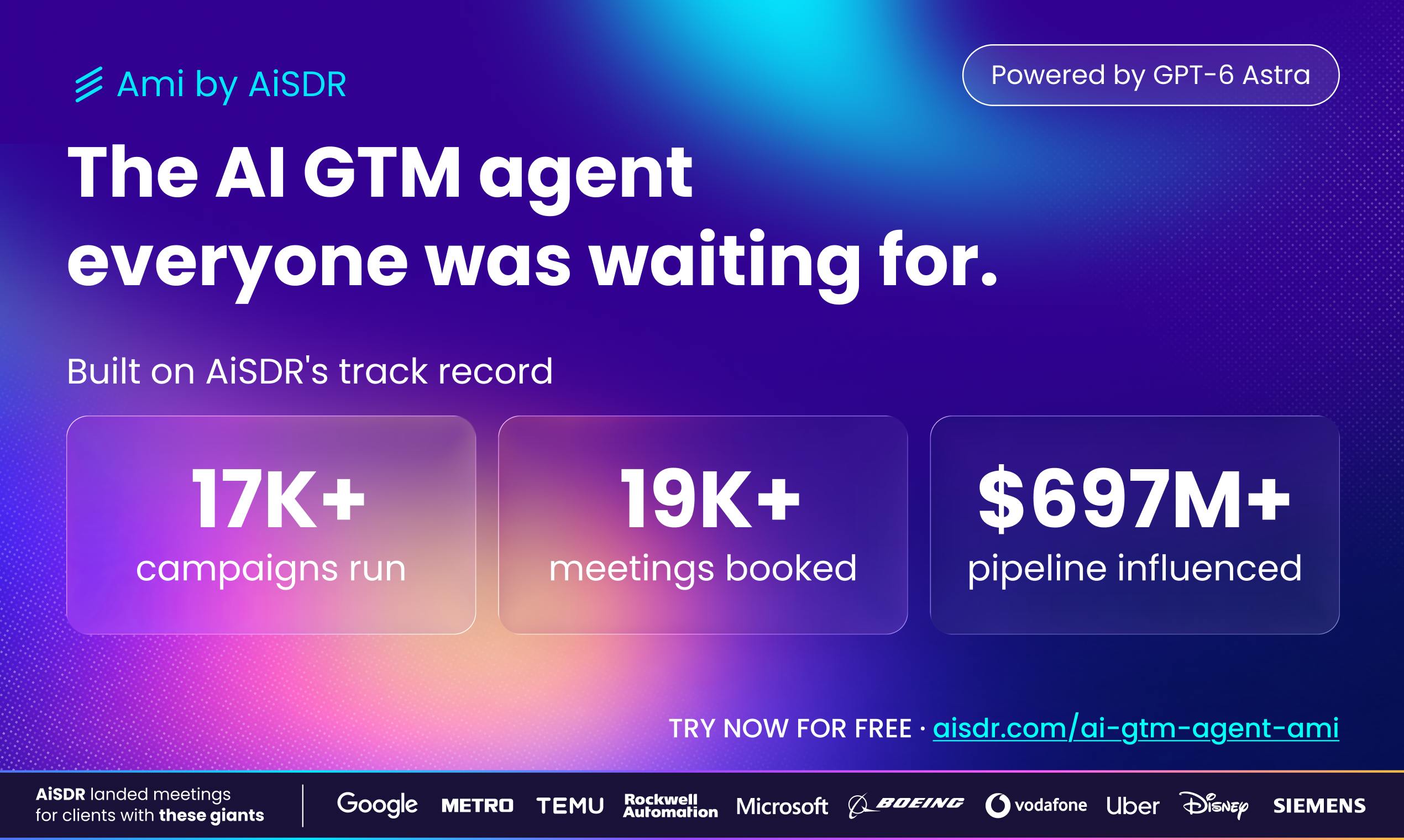
Ami AI is a B2B outreach agent built on GPT-6 Astra that plans backwards from your meeting goals and auto-executes the full campaign loop.
Ami AI tackles the most overlooked decision in B2B sales outreach: who to contact. Built on GPT-6 Astra, it reads your website, understands your business, and works backwards from a target number of meetings to determine the required lead volume, sender accounts, and timeline. Unlike most outreach tools, it flags unreachable goals upfront rather than explaining shortfalls after the fact, then runs the full campaign autonomously with self-healing. The company reports 17,707 targeting decisions made and 19,854 meetings booked. In a crowded AI outreach market, Ami differentiates through a closed loop of decision, execution, and self-scoring — making it particularly attractive to SMBs without dedicated growth teams.
What Problem Ami AI Is Trying to Solve
For B2B outbound teams, the most mentally taxing part isn't writing emails — it's the decision you face at the start of every week: who should I reach out to? Target the wrong people, and even the most polished copy won't get you meetings. Ami AI positions itself as "the Lovable for customer acquisition," aiming to have an AI agent take over this decision-making layer entirely.
According to its Product Hunt listing, Ami has made 17,707 such "who to write to" decisions, logging and scoring the outcome of each one. That accumulated data asset is the core differentiator from ordinary AI email-writing tools — it's not guessing from scratch, it's learning from a track record.
Planning Backwards from Your Goal
One of the more interesting aspects of Ami's product philosophy is what they call "plan backwards." Built on GPT-6 Astra, it starts by reading your website to understand what you're selling, then identifies buyer profiles most likely to convert.
More critically, it works backwards from the outcome you need: how many leads, how many sender accounts, how many weeks. This results-first approach shifts the focus from process metrics like "how many emails did we send" to outcome metrics like "can we actually land meetings."
Telling You When It Won't Work
One counterintuitive design choice: if the list size you have simply can't support the results you're targeting, Ami will tell you upfront before doing anything. That's rare in marketing tools — most accept the brief and explain the shortfall later. By moving expectation management to the front of the process, Ami is essentially trading transparency for trust.
GPT-6 Astra is OpenAI's flagship multimodal model released in 2025, representing a major upgrade over the GPT-4o line with significantly improved long-context understanding, tool calling, and multi-step reasoning. Compared to earlier models, Astra handles chained logic tasks — like "read website → understand business → generate structured decisions" — with notably better consistency. That's the direct reason Ami chose it as its underlying engine. It's worth noting that B2B outreach tools demand more than text generation; they need a model that can reliably follow complex constraints such as industry filters, job seniority matching, and company size criteria. Astra's stronger instruction-following capabilities are meaningfully relevant here.
End-to-End Automation and Self-Healing
Once a plan is approved, Ami actually runs the full outreach workflow: sending, monitoring every campaign, and automatically correcting course when something goes wrong. This means it's not just a planning tool — it's an execution agent that runs continuously and self-corrects.
The official claim is 19,854 meetings booked. If accurate, this indicates the platform has been deployed at meaningful scale rather than sitting in demo mode. That said, self-reported platform metrics always warrant verification against your own conversion quality in practice.
Where It Lands on the OpenAI Day Leaderboard
Ami AI was featured under Product Hunt's OpenAI Day theme, in the Sales, Marketing, and Artificial Intelligence categories. At the time of this writing, it had received 164 upvotes and 74 comments, ranking 5th on the list.
The AI sales outreach space is already crowded, with established players like Clay, Instantly, and Apollo each holding their own territory. Ami's bid for differentiation is the closed loop of "decision + execution + self-scoring," rather than simply making email sending faster. Centering the product around the hardest-to-quantify question — who to target — is a genuinely interesting angle.
Clay, Instantly, and Apollo are the dominant competitors in the B2B sales outreach space, each with distinct positioning. Apollo focuses on its massive contact database for prospecting and outreach, with over 270 million contact records. Clay's core value is data enrichment — letting users chain multiple data sources and AI prompts into automated workflows without code. Instantly specializes in email deliverability optimization and multi-account warm-up management. By contrast, Ami doesn't provide a raw database; instead, it optimizes decisions based on a user's own historical outreach performance. This makes it more of an "outreach brain" that works alongside existing data sources rather than replacing any of the above tools outright.
A Few Things Worth Thinking About
Handing core targeting decisions to an AI can save enormous effort, but it also raises new questions: could the buyer profiles Ami selects become increasingly narrow due to historical data bias? What are the boundaries of "self-healing" — could it silently change key copy or campaign timing without the user knowing? These are things to watch for in real-world use.
For small and mid-sized businesses facing pressure to generate leads without a dedicated growth team, the "plan backwards and fully manage execution" model Ami offers has clear appeal. Whether it delivers on its promised meeting conversion rates will depend on how well it generalizes across different industries and varying website quality.
Related articles
Free Open-Source Tool Rejected: The Community Controversy Sparked by r/DnD's AI Ban
A free open-source DnD campaign tool was rejected by r/DnD's AI ban — yet the same tool was approved a year ago. The case highlights the blurry line between AI tools and AI-generated content.
What LLMs Can You Run with 1.9TB of RAM? Exploring the Ceiling of Local AI Deployment
A Reddit user with 1.9TB of RAM sparked debate about local LLM deployment. We break down what massive RAM enables, where CPU inference falls short, and the real bottlenecks.
Researchers Use Claude to Hack OpenAI Systems: A New Wake-Up Call for AI Security
Security researchers used Anthropic's Claude to breach OpenAI systems, taking over employee accounts and accessing internal repos. What this means for AI security.