Amp Leans on OpenAI Models to Take AI Agents Beyond Code
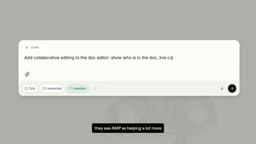
Amp shifts from coding assistant to general agent covering the entire workflow, betting on OpenAI models.
The Amp team publicly aims to build the most cutting-edge agent rather than a coding assistant. Amp's value extends to requirements gathering, solution discussions, code review, and documentation before and after coding, filling a gap most AI coding tools leave. OpenAI accounts for most tokens in Amp, users value its stability, and Sign in with ChatGPT grants more quota to ease token anxiety. Internal super-fast mode shows how low latency reshapes collaboration, and the team sees email automation as a representative path to general knowledge work. The article concludes that coding agents are evolving into general work agents, though single-vendor reliance brings capability ceiling and cost risks.
From "Writing Code" to "Doing Everything": Amp's Agent Ambition
Amp is redefining the boundaries of AI agents. In its official video, the team makes no secret of its goal: "We want to make Amp the most cutting-edge agent. Whenever a model gains a new capability, we want to be the first to figure out how an agent can use it—and then push it to the limit."
The subtext: an agent's value shouldn't be boxed in by the "coding assistant" label. Many users have found that Amp helps far more than expected both before and after the actual coding begins—requirements gathering, solution discussions, code review, documentation, and even those scattered communication tasks.
This "extending before and after" positioning hits a gap in today's AI coding tools: most products fixate on the few lines of code in the editor, while real workflows are far more sprawling. Amp chooses to place the agent within the full work chain rather than just being a faster autocomplete.
OpenAI Models Are Amp's Undisputed Workhorse
Amp is deeply tied to OpenAI. The team states plainly: "In Amp, OpenAI accounts for the vast majority of tokens." User feedback is equally direct—what they value is the stability of OpenAI models as they keep getting stronger.
That stability is especially critical for agent products. Agents require multi-turn planning, tool calls, and self-correction, so any jitter in model capability gets amplified. Users willing to hand complex tasks to Amp are essentially paying for "predictable output quality."
According to the video, Amp also supports "Sign in with ChatGPT" login. This means using Amp grants more token quota and access to the OpenAI model family, including GPT-6 Astra.

Loosening quota limits isn't just about lower costs—it's a psychological shift. In the team's words: "People get that feeling of no longer counting every token, and that opens up their imagination of what an agent can do." When users stop staring at the counter, they're willing to let the agent take on heavier tasks.
"Sign in with ChatGPT" is an account authorization and quota-sharing mechanism OpenAI offers to third-party apps: after logging in with a ChatGPT account, the app can call OpenAI models, and the consumed quota counts against the user's ChatGPT subscription rather than the app's own API key allocation. For agent products, this mechanism solves three problems at once—developers don't have to bear the full inference cost themselves, users' existing subscription benefits are reused, and model versions upgrade automatically with OpenAI's release cadence. The trade-off is deep coupling with a single vendor's account system, with pricing power and availability both subject to the other party's policies.
"Speed" Is Itself a Capability
The Amp team internally tested a "super fast" mode. Their assessment: "People haven't seen a model that is both this good and this fast."
The significance of speed for agents is often underestimated. Agent execution is serial—plan, call tools, read results, plan again—each step waiting for the model to return. A slightly faster single response compounds into an order-of-magnitude experience difference across the whole task chain. When latency drops below a certain threshold, user behavior changes: from "let it run a task and go do something else" to "watch it run and correct it in real time." That's closer to true collaboration.

The serial execution structure of agents determines the amplification of latency: a moderately complex task often involves dozens of model calls. If a single response drops from 5 seconds to 1 second, end-to-end time shrinks from several minutes to under one. This isn't just an experience optimization—it changes the interaction paradigm. At high latency, users tend toward "batch-style" delegation, throwing tasks out and walking away; at low latency, users are more likely to stay online, observe step by step, and intervene, forming "synchronous human-agent collaboration." Therefore, inference speed (tokens per second) and first-token latency have become core metrics for evaluating agent usability, on par with accuracy.
The Ultimate Scenario: Email Is Just the Beginning
When asked "what work or life task would you hand off to an agent and never think about again," the Amp team's answer was email—"read it, tell me what's important, draft replies in my tone." They added: "It feels like we're already very close to that goal."
This example seems trivial but actually tests an agent's comprehensive abilities: understanding context, judging priorities, mimicking personal writing style, and handling multi-turn exchanges. An agent that can do email well isn't far from handling other knowledge work.
The team's view of the future is simple: "The future is in our hands. The key is how agents can do more of the things we don't want to do, so we can go build better things."

Email handling looks simple but simultaneously triggers several hard problems in the agent field: long-context understanding (entire email threads and history), implicit preference modeling (mimicking personal tone and forms of address), tool orchestration (reading the inbox, retrieving contacts, generating drafts pending confirmation), and permission and safety boundaries (mis-sending or mis-deleting carries extremely high cost). The industry typically categorizes such tasks as "personal assistant agents," whose maturity marker is not single-step capability but end-to-end reliability and reversibility. That's precisely why email is often seen as the touchstone for knowledge-work automation.
What This Means for the Agent Landscape
Amp's approach reveals two trends. First, coding agents are evolving into general-purpose work agents, with the competitive focus shifting from "code completion accuracy" to "task completion" and "breadth of workflow coverage." Second, the stability of model supply and cost structure are becoming part of the agent product experience—Amp bets on OpenAI's full lineup and uses the login system to trade for quota, exchanging certainty on the model side for trust on the user side.
Risks exist too. Heavy reliance on a single model vendor means capability ceilings and pricing are dictated by others. When "stop counting tokens" becomes a selling point, there must be real cost subsidies or quota policies behind it—sustainability remains unknown.
But the direction is clear: the next stop for agents is the trivial tasks people are "willing to hand over." Email, calendars, reporting, coordination—whoever catches these first truly enters the workflow.
One-line Summary
Amp shifts from coding assistant to a general agent covering the entire workflow chain, betting on OpenAI models.
Paragraph Summary
The Amp team publicly states its goal to build the most cutting-edge agent rather than a coding assistant. The article notes Amp's value extends to requirements gathering, solution discussions, code review, and documentation before and after coding—filling the gap left by most AI coding tools that only handle lines in the editor. On the model side, OpenAI accounts for the vast majority of tokens in Amp, with users valuing the stability from continuous upgrades and gaining more quota via "Sign in with ChatGPT," easing token anxiety. Internal super-fast mode tests show low latency changes user-agent collaboration. The team sees email automation as a representative scenario toward general knowledge work. The article concludes that coding agents are evolving into general work agents, but heavy reliance on a single vendor brings capability ceiling and cost risks.
Related articles

Domestic AI Coding Plans Compared: How to Choose Between Zhipu, Kimi, and MiniMax
Compare Zhipu GLM Coding Plan, Kimi Code, and MiniMax M-Plan on pricing, points/quota rules, and model changes, plus scenario-based selection advice.

JetBrains Open-Sources AI IDE ThinkRail: Multi-Workspace Parallelism and Spec-Driven Development
ThinkRail is an open-source agentic IDE from the JetBrains Innovation Hub built on Pi, featuring multi-workspace parallelism, Git worktree isolation, spec-driven development, and diff review. Completely free under Apache 2.0.

Higgsfield: How AI Video Is Moving from the 1-Minute to the 10-Minute Era
Higgsfield shares AI video breakthroughs from 1 minute to over 10 minutes, covering Astra's text rendering, external tool use for 3D modeling, voice-to-movie, and productivity gains for small creative teams.