An $800 Open-Source Room-Scale Robotic Arm: Breaking Down Stringman
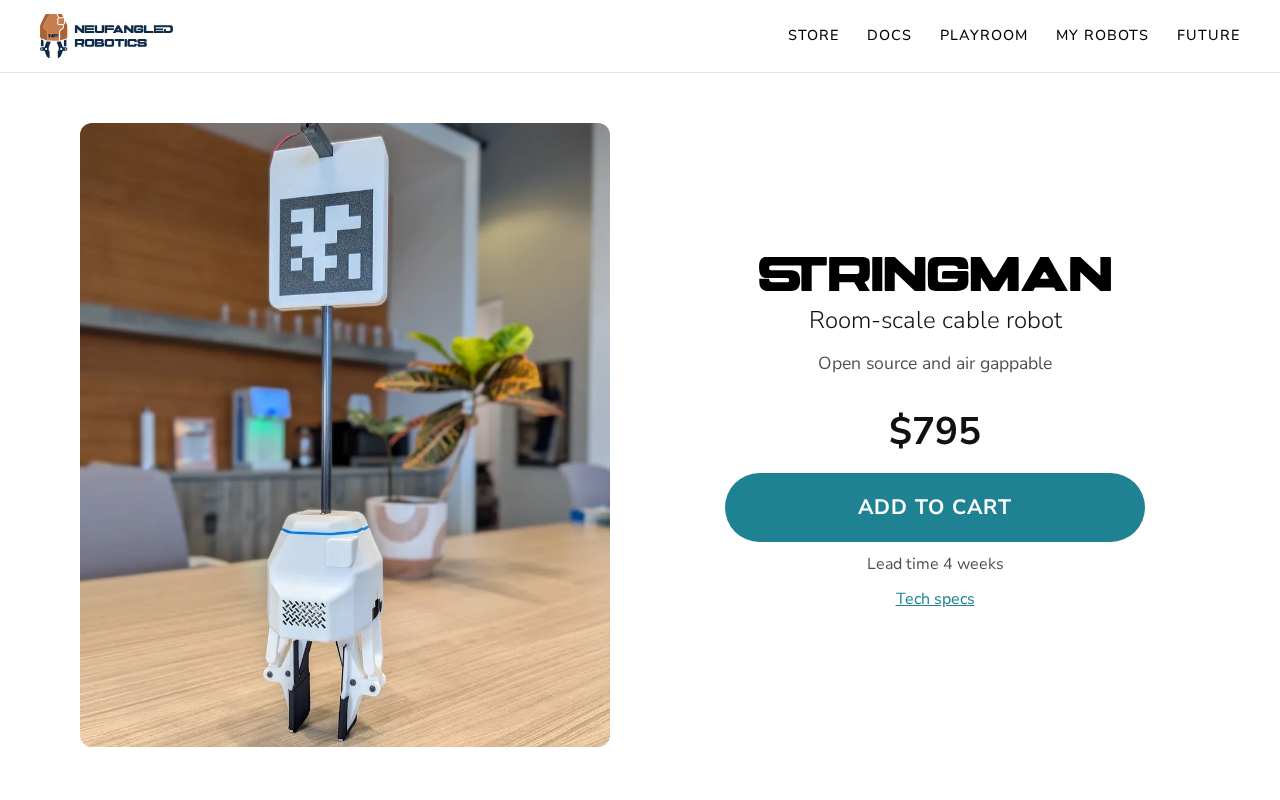
The $800 open-source room-scale cable-driven gripper robot Stringman sparks debate on low-cost, reproducible robotics.
Stringman is an $800, fully open-source room-scale gripper robot that moves its end effector via cable drive, achieving far greater reach than multi-axis arms at a fraction of the cost; it earned 284 points and 115 comments on Hacker News. The article examines cable drive's pros and cons—concentrated motors cut inertia and weight, but cable deformation, creep, wear, and coupling bring precision and reliability challenges. The $800 figure is a BOM-level estimate; real reproduction costs rise with sourcing, print precision, and assembly time. Room-scale operation demands less absolute precision but new safety, perception, and planning strategies, while open source makes designs auditable and reproducible.
In an era when robotics startups routinely raise tens of millions in funding, a room-scale gripper robot priced at $800 and fully open-source seems almost counterintuitive. The Stringman project from neufangled.com recently sparked discussion on Hacker News, earning 284 points and 115 comments—a figure that shows the community still has strong interest in robotic solutions that are "low-cost, reproducible, and ready out of the box."
What Stringman Is
Stringman is positioned as a "room scale gripper robot," meaning a gripper-style robot whose working range covers an entire room. Unlike traditional industrial robotic arms fixed at a workstation, it moves its end effector through room space via cables or wire-driven mechanisms, achieving a much larger reach at a fraction of the cost of multi-axis arms.
The project author publishes it on neufangled.com as open source, with hardware costs pushed down to the $800 level. For individual developers, educational settings, and small labs, this price point means "you can actually buy one and try it," rather than leaving it confined to papers and videos.
Judging from the Hacker News discussion, price isn't the community's only focus. Behind those 115 comments are multiple rounds of debate over open-source hardware business models, the precision limits of cable-driven structures, and safety in home environments.
Why Cable-Driven Deserves Attention
The bulk of a traditional robotic arm's cost lies in joint modules, reducers, and structural components. Each additional degree of freedom significantly raises cost and weight. Cable-driven approaches concentrate motors at the base or frame, transmitting power to the end via cables—reducing the inertia of moving parts and allowing lighter structures.
The trade-offs are equally obvious: cables suffer elastic deformation, creep, and wear, making long-term precision retention difficult; coupling among multiple cables increases control algorithm complexity; and if a cable goes slack or snaps, the end position instantly loses control. These are exactly the points of contention in the HN comments—supporters argue that for room-scale, low-load grasping tasks, precision requirements are inherently modest, and the cost-performance advantage of cable drive more than covers its shortcomings; skeptics worry about the open-source solution's lack of long-term reliability and safety redundancy.
A cable-driven parallel mechanism is a robot configuration that controls end-effector pose through the coordinated reeling and unreeling of multiple cables. Its core feature is that all actuators are fixed to the base, and cables bear only tension, not compression, so the end platform must maintain its pose through balanced cable tension. To ensure all cables remain taut, control requires redundant actuation and tension distribution algorithms; otherwise the mechanism momentarily loses degrees of freedom. Common applications include feed-cabin positioning for large radio telescopes, high-speed sorting robots in warehousing and logistics, and rehabilitation training equipment. Compared with serial robotic arms, the stiffness of cable-driven mechanisms varies with cable tension, and their workspace is constrained by both geometry and the feasible tension domain—the fundamental reason why precision and load capacity are hard to improve simultaneously.
Practical Considerations of the Open-Source Strategy
The $800 price tag holds largely because open source simplifies the supply chain: using standard parts, commodity motors, and 3D-printed structural components, avoiding custom machining and proprietary modules. This is also a common path for open-source robotics projects in recent years—publishing design files, letting the community source and assemble on their own, while vendors earn returns through kits, documentation, and value-added services.
However, the reproduction cost of open-source hardware often exceeds the sticker price. Differences in procurement channels, printer precision, and assembly labor all push actual spending upward. The $800 figure on the project page should be understood as a bill-of-materials (BOM) estimate, not a total price including all hidden costs. This distinction matters when evaluating such projects.
A bill of materials (BOM) is a list in hardware projects enumerating all constituent parts, quantities, specifications, and unit prices, commonly used as a basis for cost estimation. Open-source hardware projects typically use BOM cost as a reference price, but BOM covers only parts procurement itself—not hidden expenses like machining, assembly, debugging, rework, and tool depreciation. Moreover, small-batch unit prices are often noticeably higher than large-volume BOM quotes, and taxes and logistics vary by country and region. Industry practice is to provide both BOM cost and kit price: the former reflects the theoretical lower bound, the latter the true cost of a deliverable product. Understanding this distinction is a prerequisite for assessing the reproduction barrier of any open-source hardware project.
The Imaginative Space of Room-Scale Robots
The qualifier "room scale" deserves separate discussion. Industrial robotic arms typically have working radii measured in meters but are isolated by fences, whereas room-scale robots must operate in spaces where people are active, requiring safety strategies, perception capabilities, and task planning to be redesigned. Tasks like grasping clothing, tidying desks, and delivering items don't demand high absolute precision but do require broad coverage and flexibility—exactly the capability range of solutions like Stringman.
Some HN commenters also connected it to home service robots and educational demonstration platforms. For researchers, a low-cost, reproducible room-scale platform means batch deployment for data collection and algorithm validation; for hobbyists, it's a hardware foundation they can genuinely tinker with.
Repeatability and accuracy are two distinct metrics for evaluating robot performance. Repeatability refers to the dispersion among actual reach points when the robot returns to the same commanded position multiple times, reflecting system stability; accuracy refers to the deviation between the actual reached position and the theoretical commanded position, reflecting calibration quality. For cable-driven mechanisms, elastic deformation and creep affect both, and errors often vary with workspace position, making them hard to capture with a single number. In tasks like grasping clothing and tidying desks, repeatability and compliant control matter more, while millimeter-level absolute accuracy is less critical—an important precondition for the feasibility of low-cost cable-driven solutions in room-scale scenarios.
Taking a Rational View of Open-Source Robotics' Boundaries
Stringman's value lies not in proving that cable-driven robots can replace industrial arms, but in lowering the cost barrier for "room-scale manipulation" by an order of magnitude. Open source means designs can be audited, modified, and reproduced—especially important for a category still in its exploratory phase.
At the same time, information from the project page and HN discussion remains limited: key parameters such as payload capacity, repeatability, control interfaces, and software stack maturity require consulting the original documentation. Developers planning to reproduce it should first assess their own capacity for mechanical assembly and control debugging before deciding to jump in.
At a time when robotics hardware keeps getting more expensive, an $800 room-scale gripper robot that dares to publish its full design is itself a challenge to industry inertia.
One-line Summary
Stringman, an $800 open-source room-scale cable-driven gripper robot, has sparked community discussion about low-cost, reproducible robotic solutions.
Paragraph Summary
Stringman is an $800, fully open-source room-scale gripper robot that moves its end effector through room space via cable drive, achieving much greater reach at a fraction of multi-axis arm costs; the project earned 284 points and 115 comments on Hacker News. The article analyzes the advantages and trade-offs of cable drive: concentrating motors reduces moving inertia and lightens the structure, but cable elastic deformation, creep, wear, and multi-cable coupling pose precision and reliability challenges. The $800 figure is closer to a BOM-level estimate; actual reproduction costs rise with procurement channels, print precision, and assembly labor. Room-scale operation demands less absolute precision but raises new requirements for safety, perception, and task planning, while open source makes designs auditable, modifiable, and reproducible.
Related articles

CIO SmartKobe EX05 Review: A MagSafe Power Bank with Built-in Cable and Stand
CIO SmartKobe EX05 power bank review: built-in detachable Type-C cable, folding rotating stand, Qi 2.2 magnetic 25W wireless charging with 7.5W safe mode, 10000mAh dual semi-solid-state cells, pass-through charging and three-device simultaneous power—ideal for multi-device users who hate cables.

Nobel Laureates' Daring Self-Experiments: Betting Their Bodies to Rewrite Medical History
The official Nobel Prize video chronicles five laureates' self-experiments: de Hevesy's radioactive leftovers, Forssmann's self-catheterization, Tu Youyou's first dose, and Marshall's H. pylori gamble—how betting their bodies rewrote medical history.

Anthropic CEO Rings Nasdaq Bell: Reaffirms AI Won't Be Accelerated by Commercial Pressure
Anthropic CEO Dario Amodei reaffirmed at the Nasdaq bell-ringing that regardless of commercial or political pressure, the company will hold firm to setting the pace of AI development. This article examines the background, industry pressures, and potential impact.