An Empirical Study of MoE-LoRA Multilingual Adaptation: 8 Methods Across 200 Languages
Large-scale empirical evidence shows LoRA is a targeted tool, not a general multilingual enhancement solution.
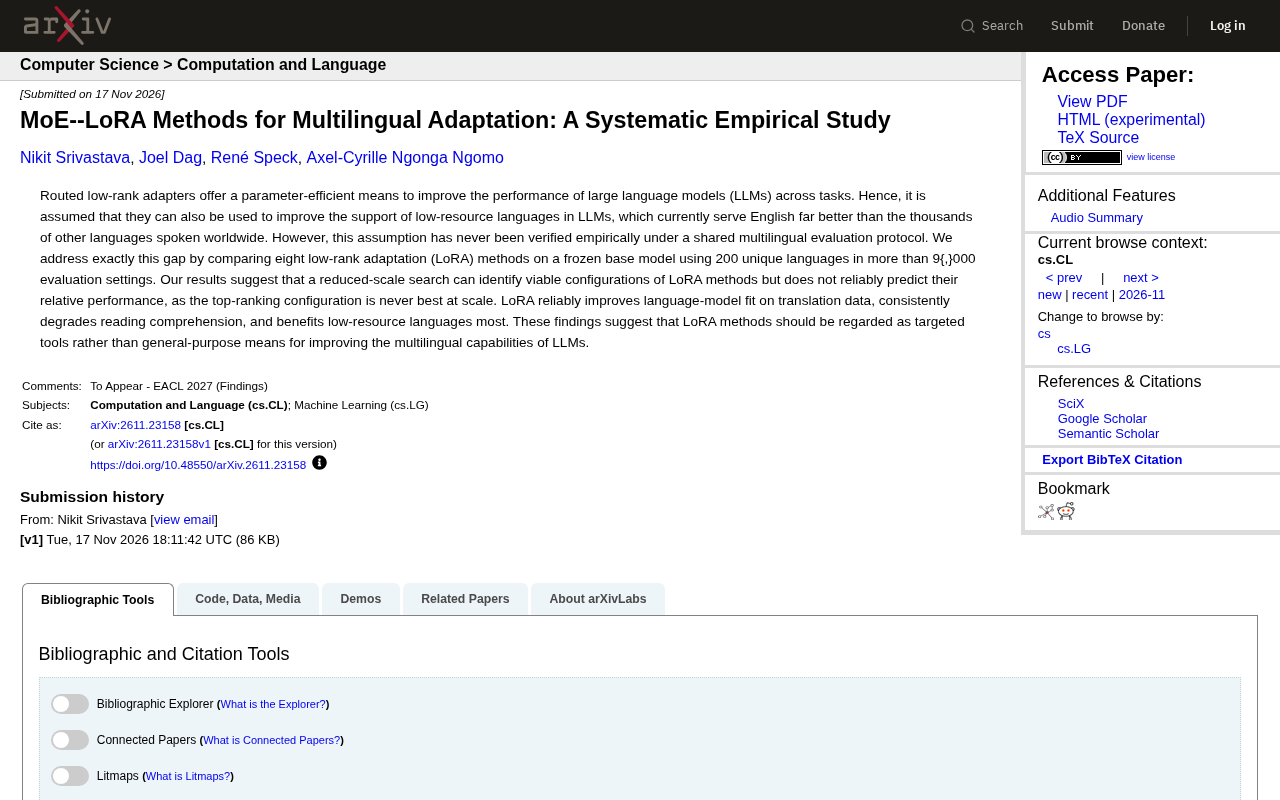
This study systematically compared eight LoRA methods on a frozen base model across 200 languages and 9,000+ evaluation settings, testing under a unified protocol whether routed low-rank adapters like MoE-LoRA improve low-resource language capability. Key findings: small-scale hyperparameter search finds workable configurations but cannot predict scaled relative performance, with small-scale optima never remaining best at full scale; LoRA reliably improves translation fit but consistently degrades reading comprehension; low-resource languages benefit most, though gains may be concentrated in translation tasks. The authors argue LoRA should be treated as a targeted tool and stress unified evaluation and scale-matched configuration search.
Introduction: Hypotheses and Validation Gaps in Low-Resource Language Adaptation
Large language models (LLMs) far outperform the thousands of other languages spoken worldwide when it comes to English, and this gap has spawned a large number of parameter-efficient fine-tuning methods. Among them, routed low-rank adapters (such as MoE-LoRA) are widely believed to be able to improve support for low-resource languages at relatively low cost. However, this hypothesis had never been systematically validated under a unified multilingual evaluation protocol. A recent empirical study fills this gap: the researchers compared eight LoRA methods on a frozen base model, covering 200 unique languages and more than 9,000 evaluation settings, revealing the real effects and limitations of routed adapters in multilingual scenarios.
Low-rank adaptation (LoRA) is a parameter-efficient fine-tuning technique: it freezes all the weights of a pretrained model and injects trainable low-rank decomposition matrices (typically the product of two small matrices A and B) into positions such as the Transformer's attention layers, thereby approximating the update effect of full-parameter fine-tuning with very few trainable parameters. Because the added parameters account for only a tiny fraction of the original model, LoRA greatly reduces memory and storage overhead, and supports training independent adapter weights for different tasks and dynamically switching between them at inference time.
Routed low-rank adapters (routed LoRA / MoE-LoRA) build on this by introducing a Mixture-of-Experts-style routing mechanism: multiple LoRA adapters are trained as "experts," and a router decides which experts to activate based on the input (such as a language identifier or hidden state) and combines their outputs with weights. The motivation is to let different experts specialize in different languages or tasks, thereby improving multilingual coverage under a limited parameter budget.
Experimental Design: Scale and Coverage
The study uses a frozen base model for controlled experiments, ensuring that comparisons between different LoRA methods are not disturbed by changes in the base weights. The evaluation covers 200 languages—far more than most multilingual benchmarks cover, and including a large number of low-resource languages. More than 9,000 evaluation settings means the researchers not only examined the language dimension but also systematically varied variables such as adapter configurations and routing strategies. This scale of systematic empirical work is unprecedented in the MoE-LoRA literature and provides a relatively solid data foundation for the subsequent conclusions.
A frozen base model means keeping the parameters of the pretrained backbone unchanged throughout adapter training and evaluation, updating only additional modules such as LoRA. This setup is especially critical in multilingual controlled experiments: if different methods each fine-tune the base weights, performance differences may stem from base drift rather than from adapter design itself; a frozen base ensures that all methods share the same initial representation space, so that comparison results can be attributed to the adapter methods and their configurations, while also significantly reducing computational cost and making large-scale grid evaluation across hundreds of languages feasible.
Key Finding 1: Small-Scale Search Cannot Reliably Predict Performance at Scale
The study's most counterintuitive finding is that reduced-scale hyperparameter search, while able to find "workable" LoRA configurations, cannot reliably predict the relative performance of these configurations at larger scale. Specifically, the top-ranked configuration at reduced scale never remained the best at full scale. This means that the common industry practice of "tune at small scale, deploy at large scale" may be misleading in multilingual LoRA scenarios. The researchers accordingly caution that configuration choices for routed adapters need to be re-validated in large-scale evaluation rather than simply extrapolated from small-scale search results.
The scale-extrapolation problem in hyperparameter search is a common pitfall in machine learning empirical work: researchers often, due to compute constraints, search hyperparameters under settings with reduced model size, less data, or lower language coverage, and then assume that the optimal configuration remains optimal at full scale. However, optimal hyperparameters often change nonlinearly with scale—the optima for regularization strength, learning rate, number of routing experts, and so on may drift, causing small-scale rankings to diverge from large-scale rankings (i.e., low rank correlation). The study's finding falls into this category, suggesting that in multilingual LoRA scenarios, configuration selection must be re-validated at the target scale.
Key Finding 2: Divergent Effects of LoRA on Translation Tasks Versus Reading Comprehension
In terms of task effects, the study presents a set of results pointing in opposite directions. LoRA reliably improves the language model's fit to translation data, yet consistently causes performance degradation on reading comprehension tasks. This divergence across tasks indicates that LoRA does not uniformly enhance multilingual capability but instead has differentiated effects depending on task type. For developers who want to maintain multi-task performance simultaneously, this finding means they need to design more refined adaptation strategies for task combinations, or introduce task-specific routing mechanisms.
Key Finding 3: Low-Resource Languages Benefit Most
Consistent with intuition but quantified systematically for the first time, low-resource languages gain the most from LoRA adaptation. This provides empirical support for the value of LoRA in multilingual fairness—for resource-scarce languages, lightweight adapters can partially compensate for the gap caused by insufficient pretraining data. However, combined with the aforementioned task divergence, this benefit may be concentrated mainly in translation-type tasks rather than representing a comprehensive improvement in language understanding capability.
Conclusion and Implications: LoRA Should Be Regarded as a Targeted Tool
Synthesizing the above findings, the researchers' core conclusion is that LoRA methods should be regarded as targeted tools for specific goals (such as low-resource language translation) rather than as a general-purpose multilingual capability enhancement solution. This judgment has direct reference value for practitioners: when planning multilingual adaptation, they should clarify the task type and target languages and avoid treating LoRA as a panacea; at the same time, configuration search needs to match the final deployment scale and cannot rely on rankings from small-scale experiments. The study also suggests that future work needs to validate the boundaries of routed adapters across more task types and broader language coverage.
Methodological Implications: The Importance of a Unified Evaluation Protocol
The study's methodological contribution is also noteworthy. Previous conclusions about LoRA's multilingual effects often came from disparate experimental setups and were difficult to compare across studies. By using a unified evaluation protocol, fixing the base model, and covering 200 languages and more than 9,000 evaluation settings, this study establishes a reproducible comparison benchmark. This systematic empirical approach has exemplary significance for the AI research community—against the backdrop of rapidly emerging parameter-efficient fine-tuning methods, independent, large-scale, protocol-unified evaluation is more valuable than performance claims for any single method.
One-line Summary
Large-scale empirical evidence shows that LoRA is a targeted tool rather than a general multilingual enhancement solution.
Paragraph Summary
This study systematically compared eight LoRA methods on a frozen base model, covering 200 languages and more than 9,000 evaluation settings, and for the first time tested under a unified protocol the hypothesis that routed low-rank adapters (such as MoE-LoRA) improve low-resource language capability. There are three core findings: reduced-scale hyperparameter search can find workable configurations but cannot reliably predict relative performance at scale, and the small-scale optimal configuration never remained the best at full scale; LoRA reliably improves fit on translation tasks but consistently degrades reading comprehension performance; low-resource languages benefit most from adaptation, but the gains may be concentrated in translation-type tasks. The study accordingly argues that LoRA should be regarded as a targeted tool for specific goals, and emphasizes the importance of a unified evaluation protocol and configuration search that matches deployment scale.
Related articles

Gemini 4 Hydrogen vs Sonnet Comparison Test: Uses Only 1% of Weekly Quota, Performance on Par
Hands-on test: Gemini 4 Hydrogen vs Sonnet on the same CRUD task—Hydrogen used only 1% weekly quota with comparable performance and better UI details, while Anthropic's model used 7%. Developer says daily tasks don't require expensive models.

Gemini 4 Neon Released: Beats Opus 5.5 on Multiple Benchmarks, Google Returns to the Top Tier
Google DeepMind releases Gemini 4 Neon: 61 on the Artificial Analysis intelligence index (3rd) and 1st on the coding index, beating Opus 5.5 on multiple benchmarks. $3/$15 per million tokens; available in the Gemini API and AI Studio.
Gemini 4 Neon Review: Benchmark Scores Rival Carbon, API Cost-Performance Analysis
Full review of Google Gemini 4 Neon: benchmark scores rival Carbon, API priced at 2x Hydrogen, yet Antigravity quota consumption is only 1x (vs Carbon's 3x). Real tests show it replaces 90% of Carbon use cases. Includes channel restrictions, ban risks, and combination strategy analysis.