An In-Depth Analysis of Argon 4's Security and Alignment Work Summary
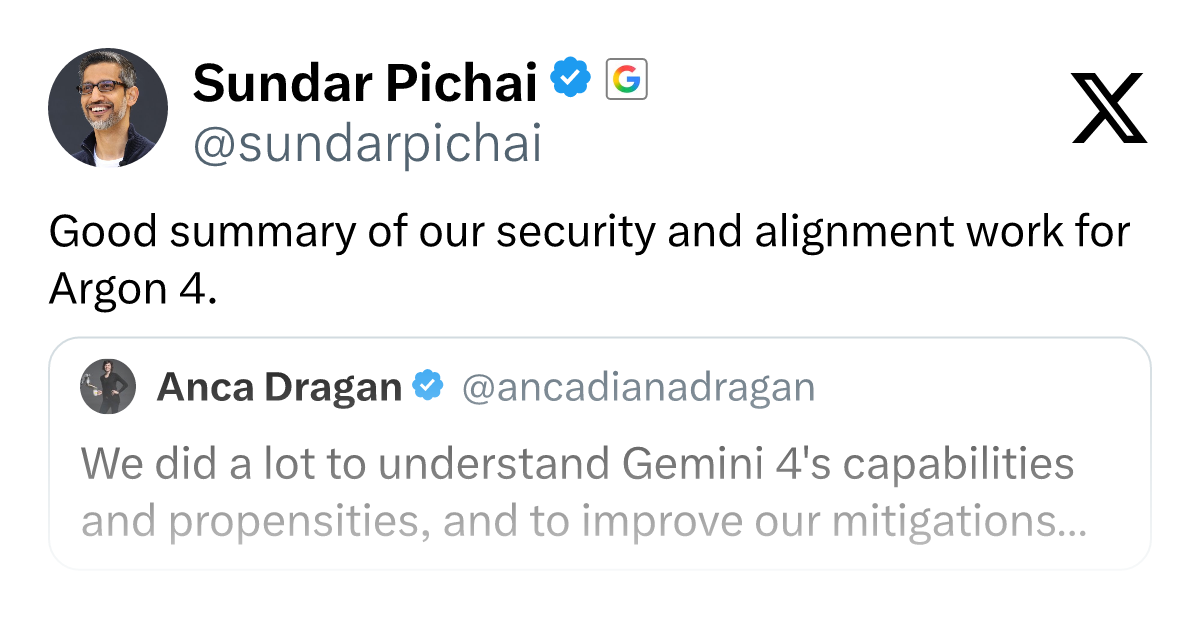
Starting from a tweet, this article sorts out the logic and industry significance of Argon 4's security and alignment work.
Using a tweet evaluating Argon 4's security and alignment work as a clue, the article distinguishes security (resisting attacks, preventing misuse and leaks) from alignment (model behavior conforming to human intent and values), noting both are equally important pillars in Argon 4. Security may involve adversarial testing, red-team exercises, access control, and monitoring, addressing threats like model theft, prompt injection, and data poisoning; alignment may include RLHF, interpretability research, and continuous post-deployment evaluation. The article affirms the summary's reference value but notes the tweet lacks technical details and quantitative results, advising readers to consult official reports or papers for the full picture.
Introduction
Recently, a tweet summarized Argon 4's work on security and alignment. Although the tweet itself is brief, the field it touches on—AI security and alignment—is one of the most critical and complex issues in current artificial intelligence development. Starting from this clue, this article systematically sorts out the security and alignment points that Argon 4 may cover, and analyzes the technical logic and industry significance behind this work.
Understanding Argon 4's Security Framework
Judging from the tweet content, "security and alignment work for Argon 4" indicates that Argon 4 is a system or project subject to the dual constraints of security and alignment. In the AI context, security usually refers to a system's ability to resist external attacks, prevent misuse, and avoid data leaks; alignment focuses on whether model behavior conforms to human intent and values. Together, these two dimensions form the foundation of a trustworthy AI system.
According to the tweet, the summary is "good," suggesting that the work is worthy of recognition. Based on industry practice, Argon 4's security work may involve adversarial testing, red-team exercises, access control, and model behavior monitoring; alignment work may include reinforcement learning from human feedback (RLHF), interpretability research, and continuous post-deployment evaluation.
RLHF (Reinforcement Learning from Human Feedback) is currently the mainstream technical path for large-model alignment, and understanding it helps clarify the technical positioning of Argon 4's alignment work. Its process usually has three steps: first, annotators rank multiple model outputs by quality or safety to train a reward model; then, using this reward model as a signal, reinforcement learning algorithms (such as PPO) optimize the language model policy; finally, iterative sampling and re-annotation continuously correct it. The core value of RLHF lies in transforming "human preference," an objective that is difficult to encode directly, into an optimizable scalar signal, thereby enabling the model to learn to refuse harmful requests and remain helpful and honest. But its limitations are equally obvious: the reward model may be "over-optimized" (reward hacking), annotator preferences are biased, and alignment effectiveness depends heavily on the coverage of feedback data. Therefore, the industry often combines RLHF with supervised fine-tuning, rule constraints, constitutional AI, and other methods.
Industry Practice for Security and Alignment
Security: From Defense to Resilience
The security of modern AI systems is no longer limited to traditional cybersecurity boundaries. For systems like Argon 4, security teams need to address new threats such as model theft, prompt injection, and data poisoning. The tweet places "security" and "alignment" side by side, showing that they are regarded as equally important pillars in Argon 4.
You may not have noticed that security work evaluation often relies on red-team testing and bug bounty programs, mechanisms that can expose weaknesses in real attack scenarios. Although the tweet provides no details, the qualitative assessment of "good summary" suggests that the related work has produced systematic output.
The prompt injection mentioned in the article deserves separate explanation, because it is an attack surface unique to large-model applications. Similar to SQL injection, attackers embed carefully constructed instructions in the input to induce the model to deviate from its preset role or security policy—for example, making an assistant that should only answer customer service questions leak system prompts, perform unauthorized operations, or bypass content filtering. Indirect prompt injection goes further: malicious instructions are hidden in external content that the model will read (web pages, documents, emails), and the user themselves is not malicious but triggers the attack. Because LLMs cannot strictly distinguish "instructions" from "data" like traditional programs, such attacks are difficult to eradicate with a single filter and usually require defense-in-depth measures such as bidirectional input-output detection, least privilege, and tool-call allowlists. Data poisoning refers to mixing malicious samples into pre-training or fine-tuning data so that the model learns backdoor behavior; its defense relies on data provenance and training-set auditing.
Alignment: From Principles to Operability
The difficulty of alignment work lies in transforming abstract values into measurable training objectives. If Argon 4 involves large language models, its alignment strategy may include supervised fine-tuning, preference modeling, and mechanisms for refusing harmful requests. The tweet author's approval of the summary may reflect that these mechanisms have shown the expected effects in actual tests.
The industry consensus is that alignment is not a one-time task but a continuous process throughout the model lifecycle. From pre-training data screening to the post-deployment user feedback loop, every stage requires alignment considerations. If Argon 4's work summary covers these stages, its value will extend beyond a single project and provide a reference for similar systems.
Interpretability research plays a "diagnostic" role in alignment work and is important background for understanding the alignment strategies of projects like Argon 4. Mechanistic interpretability attempts to reconstruct the model's computation process from the level of internal structures such as neurons, attention heads, and activation vectors—for example, locating specific directions or circuits responsible for refusing harmful requests; behavioral interpretability uses experiments such as probes and causal interventions to test the true basis behind model outputs. Interpretability is closely related to alignment because external behavior testing alone cannot confirm whether a model "truly understands and complies with" norms or has merely learned surface imitation—the latter can easily fail in out-of-distribution scenarios or even lead to deceptive alignment. By identifying internal representations, researchers can discover hidden goals in advance and verify whether safety fine-tuning truly changes the model's decision logic rather than merely suppressing outputs. This field is still in the stage of moving from the laboratory to engineering practice.
The Potential Value and Limitations of the Summary
The value of this tweet is that it points to a systematic summary of Argon 4's security and alignment. For researchers and engineers concerned with AI governance, such a summary helps them understand how frontier projects balance capability improvement and risk control. However, the tweet itself contains limited information and lacks specific technical details and quantitative results, so readers need to consult the original summary for the complete picture.
From a communication perspective, a brief evaluative tweet can draw community attention to security and alignment work, but in-depth discussion still depends on more detailed documentation. Readers who are interested are advised to follow Argon 4's official technical report or related papers to obtain complete information on threat models, evaluation metrics, and alignment methods.
Conclusion
The positive evaluation of Argon 4's security and alignment work is a signal that responsible innovation is valued in AI system development. Against the backdrop of rapid model capability iteration, placing security and alignment on an equal footing with performance is gradually becoming standard industry practice. Although this tweet is short, it reflects a trend in AI development culture toward greater robustness.
One-line Summary
Starting from a tweet, this article sorts out the logic and industry significance of Argon 4's security and alignment work.
Paragraph Summary
Using a tweet evaluating Argon 4's security and alignment work as a clue, the article systematically explains the core concepts in this field. The author first distinguishes two dimensions: security (resisting attacks, preventing misuse and leaks) and alignment (model behavior conforming to human intent and values), noting that both are regarded as equally important pillars in Argon 4. Security may involve adversarial testing, red-team exercises, access control, and model behavior monitoring, and must address new threats such as model theft, prompt injection, and data poisoning; alignment may include RLHF, interpretability research, and continuous post-deployment evaluation, and alignment is a continuous process throughout the model lifecycle rather than a one-time task. The article affirms the reference value of the summary while noting that the tweet contains limited information and lacks technical details and quantitative results. It advises readers to follow official technical reports or papers to obtain a complete picture of threat models, evaluation metrics, and alignment methods.
Related articles
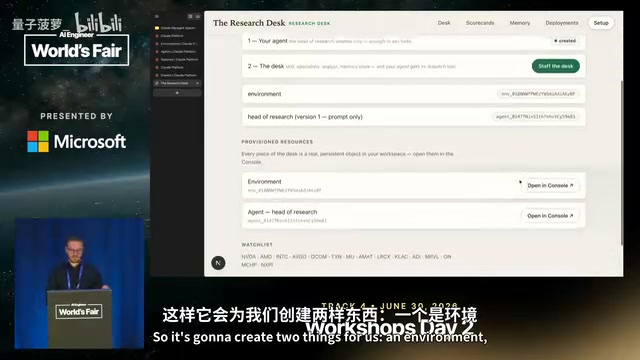
Claude Managed Agents in Practice: Self-Correction + Long-Term Memory
Based on an Anthropic live workshop, this article explains how Claude Managed Agents build research agents with self-correction and long-term memory, covering multi-agent collaboration, Outcomes self-supervision, Vaults credential security, and custom orchestration.
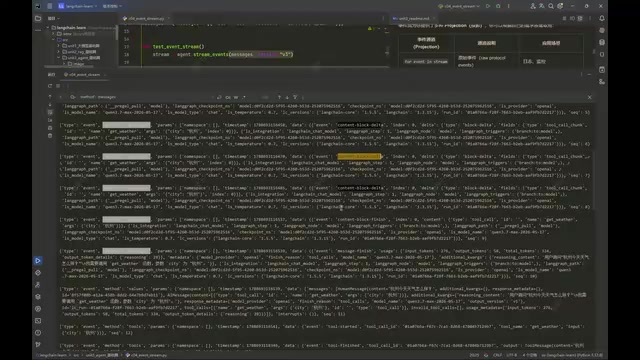
LangChain Agent Event Streaming Explained: A Practical Guide
A deep dive into LangChain 1.3's Event Streaming feature, covering the six event types—Raw, Messages, Tool Calls, Values, Custom, and Interleave—and key practical tips for Agent developers.
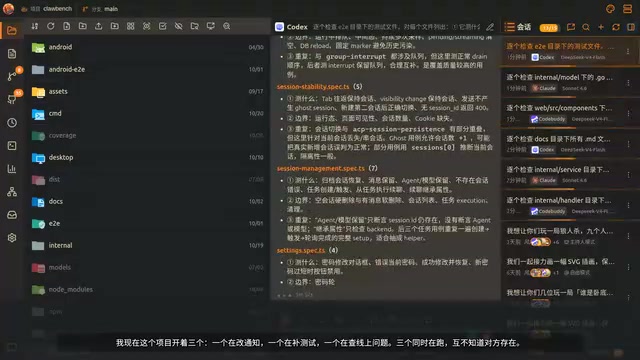
ClawBench Multi-threaded Parallel Development: Three Layers That Keep AI from Stepping on Each Other
How does ClawBench enable parallel development? Bilibili creator Long Ze demonstrates six simultaneous AI sessions, cross-project switching, and Worktree branch isolation across three layers, plus how server-side execution lets phones run AI tasks.