Analogue Unveils Super Nt Plus and Mega Sg Plus Retro Consoles with Built-in Wireless Connectivity
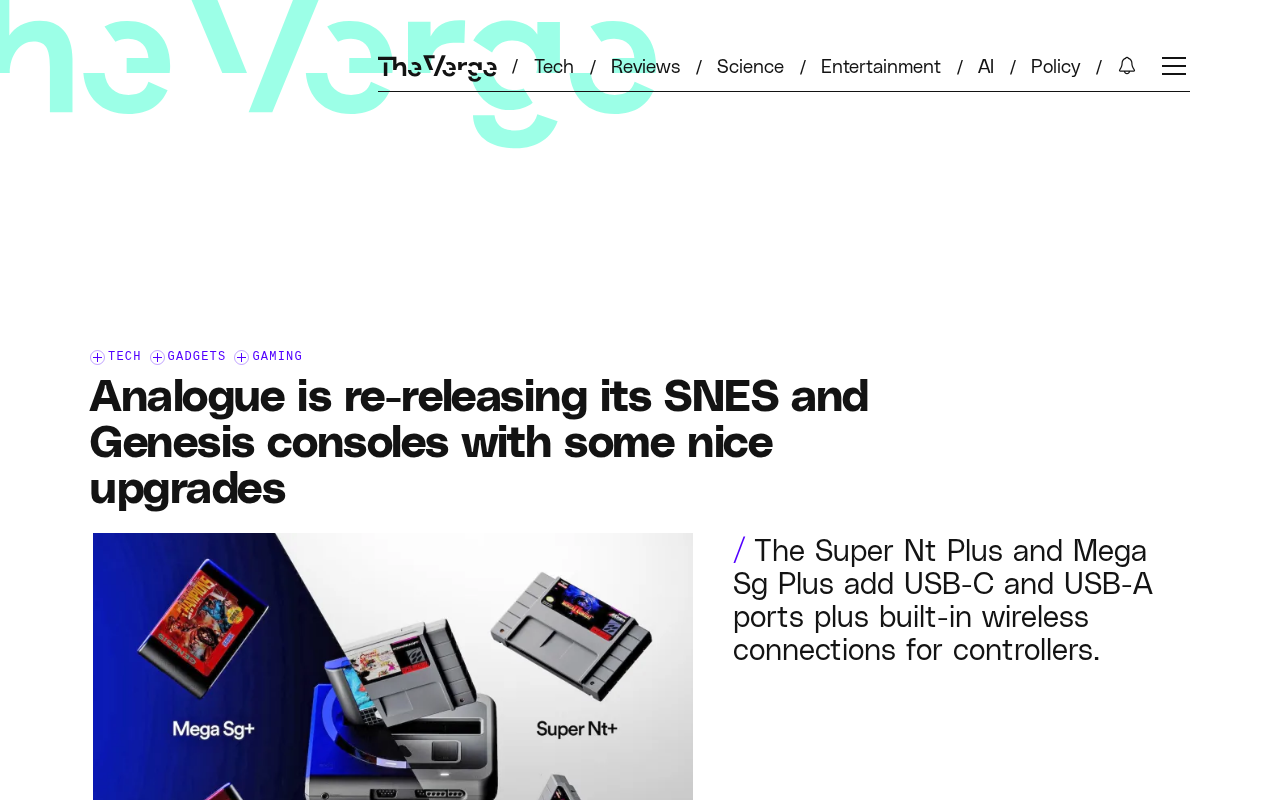
Analogue launches Super Nt Plus and Mega Sg Plus, keeping the FPGA approach and adding built-in wireless connectivity for the first time.
Analogue has released two FPGA retro consoles, the Super Nt Plus and Mega Sg Plus, compatible with SNES and Sega Genesis cartridges. While retaining hardware-level accurate reproduction, the new models feature built-in wireless connectivity for controllers and accessories with no separate receiver needed, plus a redesigned industrial look. The FPGA approach uses programmable logic gates to reproduce the original consoles' chip behavior, achieving closer timing, latency, and audio to the originals than software emulators. The new products retain cartridge slots, balancing physical media experience with modern HDMI output. Pricing, release dates, and wireless protocol details have not yet been announced.
Retro gaming hardware maker Analogue today announced two new consoles, the Super Nt Plus and Mega Sg Plus, corresponding to SNES and Sega Genesis cartridges respectively. While retaining the FPGA chip approach, the new models feature a redesigned industrial look and, for the first time, built-in wireless connectivity for controllers and accessories.
Core Upgrades: Wireless Connectivity and Industrial Design
For players familiar with Analogue, the Super Nt and Mega Sg are hardly strangers. What made these two products so highly regarded was their use of FPGA (Field-Programmable Gate Array) processors, capable of reproducing the original consoles' performance with hardware-level accuracy while supporting HDMI output.
The Plus versions introduced this time bring two clear improvements. First is built-in wireless connectivity, meaning controllers and accessories no longer require separate receivers to pair. Second is a "redesigned industrial form factor" on the exterior. While officials haven't disclosed material or dimension details, it signals the new units will differ visually from their predecessors.
For retro gamers, the significance of wireless connectivity isn't just "one less cable." The wired designs of original SNES and Genesis controllers often require extension cables or adapter solutions in today's living room setups, and built-in wireless support streamlines that step directly.
SNES (Super Nintendo Entertainment System) and Sega Genesis are the two most iconic 16-bit consoles of the 1990s. The SNES was first released by Nintendo in Japan in 1990 under the name Super Famicom, with the North American version called the SNES, featuring a 65C816 CPU and custom PPU/APU, renowned for its rich colors and outstanding audio. The Sega Genesis (known as Mega Drive in Japan) was launched by Sega in 1988, using a Motorola 68000 main processor and famed for high-speed action games and rock-style soundtracks. The two formed direct competition in the global market, each with a large library of classic cartridges. Since the original consoles were discontinued long ago and emulators vary in compatibility and latency, FPGA replica consoles that can read these cartridges directly hold special appeal in collector circles.
Why the FPGA Approach Still Matters
The reason Analogue's product line remains popular in retro gaming circles comes down to the fundamental difference between FPGA emulation and common software emulators.
Software emulators "translate" the original console's instructions one by one through programs. Constrained by CPU performance and emulation accuracy, they tend to deviate in audio timing, display latency, and other aspects. FPGA, on the other hand, uses programmable logic gate circuits to reproduce the original console's chip behavior at the hardware level, theoretically achieving timing performance nearly identical to the original.
According to the original report, the new Super Nt Plus and Mega Sg Plus still maintain compatibility with Nintendo and Sega Genesis cartridges. For players who still collect physical cartridges, this means they can simply insert the cartridge and play without relying on ROM files.
FPGA (Field-Programmable Gate Array) is an integrated circuit whose logic gate circuits can be reconfigured by the user after manufacturing. Unlike a CPU that executes programs in instruction order, an FPGA's internal lookup tables, flip-flops, and routing resources can work in parallel, enabling it to reproduce a specific chip's digital behavior with extremely low latency. In the retro console context, developers obtain logic descriptions of the original console's CPU, PPU, APU and other chips through reverse engineering, then map them onto the FPGA using hardware description languages (such as Verilog, VHDL), effectively "becoming" that console at the physical level rather than "emulating" it with software. The advantage of this "hardware-level replication" lies in precise timing, no OS interference, and typically near-zero input latency and authentic audio output. Analogue is a leading manufacturer on this path, with products that don't rely on ROM files, can read original cartridges directly, and output digital signals via HDMI, balancing the collector experience with modern display devices.
The Continuing Evolution of the Retro Hardware Market
In recent years, the retro gaming hardware space has seen a noticeable wave of product iteration. Beyond Analogue, multiple manufacturers are attempting to repackage old-generation console experiences with modern interfaces and wireless protocols.
There are two layers of demand behind this trend. One is that collector players want a reliable way to run their physical cartridges, avoiding dependence on long-discontinued original consoles. The other is that ordinary players want clean, low-latency visuals on 4K TVs rather than enduring outdated AV output.
The positioning of the Super Nt Plus and Mega Sg Plus sits right between these two types of demand: retaining the physical media experience of a cartridge slot while adapting to modern living rooms through wireless connectivity and HDMI output.
The value of HDMI output in retro gaming isn't just about a modern interface. The original SNES and Genesis output analog signals via composite video or RGB, which on 4K TVs produce noticeable latency, blur, and color distortion due to upscaling. FPGA consoles generate images directly in the digital domain, outputting clean signals from 480p to 1080p or even 4K, and supporting progressive scan and optional scanline filters, preserving the pixel art's original appearance while avoiding degradation through the analog signal chain. Additionally, digital output facilitates recording and streaming, lowering the barrier for retro gaming content creation. It is precisely these characteristics that have gradually moved FPGA retro consoles from geek toys to a broader nostalgic player base.
A Few Questions Worth Watching
Specific pricing, release dates, and regional availability information for the new products have not been disclosed in the original report. The specific wireless protocol (for example, whether it supports Bluetooth or a 2.4GHz proprietary solution) also awaits further official clarification.
For users who already own the original Super Nt or Mega Sg, whether to buy another unit for wireless functionality and design upgrades depends on personal tolerance for wired solutions and collecting inclination. For players who haven't yet purchased one, the Plus version offers a relatively complete modern solution.
FPGA retro consoles have always catered to a specific audience, but every Analogue product update sparks discussion in the community. Whether this Plus version can carry on its predecessor's reputation will depend on pricing strategy and actual wireless experience.
One-line Summary
Analogue launches the Super Nt Plus and Mega Sg Plus, retaining the FPGA approach and adding built-in wireless connectivity for the first time.
Paragraph Summary
Analogue has released two FPGA retro consoles, the Super Nt Plus and Mega Sg Plus, compatible with SNES and Sega Genesis cartridges respectively. While retaining hardware-level accurate reproduction, the new models feature built-in wireless connectivity for controllers and accessories with no separate receiver needed, plus a redesigned industrial look. The FPGA approach uses programmable logic gates to reproduce the original consoles' chip behavior, getting closer to the originals in timing, latency, and audio compared to software emulators. The new products retain cartridge slots, balancing physical media experience with modern HDMI output. Pricing, release dates, and wireless protocol details have not yet been announced; whether they can carry on the predecessor's reputation depends on pricing and actual wireless experience.
Related articles

5 Practical Ways Real Estate Agents Can Use AI to Boost Efficiency (2026 Edition)
How can real estate agents use AI to boost efficiency? Based on a YouTube walkthrough, this breaks down five methods — ChatGPT for listing descriptions, Canva for marketing materials, forms for open house leads, Zapier for automated follow-up, and seller meeting prep — and flags risk boundaries like fair housing laws, photo authenticity, and price verification.

Grok Bot vs ChatGPT Agent: Which AI Agent Is More Powerful?
How does Grok Bot differ from ChatGPT Agent? This comparison examines how they work: Grok Bot has a cloud computer and runs persistently inside tools to execute multi-step tasks automatically; ChatGPT Agent operates web pages in a browser and is more mature at general tasks. Includes selection advice.

Walmart Agent Gateway: AI Shops for You Automatically—Why Is Amazon Going the Opposite Way?
Walmart's Agent Gateway lets ChatGPT, Gemini and other AI assistants access its product catalog to search, compare and add to cart, with spending limits and per-purchase approval. Amazon blocks external AI agents—two retail giants, opposite paths. Currently US-only, India may follow.