Andrew Ng and Anthropic Launch Claude Code Practical Course: Master AI Programming Best Practices Through Three Case Studies

Andrew Ng and Anthropic's joint course systematically explains Claude Code best practices and multi-agent orchestration.
The article introduces the Claude Code course jointly launched by Andrew Ng and Anthropic's Edison. The core principle is providing clear context: locating relevant files, clarifying goals, and extending capabilities through MCP servers. Three practical cases cover backend, data, and design workflows: React chatbot, Jupyter e-commerce data analysis, and Figma design to frontend application. MCP and Git worktrees support multi-agent orchestration; code stays local with no indexing, raising security topics.
Why Learn Claude Code Now
The evolution path of AI-assisted programming has become very clear: from the early days when people occasionally threw a few programming questions at a chat window, to GitHub Copilot-style auto-completion, and now to agents that can work autonomously for minutes at a time. In the course opening, Andrew Ng stated directly that Claude Code is his current favorite programming assistant, boosting his work efficiency "dramatically."
This improvement doesn't come from a single feature, but from a shift in work paradigm. In the past, developers wrote code line by line with local auto-completion; now a task can be handed to Claude Code to push forward for minutes or even longer. Going further, some have already started coordinating multiple agents working in parallel, each handling different parts of the codebase. The goal of this course, jointly launched by Andrew Ng and Anthropic's Edison, is to systematically explain these "little-known" practices.

Core Methodology: Clear Context Is the Top Priority
One principle repeatedly emphasized in the course is: provide Claude Code with clear context—this is the prerequisite for efficiently completing tasks. It breaks down into several specific actions:
- Have Claude Code locate the relevant files, rather than letting it blindly search over a large scope;
- Clearly state the functionality and goals to be implemented;
- Extend Claude Code's capabilities through MCP servers, connecting it to other tools in the ecosystem.
Interestingly, Claude Code doesn't need to index the codebase—the code always stays local. This is both an efficiency design and a source of security issues that the course discusses separately later.
Andrew Ng specifically mentioned that if you haven't worked with developers familiar with best practices, the improvement from this methodology will be "very significant"—it's not just about tool proficiency, but an upgrade in the way you collaborate.

MCP (Model Context Protocol) is an open protocol proposed by Anthropic for standardizing communication between AI models and external tools and data sources. In Claude Code, MCP servers act as adapters, enabling the model to directly call external services like GitHub, Figma, and databases without requiring developers to manually paste context. This solves the limitation of traditional AI programming assistants that can only rely on the current file content, allowing the model to proactively obtain needed information and perform operations, thereby completing more complex tasks. The introduction of MCP servers also means developers need to pay attention to permission control and data boundaries, which is one of the backgrounds for the security discussion later in the course.
Three Practical Case Studies Form a Complete Capability Chain
The course designs three sets of case studies, covering the complete chain from backend to data analysis to frontend design.
Case 1: React Chatbot
Starting with frontend and backend feature implementation, extending to code refactoring and test writing, then handling pull requests and fixing issues through GitHub integration. This case uses planning mode, thinking mode, parallel session management, and Claude Code's memory mechanism—getting both "writing code" and "managing code" working.
Planning mode and thinking mode are two different task-processing strategies in Claude Code. Planning mode lets the model first break down the task, list steps, and evaluate dependencies before executing step by step—suitable for building new features or refactoring scenarios that require a global view. Thinking mode allows the model to perform longer internal reasoning before generating code, used for solving logically complex problems or those requiring multi-step verification. Parallel session management (possibly referring to parallel session management) allows developers to open multiple Claude Code instances simultaneously, each responsible for different parts of the codebase, improving overall throughput. The memory mechanism lets Claude Code retain key context across sessions (such as project conventions and modified files), reducing repeated communication costs. Together, these concepts form the capability foundation from "single completion" to "continuous collaboration."
Case 2: Jupyter Notebook E-commerce Data Analysis
The direction shifts to the data science scenario. Use Claude Code to refactor the Notebook, remove redundant code, and turn the analysis results into a web dashboard. The value of this case lies in showing that Claude Code isn't only for traditional software engineering—it can also transform data analysis workflows.
Case 3: Figma Design to Frontend Application
First create a visual prototype, then combine the Figma MCP server and another MCP server to import the design, iteratively modify and test, and finally build a frontend application using agent technology. This is the most intuitive demonstration of the value of the MCP protocol: letting Claude Code directly "see" the design mockup and generate code accordingly.
MCP and Multi-tool Collaboration: From Solo to Orchestration
The course discusses Git worktrees and MCP servers together, following a clear logic: as AI programming moves from "completing a line" to "independently completing a task," what developers need is orchestration capability—coordinating a single agent or even multiple parallel agents, each responsible for different parts of the codebase.
MCP servers play the role of extension interfaces here, bringing Figma, GitHub, and data analysis tools into Claude Code's capability scope. This is also why the course emphasizes repeatedly applying the same set of best practices across three different case studies, rather than staying at the conceptual level.
Git worktree is a mechanism provided by Git that allows multiple working directories to be checked out simultaneously on the same repository, with each worktree corresponding to a different branch. In AI programming scenarios, the value of worktrees lies in providing isolated working environments for multiple parallel agents: each agent can modify code and commit changes in an independent worktree without interfering with each other. Combined with MCP servers, developers can orchestrate multiple Claude Code instances, each handling different feature modules or fixing different issues, and finally merge the results. This "orchestration" pattern is exactly the key leap from solo work to multi-agent collaboration that the course emphasizes, and it's also the core thread for understanding why the course discusses Git worktrees alongside MCP servers.
Who Should Watch
Andrew Ng's assessment is: even if you're not yet a Claude Code user, learning these ideas can significantly improve your efficiency in building systems. For developers already using Claude Code, the practices shared by Edison also contain plenty of new content worth trying immediately. The course is jointly produced by Andrew Ng and Anthropic, and the next session will feature Edison explaining Claude Code's architecture design.
FAQ
Does Claude Code need to index the entire codebase?
No. The course clearly states that Claude Code doesn't need to index the codebase; the codebase is stored locally, which also brings security issues that need attention.
What role do MCP servers play in the course?
MCP servers are the core means of extending Claude Code's capabilities. The course covers the Figma MCP server and others, used to bring design and external tools into the programming workflow.
One-line Summary
Andrew Ng and Anthropic's joint course systematically explains Claude Code best practices and multi-agent orchestration.
Paragraph Summary
The article introduces the Claude Code course jointly launched by Andrew Ng and Anthropic's Edison. The course's core principle is providing clear context: locating relevant files, clarifying functionality goals, and extending capabilities through MCP servers. The course uses three practical case studies covering backend, data, and design workflows: React chatbot (including planning mode, thinking mode, parallel management, and memory mechanism), Jupyter e-commerce data analysis, and Figma design to frontend application. The article emphasizes that MCP and Git worktrees together support multi-agent parallel orchestration, and notes that Claude Code doesn't need to index the codebase—code stays local, which brings up security topics. The course is suitable for all developers who want to improve their building efficiency.
Related articles
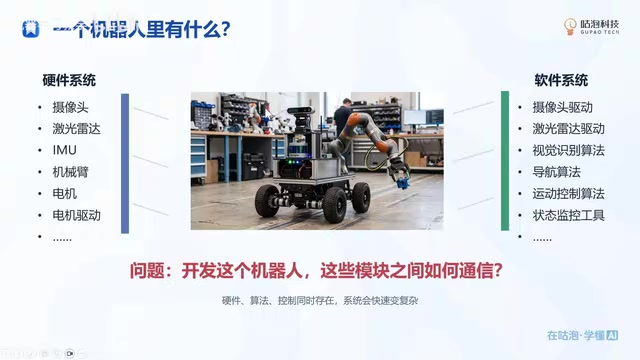
Getting Started with ROS2 Robot Development: Core Concepts and Environment Setup
This article introduces the core concepts and environment setup of ROS2 robot development, explains why ROS2 unifies module communication and facilitates collaborative work, and outlines the Turtlesim simulation experiment to help beginners get started quickly.

SLAM Mapping and Navigation Tutorial: A Complete Learning Path from Theory to Practice
This Bilibili SLAM mapping and navigation tutorial starts with a navigation overview, covering architecture, installation commands, and practical prerequisites, then connects to the Fourteen Lectures on Visual SLAM, slam_toolbox, and Cartographer—a complete learning path from theory to practice.

LangChain Beginner's Guide: Core Concepts and Hands-On Tools
What is LangChain? This guide covers its core positioning—Agent = Model + Harness—and the three key problems it solves: training time limits, external data connections, and multi-turn conversation context.