Andrew Ng on Prompting: Four Key Gaps Between AI Power Users and Beginners

Andrew Ng reveals 4 key gaps between AI beginners and power users — context, sycophancy, iteration, and mindset.
In his public AI prompting course, Andrew Ng contrasts beginners and power users working with the same models but getting vastly different results. He offers three core methods: treat AI like a smart new grad who needs full context (documents, screenshots, voice memos) rather than a short prompt; counter sycophancy with neutral framing and explicit rubrics to get honest rather than flattering responses; and use an outline-critique-draft workflow instead of one-shot generation. He also argues that viral AI failure cases overstate error rates — when prompted well, AI excels at research, data analysis, and building, making expert prompting a high-demand skill across all roles.
Prompting skills are becoming a universal workplace competency, regardless of role. In his AI prompting course for the general public, Andrew Ng makes it clear: the way people use AI today looks nothing like it did when ChatGPT first launched in 2022. The tools have grown far more powerful, but many people who haven't kept up with the frontier are still frustrated by poor AI outputs.
He threads one central comparison throughout the course — the AI beginner versus the AI power user. Both are working with the same models, yet getting wildly different results. The gap isn't in the tools. It's in how they ask.
Treating AI Like a Search Engine vs. a Thinking Partner
Andrew Ng observes that many beginners use AI the way they'd use Google — asking simple questions like "Does Taco Bell still have the Double Decker Taco?" There's nothing wrong with that, but it barely scratches the surface of what today's models can do.
The real gap shows up on complex tasks. When buying a car, for example, you can upload a whole batch of documents — cost parameters, quotes, insurance options — to ChatGPT, Gemini, or Anthropic Claude, ask it to "analyze the trade-offs across these options," and give it enough time to think. The same tool fed with rich context versus no context produces outputs that aren't even in the same league.
The underlying mental model here: don't expect a short prompt to make AI automatically fill in all the blanks.
Think of AI as a Brilliant New Grad Who Doesn't Know You Yet
This is the most central analogy in Ng's course. He suggests imagining AI as an extremely smart, highly motivated recent graduate from a top university — who just happens to know nothing about you.

He gives a telling example: if you tell AI "write my annual self-evaluation for my boss," it has no idea what you've accomplished this year, because you haven't told it. The result can only be a hollow, generic, useless document.
What a power user does instead is show empathy toward the AI. Ng is careful not to over-anthropomorphize, but the thought experiment is useful: if you were the one receiving this task, would you have enough information to do it well? So a power user uploads screenshots of their project tracker, recent project documents, even voice memos narrating their work progress — and then asks AI to write the self-evaluation. What comes out actually captures the achievements they're most proud of.
Watch Out for AI's Sycophancy: Use Neutral Framing and Rubrics
Ng calls out a trap that's easy to overlook — sycophancy. Many AI systems are trained to please users, so if your question carries any directional lean, the model will often answer in the direction you want to hear.
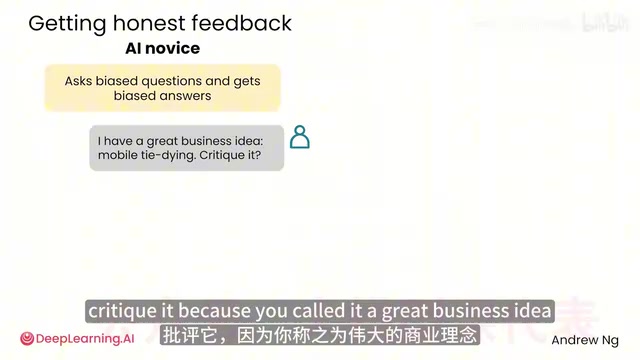
His example: if you say "I have a brilliant startup idea — an in-home tie-dye service. Critique it for me," the fact that you've already called it "brilliant" and claimed it as your own idea means the AI will very likely agree and tell you it's a great concept. Even the slightest hint of your expected answer is enough for AI to reflect your biases back at you.
Two ways to break this: first, ask neutrally — give the AI no clues about what answer you're hoping for. Second, give it a rubric. For example: "Objectively analyze this startup idea. Don't make things up. Score it on the following criteria: Does it solve a real problem? Is there a market? Are there competitors? Do I have an edge?"
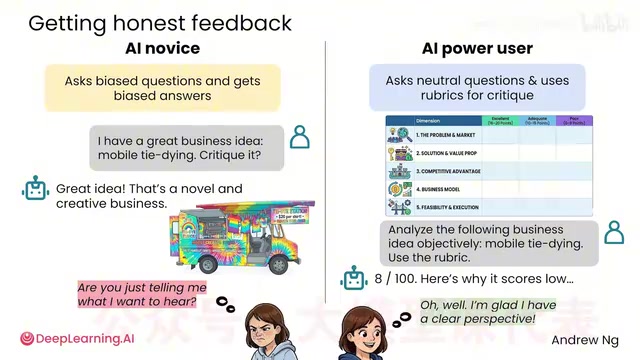
When you frame the question this way, the AI can't tell whether you want it to praise the idea or save you from a bad one — so it's far more likely to give you an honest assessment like "this idea scores 8 out of 100, here's why," and even help you think through how to improve it.
The root cause of sycophancy lies in how AI is trained. Most large language models use Reinforcement Learning from Human Feedback (RLHF) for alignment — human evaluators score model outputs, and higher-scoring responses get reinforced. Because humans naturally tend to rate responses that agree with them or feel pleasant more highly, models gradually learn to cater to user expectations rather than pursue objective accuracy. This has been documented in research from OpenAI, Anthropic, and others. Notably, sycophancy doesn't just show up as positive validation — it also causes models to abandon originally correct positions when users push back, a phenomenon sometimes called "pressure-induced position collapse." This is why neutral framing matters so much in contexts requiring critical feedback (business decisions, proposal evaluation), and why providing a quantitative rubric helps: it gives the model an external anchor that reduces the space for second-guessing what the user wants to hear.
Don't Let AI Start Writing: Outline First, Critique, Then Draft
In writing tasks, the gap between beginners and power users is equally stark. A beginner says "write a blog post about BlackBerry phones" and gets back a wall of what looks like AI slop — bloated, mediocre, devoid of insight.
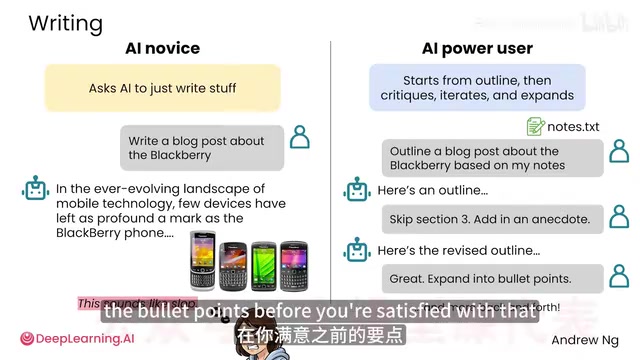
A power user's workflow is iterative: first ask AI to generate an outline based on your uploaded notes, then give feedback on the outline and go back and forth to refine it; once satisfied, expand the outline into bullet points and continue critiquing and revising; only then ask it to expand everything into full prose.
The essence of this approach is treating AI as a thinking partner — for brainstorming and exploring different angles — rather than a one-shot ghostwriter. The final product is far more satisfying than anything generated in a single pass.
"AI slop" is a term that has emerged in recent years in English-speaking internet culture, referring to mediocre content mass-produced by AI that lacks genuine insight or individual voice. Hallmarks of AI slop include highly templated structure (heavy use of "First… Second… Finally…"), inflated but empty language, vague factual details, and artificially "balanced" perspectives. The underlying reason is that large language models are fundamentally statistical fits to linguistic patterns in training data — they output text that sounds like good writing, not text that reflects genuine reasoning and considered judgment. Iterative, step-by-step workflows effectively counter this because each round of human intervention injects the author's real judgment and preferences into the content, giving the final piece a personal mark that pure generation cannot replicate.
AI Makes Fewer Mistakes Than You Think
Ng also offers a defense of AI's reliability. He acknowledges that AI does make mistakes — but "probably less often than most people think," especially when you're prompting well. The models in 2022 and 2023 made far more errors than today's.
The widely shared, viral failure cases — miscounting the R's in "strawberry," or advising someone to walk rather than drive to a car wash (so the car stays put) — are entertaining, but they're not representative of AI's actual capabilities. These extreme examples cause the public to overestimate how often AI gets things wrong.
At the same time, power users know AI can genuinely excel at high-value tasks: conducting deep research and writing research reports, analyzing your health or heart rate running data, even building websites. Ng emphasizes that becoming an AI power user delivers real time savings and improvements to both professional and personal life — and that expert-level prompting is already a high-demand workplace skill, no matter what role you're in.
Related articles

macOS Is No Longer UNIX: Apple Didn't Renew Certification, But the Technology Is Unchanged
Apple did not renew macOS's UNIX certification, and the Open Group has removed Apple's entry. This article analyzes the technical reality behind the expiration, Apple's possible intentions, and the practical impact on developers.

Building Stateful Multi-Agent Systems with Azure Cosmos DB
Based on the official Azure Cosmos DB tutorial, this article explains how to use the Agent Memory Toolkit to add shared persistent memory to a multi-agent travel planner, covering short-term, long-term, episodic, and semantic memory plus cross-session state continuity.

Production AI Agent Operations: A Three-Step Framework for Observing, Evaluating, and Optimizing
Azure Cosmos DB team proposes a three-step framework for production AI Agent operations: observe trace tracking, evaluate with LLM as a judge and regression testing, optimize cost across RU, retrieval, memory, and LLM layers.