macOS Is No Longer UNIX: Apple Didn't Renew Certification, But the Technology Is Unchanged

Apple didn't renew its UNIX certification, so macOS is officially no longer UNIX—though nothing has changed technically.
Apple failed to renew the UNIX certification that expired on August 29, and the Open Group has removed macOS from its official list, meaning that as of August 30 macOS is no longer a UNIX system in trademark terms. The news was disclosed by Lunduke Journal, and the certificate showed registration number P1223 covering macOS 26.0 Tahoe. The key point is that nothing changed technically: POSIX compatibility, the XNU kernel, and the command-line tools all remain the same. Only IBM, HP, and SCO currently hold valid certifications. Apple may have dropped the renewal due to a mistake, negligence, or no longer caring about the brand; the long-term impact is unknown, but in the short term there is no practical effect on developers or users.
Apple's macOS has quietly lost an identity it held for years—its UNIX certification. According to official information from the Open Group, which oversees the UNIX trademark, Apple failed to renew the certification that expired on August 29, meaning that as of August 30, macOS is officially no longer a UNIX system. The news comes from an analysis by the YouTube channel Lunduke Journal, whose video showed screenshots of the Open Group certification page and certificate confirming the change.
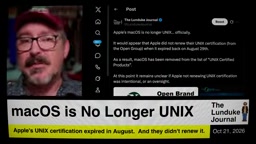
Certification Expires: macOS Disappears from the UNIX List
The UNIX trademark is controlled by the Open Group, and any system that wants to call itself UNIX must pass its certification program. Apple maintained this certification for years and even used it as a selling point in its early days. According to the Open Brand certificate shown in the video, registration number P1223 covered macOS 26.0 Tahoe on Apple Silicon, with the next renewal date originally set for August 29.
However, after expiration, Apple's entry disappeared from the Open Group's "UNIX Certified Products" page. The only products still listed are IBM's z/OS and AIX, HP's HP-UX, and SCO Group's related systems—about nine products in total from three vendors.
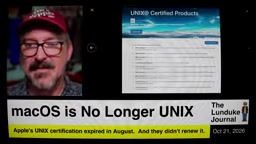
You may not have noticed that the certificate page shows the registration was filed in August 2025 and has expired. The certificate signed by Open Group CEO Steve Nguyen is now a historical document.
The Open Group's UNIX certification is not a one-time grant but a commercial model of per-product-version registration and periodic renewal. Vendors must submit test suite results and pay fees, and the certificate lists the specific product version and validity period. This mechanism means certification status is tied to the product lifecycle: new versions require re-certification, and once the renewal window is missed, the entry is removed from the public list. Historically, Apple repeatedly updated certificates for different macOS versions and even negotiated with the Open Group in 2018 to adjust testing requirements to accommodate macOS's differences. This expiration therefore looks more like an incomplete administrative renewal than an active revocation of eligibility by the Open Group.
No Technical Change—Only the Trademark Changed
The key point: after August 30, nothing about macOS changed technically. POSIX compatibility, the underlying architecture, the command-line tools—all remain the same. The video's author explicitly notes, "It's as if on August 30, when macOS booted up, everything that made UNIX UNIX suddenly vanished—but in reality it's exactly the same."
For years, Apple negotiated with the Open Group to make macOS fit the UNIX definition, and the latter even modified several requirements to accommodate macOS. This shows there has always been a slight gap between macOS and the UNIX standard, and the certification itself is more of a brand endorsement than a declaration of technical equivalence.
The XNU kernel is an often-overlooked part of macOS's technical foundation. XNU is a recursive acronym for "XNU is Not Unix," combining the Mach microkernel, BSD kernel components, and the I/O Kit driver framework. The BSD subsystem derives directly from FreeBSD, providing POSIX system calls, the process model, and the network stack. This hybrid architecture makes macOS behave like UNIX, but its internal implementation differs from traditional System V or BSD distributions. This is precisely why the Open Group previously had to adjust some certification requirements for macOS. The lapse of certification does not change the code composition of XNU; the BSD subsystem will continue to evolve with system updates—Apple simply no longer claims publicly that it meets the formal standard represented by the UNIX trademark.
Why Did Apple Abandon Renewal? Three Possibilities
It is currently unclear whether Apple let the certification expire intentionally or unintentionally. The video proposes three possibilities: a mistake, negligence, or Apple no longer caring about the brand. In recent years, Apple's marketing materials have rarely mentioned UNIX certification, and the early practice of using UNIX compliance as a selling point has long faded. The author says he contacted Apple for comment but had received no reply as of the video's release.
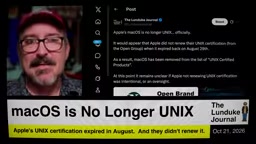
A More Fundamental Question: What Exactly Is UNIX?
This raises a long-standing debate: if FreeBSD, NetBSD, and OpenBSD—systems directly descended from UNIX lineage—are not certified as UNIX by the Open Group, what does UNIX actually mean? Linux is UNIX-like but likewise uncertified. By the Open Group's standards, only IBM, HP, and SCO systems worldwide can legally use the UNIX trademark.
The video's author admits that the significance of this trademark certification "may not be that great," since a certification system with only three customers has limited real influence. But he also acknowledges that macOS's historical ties to UNIX—a lineage inherited from OpenStep and NeXTSTEP—are worth pondering.
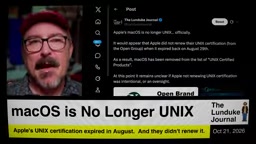
The POSIX standard is key to understanding this debate. POSIX (Portable Operating System Interface), developed by the IEEE, defines a set of APIs, command-line tools, and runtime behaviors an operating system must provide, with the goal of making source code portable across systems. It is a separate system from UNIX trademark certification: the former is a technical specification, the latter a commercial trademark license. macOS has long passed POSIX certification, and its BSD-derived toolchain and XNU kernel provide POSIX-compliant interfaces, so even without the UNIX trademark it remains a POSIX-compatible system. The same goes for Linux—its kernel and GNU toolchain closely follow POSIX yet it has never applied for Open Group UNIX certification. Only by understanding this distinction can one see that "macOS is no longer UNIX" is merely a change in legal designation, not a break at the API or toolchain level.
What It Means for Developers and Users
In the short term, this has no impact on daily use. macOS remains the same operating system with a POSIX compatibility layer that can run a large number of UNIX tools. In the long term, however, the lapse of certification may suggest Apple will gradually relax its maintenance of UNIX compliance. There is currently no evidence that Apple will remove POSIX compatibility or change the underlying architecture, and the video's author stresses that "we really don't know" the long-term effects.
For programmers who rely on macOS as a development environment, what is worth watching is whether Apple will continue to track POSIX standard updates. Certification can be abandoned, but the continuity of the technical foundation is what truly affects the ecosystem.
Related articles

WorkBuddy Full Tutorial: Build an AI Office Automation Agent from Scratch
A complete WorkBuddy tutorial: installation, three working modes, multimodal picture book video practice, expert team agent building, and workflow configuration for low-cost AI office automation.

WorkBuddy Agent Complete Guide: From Beginner to Automation in 7 Days
Based on Bilibili's 256-episode WorkBuddy masterclass, this systematically breaks down Tencent's AI office workbench core capabilities: Agent principles, Skill encapsulation, cross-platform connectors, scheduled automation, knowledge bases, and zero-code development, with learning path recommendations.

8 AI Accounts, 7 Failed: An Honest Review of Using AI to Get Work Done
Only 1 of 8 AI-run Bilibili accounts succeeded. We break down the real difference between "performing AI" and "using AI to get work done."